

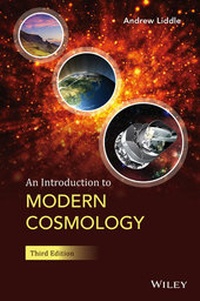
An Introduction to Modern Cosmology
3rd Edition
Published on 9. March 2015
200 pages
978-1-118-69027-7 (ISBN)
Description

An Introduction to Modern Cosmology Third Edition is anaccessible account of modern cosmological ideas. The Big BangCosmology is explored, looking at its observational successes inexplaining the expansion of the Universe, the existence andproperties of the cosmic microwave background, and the origin oflight elements in the universe. Properties of the very earlyUniverse are also covered, including the motivation for a rapidperiod of expansion known as cosmological inflation. The thirdedition brings this established undergraduate textbook up-to-datewith the rapidly evolving observational situation.
This fully revised edition of a bestseller takes an approachwhich is grounded in physics with a logical flow of chaptersleading the reader from basic ideas of the expansion described bythe Friedman equations to some of the more advanced ideas about theearly universe. It also incorporates up-to-date results from thePlanck mission, which imaged the anisotropies of the CosmicMicrowave Background radiation over the whole sky. The AdvancedTopic sections present subjects with more detailed mathematicalapproaches to give greater depth to discussions. Student problemswith hints for solving them and numerical answers are embedded inthe chapters to facilitate the reader's understanding andlearning.
Cosmology is now part of the core in many degree programs. Thiscurrent, clear and concise introductory text is relevant to a widerange of astronomy programs worldwide and is essential reading forundergraduates and Masters students, as well as anyone startingresearch in cosmology. Supplementary material, includingfull-colour images, updates and links for students and instructors,is available on the author's website: http://www.roe.ac.uk/~arl/.
More details
Other editions
Additional editions
Andrew Liddle
An Introduction to Modern Cosmology
Book
06/2015
3rd Edition
Wiley
€97.90
Shipment within 15-20 days
Andrew Liddle
An Introduction to Modern Cosmology
Book
06/2015
3rd Edition
Wiley
€38.90
Article exhausted; check for reprint
Person
Andrew Liddle
Institute for Astronomy, University of Edinburgh, U
Content
- Cover
- Title Page
- Copyright
- Contents
- Preface
- Constants, conversion factors and symbols
- Chapter 1 A (Very) Brief History of Cosmological Ideas
- Chapter 2 Observational Overview
- 2.1 In visible light
- 2.2 In other wavebands
- 2.3 Homogeneity and isotropy
- 2.4 The expansion of the Universe
- 2.5 Particles in the Universe
- 2.5.1 What particles are there?
- 2.5.2 Thermal distributions and the black-body spectrum
- Chapter 3 Newtonian Gravity
- 3.1 The Friedmann equation
- 3.2 On the meaning of the expansion
- 3.3 Things that go faster than light
- 3.4 The fluid equation
- 3.5 The acceleration equation
- 3.6 On mass, energy and vanishing factors of c2
- Chapter 4 The Geometry of the Universe
- 4.1 Flat geometry
- 4.2 Spherical geometry
- 4.3 Hyperbolic geometry
- 4.4 Infinite and observable universes
- 4.5 Where did the Big Bang happen?
- 4.6 Three values of k
- Chapter 5 Simple Cosmological Models
- 5.1 Hubble's law
- 5.2 Expansion and redshift
- 5.3 Solving the equations
- 5.3.1 Matter
- 5.3.2 Radiation
- 5.3.3 Mixtures
- 5.4 Particle number densities
- 5.5 Evolution including curvature
- Chapter 6 Observational Parameters
- 6.1 The expansion rate H0
- 6.2 The density parameter O0
- 6.3 The deceleration parameter q0
- Chapter 7 The Cosmological Constant
- 7.1 Introducing ?
- 7.2 Fluid description of ?
- 7.3 Cosmological models with ?
- Chapter 8 The Age of the Universe
- Chapter 9 The Density of the Universe and Dark Matter
- 9.1 Weighing the Universe
- 9.1.1 Counting stars
- 9.1.2 Nucleosynthesis foreshadowed
- 9.1.3 Galaxy rotation curves
- 9.1.4 Galaxy cluster composition
- 9.1.5 The formation of structure
- 9.1.6 The geometry of the Universe and the brightness of supernovae
- 9.1.7 Overview
- 9.2 What might the dark matter be?
- 9.2.1 Fundamental particles
- 9.2.2 Compact objects
- 9.3 Dark matter searches
- Chapter 10 The Cosmic Microwave Background
- 10.1 Properties of the microwave background
- 10.2 The photon to baryon ratio
- 10.3 The origin of the microwave background
- 10.4 The origin of the microwave background (advanced)
- Chapter 11 The Early Universe
- Chapter 12 Nucleosynthesis: The Origin of the Light Elements
- 12.1 Hydrogen and helium
- 12.2 Comparing with observations
- 12.3 Contrasting decoupling and nucleosynthesis
- Chapter 13 The Inflationary Universe
- 13.1 Problems with the Hot Big Bang
- 13.1.1 The flatness problem
- 13.1.2 The horizon problem
- 13.1.3 Relic particle abundances
- 13.2 Inflationary expansion
- 13.3 Solving the Big Bang problems
- 13.3.1 The flatness problem
- 13.3.2 The horizon problem
- 13.3.3 Relic particle abundances
- 13.4 How much inflation?
- 13.5 Inflation and particle physics
- Chapter 14 The Initial Singularity
- Chapter 15 Overview: The Standard Cosmological Model
- Advanced Topic 1 General Relativistic Cosmology
- A1.1 The metric of space-time
- A1.2 The Einstein equations
- A1.3 Aside: Topology of the Universe
- Advanced Topic 2 Classic Cosmology: Distances and Luminosities
- A2.1 Light propagation and redshift
- A2.2 The observable Universe
- A2.3 Luminosity distance
- A2.4 Angular diameter distance
- A2.5 Source counts
- Advanced Topic 3 Neutrino Cosmology
- A3.1 The massless case
- A3.2 Massive neutrinos
- A3.2.1 Light neutrinos
- A3.2.2 Heavy neutrinos
- A3.3 Neutrinos and structure formation
- Advanced Topic 4 Baryogenesis
- Advanced Topic 5 Structures in the Universe
- A5.1 The observed structures
- A5.2 Gravitational instability
- A5.3 The clustering of galaxies
- A5.4 Cosmic microwave background anisotropies
- A5.4.1 Statistical description of anisotropies
- A5.4.2 Computing the Cl
- A5.4.3 Microwave background observations
- A5.4.4 Spatial geometry
- A5.5 The origin of structure
- Advanced Topic 6 Constraining cosmological models
- A6.1 Cosmological models and parameters
- A6.2 Key cosmological observations
- A6.3 Cosmological data analysis
- A6.4 The Standard Cosmological Model: 2014 edition
- A6.5 The future
- Bibliography
- Numerical Answers and Hints to Problems
- Index
- EULA
