

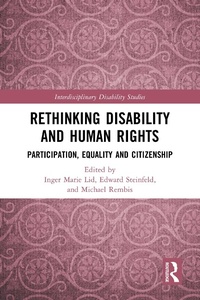
Rethinking Disability and Human Rights
Participation, Equality and Citizenship
1st Edition
Published on 16. June 2023
188 pages
978-1-000-90028-6 (ISBN)
Description

This book examines the role of disability in the right to political and social participation, an act of citizenship that many disabled people do not enjoy.
The disability rights movement does not accept the use of disability to create limits on citizenship, which poses challenges for contemporary societies that will become ever greater as the science and technology of enhancing human abilities evolves. Comprised of eight chapters, three interludes, and a postscript written by leading scholars and disability rights activists, the book explores citizenship for people with disabilities from an interdisciplinary perspective using the United Nations Convention on the Rights of Persons with Disabilities (CRPD) as a point of departure and the concept of universal design as a strategy for actualizing full citizenship for all. Situating disability in its historical and cultural contexts, the authors offer directions for rethinking citizenship, including implications for access to the built environment, information and communication systems, education, work, community life and politics.
This book will be of interest to all scholars and students working in disability studies, planning, architecture, public health, rehabilitation, social work, and education.
The disability rights movement does not accept the use of disability to create limits on citizenship, which poses challenges for contemporary societies that will become ever greater as the science and technology of enhancing human abilities evolves. Comprised of eight chapters, three interludes, and a postscript written by leading scholars and disability rights activists, the book explores citizenship for people with disabilities from an interdisciplinary perspective using the United Nations Convention on the Rights of Persons with Disabilities (CRPD) as a point of departure and the concept of universal design as a strategy for actualizing full citizenship for all. Situating disability in its historical and cultural contexts, the authors offer directions for rethinking citizenship, including implications for access to the built environment, information and communication systems, education, work, community life and politics.
This book will be of interest to all scholars and students working in disability studies, planning, architecture, public health, rehabilitation, social work, and education.
More details
Series
Edition
1. Auflage
Language
English
Place of publication
London
United Kingdom
Publishing group
Taylor & Francis Ltd
Target group
College/higher education
Product notice
Reflowable
Illustrations
2 Tables, black and white; 3 Line drawings, black and white; 6 Halftones, black and white; 9 Illustrations, black and white
ISBN-13
978-1-000-90028-6 (9781000900286)
Copyright in bibliographic data and cover images is held by Nielsen Book Services Limited or by the publishers or by their respective licensors: all rights reserved.
Schweitzer Classification
Other editions
Additional editions
Inger Marie Lid | Edward Steinfeld | Michael Rembis
Rethinking Disability and Human Rights
Participation, Equality and Citizenship
Book
11/2024
1st Edition
Routledge
€64.90
Shipment within 15-20 days
Inger Marie Lid | Edward Steinfeld | Michael Rembis
Rethinking Disability and Human Rights
Participation, Equality and Citizenship
Book
06/2023
1st Edition
Routledge
€195.90
Shipment within 15-20 days
Persons
Inger Marie Lid is a Professor of Public Health and Rehabilitation at VID Specialized University. Her research interests include ethics, citizenship, universal design accessibility, and Human Rights. Lid has authored and edited many books, chapters and articles. Recent publications include "The significance of relations. Rethinking autonomy in a disability perspective" in Lived Citizenship for Persons in Vulnerable Life Situations. Theories and Practices (Scandinavian University Press). She is currently engaged in research on inclusion in higher education.
Edvard Steinfeld, Arch. D., is a SUNY Distinguished Professor of Architecture and Director of the Center for Inclusive Design and Environmental Access at the School of Architecture, University at Buffalo, State University of New York. His research interests include accessibility, universal design, and design for aging. He is currently engaged in research and public education on design for gender diversity
Michael Rembis is the Director of the Center for Disability Studies and an Associate Professor in the Department of History at the University at Buffalo (SUNY). Rembis has authored or edited many books, articles, and book chapters. He is currently completing a book entitled, Writing Mad Lives - in the Age of the Asylum. He is the coeditor of The Oxford Handbook of Disability History.
Edvard Steinfeld, Arch. D., is a SUNY Distinguished Professor of Architecture and Director of the Center for Inclusive Design and Environmental Access at the School of Architecture, University at Buffalo, State University of New York. His research interests include accessibility, universal design, and design for aging. He is currently engaged in research and public education on design for gender diversity
Michael Rembis is the Director of the Center for Disability Studies and an Associate Professor in the Department of History at the University at Buffalo (SUNY). Rembis has authored or edited many books, articles, and book chapters. He is currently completing a book entitled, Writing Mad Lives - in the Age of the Asylum. He is the coeditor of The Oxford Handbook of Disability History.
Content
0.Introduction - Rethinking citizenship and disability. Part One. 1.Exploring the relationship between Citizenship and Universal Design. 2.Veterans from Life: Rehabilitation as Compensation. Interlude One - Life is possible. 3.Rethinking Utopia. Posthumanism, Transhumanism, and Disability. 4.Mad Citizenship. Part Two. 5.Conditions for religious citizenship for people with intellectual disabilities: Cases from Norway and Slovakia. Interlude Two - "Symbiotic citizenship" and a struggle for the right of life as frames for interpreting the 40-day disability protest in the Polish Parliament. 6.The Space of Accessibility and Universal Design. 7.Enabling equal citizenship: Responses from civil society. Interlude Three - Global Disability Summit: How to realize "nothing without us". 8.Universal Human Rights and Universal Design for People with Disabilities: Challenges and Lessons from Sub-Saharan Africa. Postscript - Dialogue between Rosemarie Garland-Tomson and Inger Marie Lid.
