

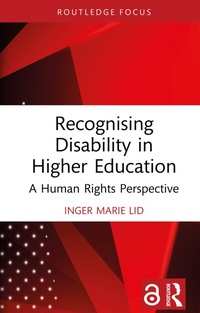
Recognising Disability in Higher Education
A Human Rights Perspective
Published on 1. May 2026
114 pages
978-1-040-58566-5 (ISBN)
Description

Exploring and addressing disability in higher education, this key title focusses on education as a human rights topic. It provides empirical examples and analyses selected national policies in global contexts to discuss how to facilitate for equal access to higher education for students and academics with disabilities.
Based on the UN Convention on the Rights of Persons with Disabilities (CRPD), the author demonstrates how to facilitate equal access to higher education and raise awareness of disability as human condition and aspect of diversity in higher education. This book discusses dilemmas with regards to implementing universal design and individual accommodation in order to facilitate for diversity of individuals among students and staff.
With chapters covering implementation of the UN CRPD, ableism, recognition theory, disability and universal design, this book focuses on the institutional perspective - what are the universities' responsibilities and how can universities and teachers respond by implementing and practicing inclusive policies? It makes ideal reading for anyone interested in addressing the topic of disability in higher education.
Based on the UN Convention on the Rights of Persons with Disabilities (CRPD), the author demonstrates how to facilitate equal access to higher education and raise awareness of disability as human condition and aspect of diversity in higher education. This book discusses dilemmas with regards to implementing universal design and individual accommodation in order to facilitate for diversity of individuals among students and staff.
With chapters covering implementation of the UN CRPD, ableism, recognition theory, disability and universal design, this book focuses on the institutional perspective - what are the universities' responsibilities and how can universities and teachers respond by implementing and practicing inclusive policies? It makes ideal reading for anyone interested in addressing the topic of disability in higher education.
Reviews / Votes
Jan Grue, Professor of Sociology, University of Oslo:<<A timely and clear-minded view of the politics of inclusion in higher education.>>
Michael Rembis is the Director of the Center for Disability Studies at the University at Buffalo and the author of Writing Mad Lives in the Age of the Asylum:
In this cogent, accessible book, Lid reminds us of the importance of thinking about and supporting access to higher education for disabled people as a human right. She draws on the CRPD and rich anecdotal evidence to contemplate the individual, local, and global implications of legislative enactments and personal and institutional efforts to make higher education institutions more accessible. This book should be necessary reading for advocates and students and scholars alike.
Hisayo Katsui, Professor in Disability Studies, President of the Nordic Network on Disability Research:
In this book, Inger Marie Lid, a professor living with disabilities, examines the realities and experiences of disability in higher education institutions in Norway and beyond, offering a personal perspective. The United Nations Convention on the Rights of Persons with Disabilities is used critically to help readers understand the relational nature of disability. The book is useful for understanding our reality.
More details
Language
English
Place of publication
London
United Kingdom
Publishing group
Taylor & Francis Ltd
Target group
College/higher education
Professional and scholarly
Illustrations
1 Tables, black and white
File size
0,94 MB
ISBN-13
978-1-040-58566-5 (9781040585665)
Copyright in bibliographic data and cover images is held by Nielsen Book Services Limited or by the publishers or by their respective licensors: all rights reserved.
Schweitzer Classification
Other editions
Additional editions
Book
approx. 05/2026
1st Edition
Routledge
€79.40
Not yet published
Person
Inger Marie Lid, Professor of public health and rehabilitation with a focus on interdisciplinary disability research, citizenship studies and universal design at VID Specialized University, Norway.
Content
Preface
Chapter 1 Recognising disability in higher education
Chapter 2 The significance of recognition
Chapter 3 Institutional responsibilities
Chapter 4 Misrecognition and ableism
Chapter 5 Contextualising access: Universal design and individual accommodation
Chapter 6 A culture of recognition
Chapter 7 Building knowledge for society
Postscript Looking back, thinking of the future
Chapter 1 Recognising disability in higher education
Chapter 2 The significance of recognition
Chapter 3 Institutional responsibilities
Chapter 4 Misrecognition and ableism
Chapter 5 Contextualising access: Universal design and individual accommodation
Chapter 6 A culture of recognition
Chapter 7 Building knowledge for society
Postscript Looking back, thinking of the future
