

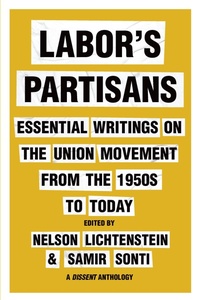
Labor's Partisans
Description

In 1954, the American labor movement reached its historic height, with one-third of all non-agricultural workers belonging to a union-and much higher percentages in the nation's key industries. That same year, a group of socialists, many of them with close ties to labor, founded a small magazine called Dissent.
Over the next seventy years, Dissent would become the publishing home for the most important progressive voices on American unions-writers who pushed the labor movement towards a more democratic, inclusive, and expansive vision. Today, at a time of both resurgent union organizing and socialist politics, the need for this rich tradition of ideas is as pressing as ever.
With over twenty-five contributions by some of the nation's most influential progressive voices, Labor's Partisans brings to life a history of labor that is of immediate relevance to our own times. Introduced and edited by leading labor historians Nelson Lichtenstein and Samir Sonti, this essential volume reveals the powerful currents and debates running through the labor movement, from the 1950s to today.
Combining stunning writing, political passion, and deep historical perspective, Labor's Partisans will be a source of ideas and inspiration for anyone concerned with a more just future for working people.
More details
Persons
Content
- Intro
- Introduction: Socialism Is the Name of Our Desire
- PART I: Socialists Look to the Postwar Labor Movement
- Problems of Labor Unity (1955) - Sid Lens
- The CIO Faces Automation (1955) - Gabriel Kolko
- Meaning in Work-A New Direction (1959) - Daniel Bell
- The Limits of Unionism (1959) - B.J. Widick
- The UAW: Over the Top or Over the Hill? (1963) - Harvey Swados
- Old Working Class, New Working Class (1972) - Michael Harrington
- Images of Labor (1981) - Irving Howe
- PART II: Democracy in AmericanTrade Unions?
- Hoffa and the Underworld (1959) - Paul Jacobs
- Labor Leaders, Intellectuals, and Freedom in the Unions (1973) - H.W. Benson
- Insurgency in the Steel Union (1975) - William Kornblum
- Is Democracy Good for Unions? (1998) - Steve Fraser
- The Legacy of Andy Stern (2010) - Melvyn Dubofsky
- How Union Democracy Builds Labor's Strike Power (2024) - Alex Press
- PART III: A Time of Troubles
- Johnstown: Ordeal of a Union Town (1985) - Jack Metzgar
- Hard Times for Labor (1989) - David Moberg
- The CIO After 50 Years: A Historical Reckoning (1985) - David Brody
- Labor Law Reform and Postindustrial Unionism (1994) - Dorothy Sue Cobble
- Frontline Caregivers: Still Struggling (2012) - Eileen Boris and Jennifer Klein
- "It's Business, Man!" Unions and "Socially Responsible"Corporations (1999) - Liza Featherstone
- Janus v. Democracy (2018) - Joseph McCartin
- PART IV: New Frontiers
- Hospital Workers Knock at the Door (1959) - Dan Wakefield
- Tragedy at Ocean Hill (1969) - Thomas R. Brooks
- Immigrant Workers Didn't Kill Your Union (2019) - Ruth Milkman
- Organizing the Unorganizable (2015) - E. Tammy Kim
- The Care Gap (2016) - Michelle Chen
- Graduate Student Unions Fight the Corporate University (2001) - Gordon Lafer
- PART V: What Is to Be Done?
- Why Labor Moved Left (2015) - Nelson Lichtenstein
- Austerity vs. the Planet: The Future of Labor Environmentalism (2016) - Trish Kahle
- After Act 10: How Milwaukee Teachers Fought Back (2019) - Eleni Schirmer
- West Virginia Teachers Walk Out (2018) - Sarah Jaffe
- A Seat at the Table: Sectoral Bargaining for the Common Good (2019) - Kate Andrias
- Release the Wage (2024) - Veena Dubal
- PART VI: The Dissent Tradition, Then and Now: A Roundtable Discussion on the Labor Movement and Democratic Socialism
- Acknowledgments
- Notes
- About the Editors
- Copyright
