

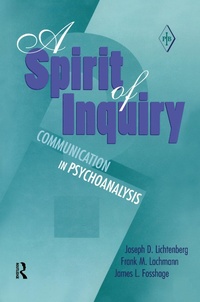
A Spirit of Inquiry
Communication in Psychoanalysis
Published on 17. June 2013
216 pages
978-1-134-90818-9 (ISBN)
Description

Thoroughly grounded in contemporary developmental research, A Spirit of Inquiry: Communication in Psychoanalysis explores the ecological niche of the infant-caregiver dyad and examines the evolutionary leap that permits communication to take place concurrently in verbal an nonverbal modes. Via the uniquely human capacity for speech, the authors hold, intercommunication deepens into a continuous process of listening to, sensing into, and deciphering motivation-driven messages. The analytic exchange is unique owing to a broad communicative repertoire that encompasses all the permutations of day-to-day exchanges. It is the spirit of inquiry that endows such communicative moments with an overarching sense of purpose and thereby permits analysis to become an intimate relationship decisively unlike any other.
In elucidating the special character of this relationship, the authors refine their understanding of motivational systems theory by showing how exploration, previously conceptualized as a discrete motivational system, simultaneously infuses all the motivational systems with an integrative dynamic that tends to a cohesive sense of self. Of equal note is their discerning use of contemporary attachment reseach, which provides convincing evidence of the link between crucial relationships and communication.
Replete with detailed case studies that illustrate both the context and nature of specific analytic inquiries, A Spirit of Inquiry presents a novel perspective, sustained by empirical research, for integrating the various communicative modalities that arise in any psychoanalytic treatment. The result is a deepened understanding of subjectivity and intersubjectivity in analytic relationships. Indeed, the book is a compelling brief for the claim that subjectivity and intersubjectivity, in their full complexity, can only be understood through clinically relevant and scientifically credible theories of motivation and communication.
In elucidating the special character of this relationship, the authors refine their understanding of motivational systems theory by showing how exploration, previously conceptualized as a discrete motivational system, simultaneously infuses all the motivational systems with an integrative dynamic that tends to a cohesive sense of self. Of equal note is their discerning use of contemporary attachment reseach, which provides convincing evidence of the link between crucial relationships and communication.
Replete with detailed case studies that illustrate both the context and nature of specific analytic inquiries, A Spirit of Inquiry presents a novel perspective, sustained by empirical research, for integrating the various communicative modalities that arise in any psychoanalytic treatment. The result is a deepened understanding of subjectivity and intersubjectivity in analytic relationships. Indeed, the book is a compelling brief for the claim that subjectivity and intersubjectivity, in their full complexity, can only be understood through clinically relevant and scientifically credible theories of motivation and communication.
Reviews / Votes
"With the graceful facility of masters, Lichtenberg, Lachmann, and Fosshage offer a thorough story of the developmental origins of communication and build with clarity their case for a flexible, resourceful, and empathically inventive spirit of communication on the part of the analyst. Readers at all levels will find here the freeing and affirming voice of senior clinicians who demonstrate how the interactive, nonverbal, and relational dimensions of the analytic process combine with apt words to reorganize experience, memory, and affect and to facilitate the emergence of reflective functioning and mutual inquiry."-Stuart A. Pizer, Ph.D., Author, Building Bridges (Analytic Press, 1998)
"Under the overarching themes of spirit of inquiry and communication this exciting book integrates many of the significant controversies of our time into a modern psychoanalytic approach. The authors provide the most up to date and broad ranging summary of human development available and demonstrate its application to modern psychoanalytic practice with lucid and varied case material. They have moved us along in our thinking by reconceptualizing some of the central but contentious issues in modern self-psychological and relational psychoanalysis. I found their arguments compelling and influential in my own day to day practice."
- Alan R. Kindler, FRCP, Training and Supervising Analyst, Toronto Institute for Psychoanalysis
More details
Series
Language
English
Place of publication
London
United Kingdom
Publishing group
Taylor & Francis Ltd
Target group
Professional and scholarly
File size
88,74 MB
ISBN-13
978-1-134-90818-9 (9781134908189)
Copyright in bibliographic data and cover images is held by Nielsen Book Services Limited or by the publishers or by their respective licensors: all rights reserved.
Schweitzer Classification
Other editions
Additional editions
Joseph D. Lichtenberg | Frank M. Lachmann | James L. Fosshage
A Spirit of Inquiry
Communication in Psychoanalysis
Book
09/2014
1st Edition
Routledge
€69.60
Shipment within 10-20 days
Joseph D. Lichtenberg | Frank M. Lachmann | James L. Fosshage
A Spirit of Inquiry
Communication in Psychoanalysis
Book
10/2002
1st Edition
Analytic Press,U.S.
€71.50
Shipment within 3-4 weeks
Persons
Joseph D. Lichtenberg, M.D., is Editor-in-Chief of Psychoanaytic Inquiry, Director Emeritus of the Institute of Contemporary Psychotherapy and Psychoanalysis, and past President of the International Council for Psychoanalytic Self Psychology. He has authored and edited numerous books and articles, including Craft and Spirit: A Guide to the Exploratory Psychotherapies (Analytic Press, 2005) and, with Frank Lachmann and James Fosshage, A Sprit of Inquiry: Communication in Psychoanalysis (Analytic Press, 2002).
Frank M. Lachmann, Ph.D., is a founding faculty member of the Institute for the Psychoanalytic Study of Subjectivity, Training and Supervising Analyst, Postgraduate Center for Mental Health, and Clinical Assistant Professor at the NYU Postdoctoral Program in Psychotherapy and Psychoanalysis. He has contributed over 100 articles to the journal literature, and is author of Transforming Aggression (Aronson, 2000), and co-author of Self and Motivational Systems (Analytic Press, 1992), The Clinical Exchange (Analytic Press, 1996), and Infant Research and Adult Treatment (Analytic Press, 2002).
James L. Fosshage, Ph.D., is Cofounder, Board Director, and faculty member, National Institute for the Psychotherapies, NYC; founding faculty member, Institute for the Psychoanalytic Study of Subjectivity, NYC; and Clinical Professor of Psychology, New York University Postdoctoral Program in Psychotherapy and Psychoanalysis.
Frank M. Lachmann, Ph.D., is a founding faculty member of the Institute for the Psychoanalytic Study of Subjectivity, Training and Supervising Analyst, Postgraduate Center for Mental Health, and Clinical Assistant Professor at the NYU Postdoctoral Program in Psychotherapy and Psychoanalysis. He has contributed over 100 articles to the journal literature, and is author of Transforming Aggression (Aronson, 2000), and co-author of Self and Motivational Systems (Analytic Press, 1992), The Clinical Exchange (Analytic Press, 1996), and Infant Research and Adult Treatment (Analytic Press, 2002).
James L. Fosshage, Ph.D., is Cofounder, Board Director, and faculty member, National Institute for the Psychotherapies, NYC; founding faculty member, Institute for the Psychoanalytic Study of Subjectivity, NYC; and Clinical Professor of Psychology, New York University Postdoctoral Program in Psychotherapy and Psychoanalysis.
Content
How Do We Explain the Development of Communication with Self and Other in Infancy? Part I. How Do We Explain the Development of Communication with Self and Other in Infancy? Part II. Open Flexible Communication in Moment-to-Moment Exchanges. Effective Communication Exchanges. Transference as Communication: The Language of the Body. Words, Gestures, Metaphors, and Model Scenes. Verbal and Nonverbal Communication During Analysis. Controversies and Answers: Communication and a Spirit of Inquiry Reconsidered.
