

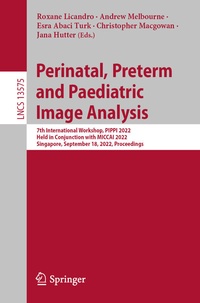
Perinatal, Preterm and Paediatric Image Analysis
7th International Workshop, PIPPI 2022, Held in Conjunction with MICCAI 2022, Singapore, September 18, 2022, Proceedings
Published on 22. September 2022
XII, 116 pages
978-3-031-17117-8 (ISBN)
Description

This book constitutes the refereed proceedings of the First International Workshop on Perinatal, Preterm and Paediatric Image Analysis, PIPPI 2022, held in conjunction with the 25th International Conference on Medical Imaging and Computer-Assisted Intervention, MICCAI 2022, in Singapore, Singapore, in September 2021.
The 10 full papers and 1 short papers presented at PIPPI 2022 were carefully reviewed and selected from 12 submissions. PIPPI 2022 workshop complements the main MICCAI conference by providing a focused discussion of perinatal and paediatric image analysis, including the application of sophisticated analysis tools to fetal, neonatal and paediatric imaging data.
More details
Series
Edition
1st ed. 2022
Language
English
Place of publication
Cham
Switzerland
Publishing group
Springer International Publishing
Product notice
Reflowable
Illustrations
XII, 116 p. 49 illus., 42 illus. in color.
File size
25,61 MB
ISBN-13
978-3-031-17117-8 (9783031171178)
DOI
10.1007/978-3-031-17117-8
Schweitzer Classification
Other editions
Additional editions
Roxane Licandro | Andrew Melbourne | Esra Abaci Turk
Perinatal, Preterm and Paediatric Image Analysis
7th International Workshop, PIPPI 2022, Held in Conjunction with MICCAI 2022, Singapore, September 18, 2022, Proceedings
Book
09/2022
Springer
€58.84
Shipment within 15-20 days
Content
- Intro
- Preface
- Organization
- Contents
- Automatic Segmentation of the Placenta in BOLD MRI Time Series
- 1 Introduction
- 2 Methods
- 2.1 Model
- 2.2 Additive Boundary Loss
- 2.3 Implementation Details
- 3 Model Evaluation
- 3.1 Data
- 3.2 Evaluation
- 3.3 Results
- 4 Discussion and Conclusion
- References
- A Fast Anatomical and Quantitative MRI Fetal Exam at Low Field
- 1 Introduction
- 2 Methods
- 2.1 Evaluation
- 2.2 Analysis
- 3 Results
- 4 Discussion and Conclusions
- References
- Automatic Fetal Fat Quantification from MRI
- 1 Introduction
- 2 Methodology
- 2.1 Semi-automatic Fetal AT Segmentation
- 2.2 Automatic Fetal Fat Segmentation
- 3 Experimental Results
- 3.1 Study 1: Manual and Semi-automatic Observer Variability
- 3.2 Study 2: Automatic Fetal AT Segmentation
- 3.3 Study 3: Analysis of Manual Corrections Following Automatic Segmentation
- 4 Discussion
- 5 Conclusion
- References
- Continuous Longitudinal Fetus Brain Atlas Construction via Implicit Neural Representation
- 1 Introduction
- 2 Method
- 2.1 Pre-train Stage
- 2.2 Refine Stage
- 2.3 Inference Stage
- 3 Experiments
- 3.1 Setup
- 3.2 Results
- 4 Conclusion
- References
- Automated Segmentation of Cervical Anatomy to Interrogate Preterm Birth
- 1 Introduction
- 2 Methods
- 2.1 Dataset
- 2.2 Model Architecture
- 3 Results
- 4 Conclusion
- References
- Deep Learning Framework for Real-Time Fetal Brain Segmentation in MRI
- 1 Introduction
- 2 Materials and Methods
- 2.1 Proposed Network Architecture
- 2.2 Alternative Methods and Evaluation Metrics
- 2.3 Data, Implementation, and Training
- 3 Results
- 4 Analysis and Discussion
- 5 Conclusion
- References
- Attention-Driven Multi-channel Deformable Registration of Structural and Microstructural Neonatal Data
- 1 Introduction
- 2 Method
- 3 Results
- 4 Conclusion
- References
- Automated Multi-class Fetal Cardiac Vessel Segmentation in Aortic Arch Anomalies Using T2-Weighted 3D Fetal MRI
- 1 Introduction
- 1.1 Deep Learning Segmentation
- 1.2 Label Propagation
- 1.3 Contribution
- 2 Methods
- 2.1 Data Specifications
- 2.2 Deep Learning Segmentation Framework
- 2.3 Label Propagation
- 2.4 Attention U-Net Segmentation
- 3 Results
- 3.1 Preliminary Network Architecture Experiments
- 3.2 Test Set and Experiments
- 3.3 Quantitative Results
- 3.4 Visual Inspection
- 4 Discussion
- 5 Conclusion
- References
- Segmentation of Periventricular White Matter in Neonatal Brain MRI: Analysis of Brain Maturation in Term and Preterm Cohorts
- 1 Introduction
- 2 Methods
- 2.1 Cohort, Datasets and Preprocessing
- 2.2 Parcellation Map of Periventricular WM ROIs in the Atlas Space
- 2.3 Automated Segmentation of Periventricular WM ROIs
- 2.4 Quantitative Analysis of PWM in Term and Preterm Cohorts
- 3 Results and Discussion
- 3.1 Parcellation Map of Periventricular WM ROIs in the Atlas Space
- 3.2 Automated Segmentation of Periventricular WM ROIs
- 3.3 Quantitative Analysis of PWM in Term and Preterm Cohorts
- 4 Conclusions
- References
- Knowledge-Guided Segmentation of Isointense Infant Brain
- 1 Introduction
- 2 Methodology
- 2.1 Dataset and Atlas
- 2.2 Data Preparation
- 2.3 Deep Learning Network
- 2.4 Implementation Details
- 3 Experiments and Results
- 3.1 iSeg19 Validation Dataset
- 4 Discussion and Conclusions
- References
- Correction to: Knowledge-Guided Segmentation of Isointense Infant Brain
- Correction to: Chapter "Knowledge-Guided Segmentation of Isointense Infant Brain" in: R. Licandro et al. (Eds.): Perinatal, Preterm and Paediatric Image Analysis, LNCS 13575, https://doi.org/10.1007/978-3-031-17117-8_10
- Author Index
