

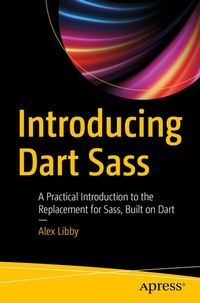
Introducing Dart Sass
Description

Leverage the power of Dart Sass to quickly create valid CSS styles for use within websites. This short project-oriented book simplifies the process of creating and manipulating Sass code in the browser, for websites, or online applications, using little more than a text editor or free software.
Designed to be much faster and simpler to use, yet still maintain the same features as past versions of Sass, Dart Sass offers a host of benefits of using it against writing CSS manually. You will be equipped with a starting toolset that you can use to develop future projects, incorporate into your existing workflow and reduce any dependency on graphics applications such as Illustrator for simple projects.
Dart Sass is a complete rewrite of what many know as Ruby Sass but you don't have to convert your whole work process immediately to working with Sass. You will learn how to incorporate as little or as much as you need, and how to build on it as your skills develop.
We live in an age where speed and simplicity are of the essence - Introducing Dart Sass provides a perfect way to create valid CSS quickly, efficiently, and with the minimum of fuss.
What You Will Learn
-
Understand how Sass works and the benefits of using it against writing CSS manually
-
Create styles quickly and easily, using the power of Sass
-
Apply styles from pre-built libraries, to help reduce time and effort required
-
Gain an appreciation of the importance of optimizing content for efficiency
-
Work through a real-world project example using Sass and third-party Sass-based libraries.
Who This Book Is For
-
Website developers who are already familiar with writing CSS and to learn how to leverage Sass to quickly and more efficiently create valid CSS in projects.
-
Those in agile developmentteams, where time is of the essence, and the pressure is on to deliver results quickly.
-
Developers who want to focus on simplicity to produce properly optimized content in modern browsers using tools already in their possession.
More details
Other editions
Additional editions
Person
Alex Libby is an A/B testing developer and seasoned computer book author, who hails from England. His passion for all things Open Source dates back to the days of his degree studies, where he first came across web development, and has been hooked ever since. His daily work involves extensive use of JavaScript, HTML and CSS to manipulate existing website content; Alex enjoys tinkering with different open source libraries to see how they work. He has spent a stint maintaining the jQuery Tools library, and enjoys writing about Open Source technologies, principally for front end UI development.
Content
1. Introducing Sass.- 2. Introducing Variables and Mixins.- 3. Creating Nested Styles.- 4. Calculating Values using Operations.- 5. Making the Conversion using Sass.- 6. Introducing our Project.- Appendix. Adding Sass to your Path.
