

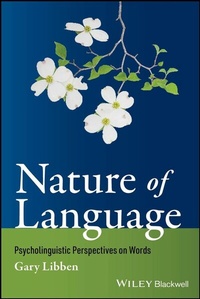
Nature of Language
Description

A student-friendly introduction to the field of psycholinguistics, offering an exciting overview of the cognitive processes behind language processing
Nature of Language: Psycholinguistic Perspectives on Words presents an accessibleoverview of the dynamic field of psycholinguistics. Requiring no previous background in linguistics or psychology, this student-friendly textbook emphasizes the integrated nature of language processing and highlights the complex interactions between comprehension and production in human language. Clear, easy-to-read chapters define and explain all concepts with an engaging narrative style-providing students with the intellectual foundation necessary to explore the cognitive processes of language behavior, consider new linguistic phenomena, and think critically about unsolved problems. Throughout the text, students engage with overarching questions about the nature of language as they learn how psycholinguistics uses data to translate conceptual questions into specific research questions.
- Explores how traditional linguistic notions both help and hinder understanding of how people do language
- Investigates social and cultural aspects of psycholinguistics, such as how people use language to influence others
- Describes the nineteenth-century foundations of psycholinguistics and neurolinguistics
- Offers new perspectives about the future of words and the future of language
- Features helpful pedagogical tools including numerous images, charts, diagrams, and boxed sections designed to enhance the reading experience and provide context for key concepts and developments
Nature of Language is an excellent primary textbook for undergraduate courses in psycholinguistics and psychology of language, and a valuable supplement for students of cognitive science, applied linguistics, and speech language pathology. It is also an informative resource for anyone interested in the mysteries of words, language, and the mind.
More details
Other editions
Additional editions
Person
GARY LIBBEN was Professor of Applied Linguistics at Brock University, Ontario, Canada. He was Director of the Words in the World Partnership project, a Fellow of the Royal Society of Canada, a Corresponding Member of the Austrian Academy of Sciences, and co-founder of the journal The Mental Lexicon. His research focused on the development of new models of words in the mind and the development of new laboratory methods. He was the author of more than 100 articles and books on language and language processing.
Content
Acknowledgments vi
1 Introduction: Psycholinguistics and the Nature of Language 1
2 Historical Perspectives on the Representation of Words in the Mind and Brain 15
3 What Is a Word? 30
4 The Mental Lexicon: Do I Have a Dictionary in My Mind? 43
5 The Maximization of Speed: How Processing Speed Shapes Psycholinguistic Methodology and the Nature of Language Processing 56
6 The Maximization of Opportunity: How the Mental Lexicon Is a Meaning Making Machine 76
7 From Morphological Transcendence to Lexical Superstates 88
8 Words as Action and the Actions of Words 100
9 Expanding the Mental Lexicon: Learning New Words and Learning New Languages 108
10 Looking Forward: Frontiers of Research on Words and the Psycholinguistics of the Future 119
Index 135
