

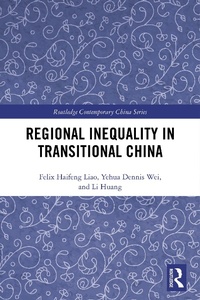
Regional Inequality in Transitional China
1st Edition
Published on 17. September 2020
212 pages
978-1-351-66977-1 (ISBN)
Description

This book investigates uneven regional development in China - with particular focus on the cases of Guangdong and Zheijiang provinces - which have been at the forefront of debate since Chinese economic reform.
Rapid economic growth since the 'opening-up' of China has been accompanied by significant disparities in the regional distribution of income: this book represents one of the most recent studies to present a picture of this inequality. Built upon a multi-scale and multi-mechanism framework, it provides systematic examination of both the patterns and mechanisms of regional development and inequality in provincial China, emphasizing the effects of economic transition. Approaching from a geographical perspective, its authors consider the interplay between the local, the state, and the global forces in shaping the landscape of regional inequality in China. Extensive empirical findings will prove useful to those researching other developing countries within the frontier of globalization and economic transition.
Regional Inequality in Transitional China will appeal to scholars and students of geography, economics and Chinese studies more broadly.
Rapid economic growth since the 'opening-up' of China has been accompanied by significant disparities in the regional distribution of income: this book represents one of the most recent studies to present a picture of this inequality. Built upon a multi-scale and multi-mechanism framework, it provides systematic examination of both the patterns and mechanisms of regional development and inequality in provincial China, emphasizing the effects of economic transition. Approaching from a geographical perspective, its authors consider the interplay between the local, the state, and the global forces in shaping the landscape of regional inequality in China. Extensive empirical findings will prove useful to those researching other developing countries within the frontier of globalization and economic transition.
Regional Inequality in Transitional China will appeal to scholars and students of geography, economics and Chinese studies more broadly.
More details
Series
Edition
1. Auflage
Language
English
Place of publication
London
United Kingdom
Publishing group
Taylor & Francis Ltd
Target group
College/higher education
Product notice
Reflowable
Illustrations
30 Tables, black and white; 83 Line drawings, black and white; 83 Illustrations, black and white
ISBN-13
978-1-351-66977-1 (9781351669771)
Copyright in bibliographic data and cover images is held by Nielsen Book Services Limited or by the publishers or by their respective licensors: all rights reserved.
Schweitzer Classification
Other editions
Additional editions
Felix Haifeng Liao | Yehua Dennis Wei | Li Huang
Regional Inequality in Transitional China
Book
04/2022
1st Edition
Routledge
€65.10
Shipment within 15-20 days
Felix Haifeng Liao | Yehua Dennis Wei | Li Huang
Regional Inequality in Transitional China
Book
09/2020
1st Edition
Routledge
€207.50
Shipment within 10-20 days
Persons
Felix Haifeng Liao is an Associate Professor of Geography at the University of Idaho in the United States. His research interests are in the areas of economic and urban geographies, regional development, urban environmental planning, and geographic information systems (GIS) applications. He has used mixed-methods, GIS, spatial analysis and modeling, and spatial optimization to examine issues related to China's urban and regional development, transnational corporations, land and resource management, and other environmental and equity-related problems in China and the United States. He has published widely in geography journals and other interdisciplinary journals in the field of environmental science, urban studies, and sustainability science. His research has been funded by the NSF, the Natural Science Foundation of China (NSFC), United States Department of Agriculture (USDA), and Idaho NSF EPSCoR (Experimental Program to Stimulate Competitive Research).
Yehua Dennis Wei is a Professor in the Department of Geography at the University of Utah in the United States. He is an economic/urban geographer and development specialist, with research interests in globalization, urbanization, and regional development in China. Using recent developments in geographical information systems (GIS), Wei has investigated the effects of globalization and economic transition on cities, regions, and places with respect to regional inequality, urban transition, foreign investment, innovation, and sustainable development. Wei is the author of Regional Development in China: States, Globalization, and Inequality and more than 200 journal articles and book chapters. His research has been funded by the NSF, Ford Foundation, Lincoln Institute of Land Policy, National Geographic Society, and Natural Science Foundation of China (NSFC). He has received awards for research excellence from the NSFC (Outstanding Young Scientist Award), Association of American Geographers' (AAG) Regional Development and Planning Specialty Group, University of Wisconsin-Milwaukee, and the Chinese Academy of Sciences. His professional services include advisor/panelist for the NSF, consultant to the World Bank, overseas evaluation experts of the Chinese Academy of Sciences, Chair for AAG's China, Asian, and Regional Development and Planning specialty groups, Vice President of Chinese Professionals in GIS, etc.
Li Huang is a doctoral graduate in the Department of Geography, University of Idaho in the United States. His primary research interests are in economic geography, regional development and inequality, land and resource management, and GIScience. He obtained his bachelor of science degree in GIS and a master's degree of science in urban and regional planning from Peking University in China.
Yehua Dennis Wei is a Professor in the Department of Geography at the University of Utah in the United States. He is an economic/urban geographer and development specialist, with research interests in globalization, urbanization, and regional development in China. Using recent developments in geographical information systems (GIS), Wei has investigated the effects of globalization and economic transition on cities, regions, and places with respect to regional inequality, urban transition, foreign investment, innovation, and sustainable development. Wei is the author of Regional Development in China: States, Globalization, and Inequality and more than 200 journal articles and book chapters. His research has been funded by the NSF, Ford Foundation, Lincoln Institute of Land Policy, National Geographic Society, and Natural Science Foundation of China (NSFC). He has received awards for research excellence from the NSFC (Outstanding Young Scientist Award), Association of American Geographers' (AAG) Regional Development and Planning Specialty Group, University of Wisconsin-Milwaukee, and the Chinese Academy of Sciences. His professional services include advisor/panelist for the NSF, consultant to the World Bank, overseas evaluation experts of the Chinese Academy of Sciences, Chair for AAG's China, Asian, and Regional Development and Planning specialty groups, Vice President of Chinese Professionals in GIS, etc.
Li Huang is a doctoral graduate in the Department of Geography, University of Idaho in the United States. His primary research interests are in economic geography, regional development and inequality, land and resource management, and GIScience. He obtained his bachelor of science degree in GIS and a master's degree of science in urban and regional planning from Peking University in China.
Content
1. Introduction 2. Literature Review and Analytical Framework 3. Multi-scalar patterns of regional inequality 4. Provincial dynamics and multi-mechanism process of regional inequality 5. Patterns of regional inequality in Guangdong Province 6. Mechanisms of uneven development in Guangdong 7. Regional inequality in Zhejiang Province 8. Conclusion
