

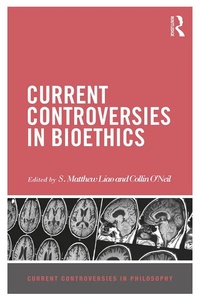
Current Controversies in Bioethics
Published on 8. December 2016
194 pages
978-1-315-43752-1 (ISBN)
Description

Bioethics is the study of ethical issues arising out of advances in the life sciences and medicine. Historically, bioethics has been associated with issues in research ethics and clinical ethics as a result of research scandals such as the Tuskegee Syphilis Study and public debates about the definition of death, medical paternalism, health care rationing, and abortion. As biomedical technologies have advanced, challenging new questions have arisen for bioethics and new sub-disciplines such as neuroethics and public health ethics have entered the scene. This volume features ten original essays on five cutting-edge controversies in bioethics written by leading philosophers.
I. Research Ethics: How Should We Justify Ancillary Care Duties?
II. Clinical Ethics: Are Psychopaths Morally Accountable?
III. Reproductive Ethics: Is There A Solution to the Non-Identity Problem?
IV. Neuroethics: What is Addiction and Does It Excuse?
V. Public Health Ethics: Is Luck Egalitarianism Implausibly Harsh?
S. Matthew Liao and Collin O'Neil's concise introduction to the essays in the volume, the annotated bibliographies and study questions for each controversy, and the supplemental guide to additional current controversies in bioethics give the reader a broad grasp of the different kinds of challenges in bioethics.
I. Research Ethics: How Should We Justify Ancillary Care Duties?
II. Clinical Ethics: Are Psychopaths Morally Accountable?
III. Reproductive Ethics: Is There A Solution to the Non-Identity Problem?
IV. Neuroethics: What is Addiction and Does It Excuse?
V. Public Health Ethics: Is Luck Egalitarianism Implausibly Harsh?
S. Matthew Liao and Collin O'Neil's concise introduction to the essays in the volume, the annotated bibliographies and study questions for each controversy, and the supplemental guide to additional current controversies in bioethics give the reader a broad grasp of the different kinds of challenges in bioethics.
Reviews / Votes
"This book is admirably distinctive in the literature on bioethics. It is selective in addressing only five issues, each drawn from a different area of bioethics and discussed in a pair of contrasting essays. The issues are not only of great practical importance but also intellectually difficult. They demand engagement with matters of moral theory and require the most advanced understanding of relevant empirical material. The authors - all philosophers of distinction - abundantly satisfy these requirements, while also presenting their carefully-developed arguments in writing that is both lucid and accessible. The editors have done their work extremely well."--Jeff McMahan, University of Oxford
More details
Series
Language
English
Place of publication
London
United Kingdom
Publishing group
Taylor & Francis Ltd
Target group
College/higher education
File size
1,16 MB
ISBN-13
978-1-315-43752-1 (9781315437521)
Copyright in bibliographic data and cover images is held by Nielsen Book Services Limited or by the publishers or by their respective licensors: all rights reserved.
Schweitzer Classification
Other editions
Additional editions
S. Matthew Liao | Collin O'Neil
Current Controversies in Bioethics
Book
12/2019
1st Edition
Routledge
€67.40
Shipment within 15-20 days
S. Matthew Liao | Collin O'Neil
Current Controversies in Bioethics
Book
12/2016
1st Edition
Routledge
€231.40
Shipment within 10-20 days
Persons
S. Matthew Liao is Arthur Zitrin Professor of Bioethics, Director of the Center for Bioethics, and Affiliated Professor of Philosophy, New York University. He is the author or editor of The Right to Be Loved (2015) and Moral Brains: The Neuroscience of Morality (2016), and co-edited Philosophical Foundations of Human Rights (2015). He has been featured in the New York Times and other media outlets and is the Editor in Chief for the Journal of Moral Philosophy.
Collin O'Neil is Assistant Professor of Philosophy at Lehman College, City University of New York. His recent publications have appeared in Philosophy & Public Affairs, American Journal of Bioethics, and Journal of Law, Medicine, and Ethics.
Collin O'Neil is Assistant Professor of Philosophy at Lehman College, City University of New York. His recent publications have appeared in Philosophy & Public Affairs, American Journal of Bioethics, and Journal of Law, Medicine, and Ethics.
Content
Acknowledgements
Contributors
Bioethics: Current Controversies
S. Matthew Liao and Collin O'Neil
Part I
Research Ethics: How Should We Justify Ancillary Care Duties?
Locating Medical Researchers' Ancillary-Care Obligations within the Division of Moral Labor
Henry S. Richardson
The Grounds of Ancillary Care Duties
S. Matthew Liao and Collin O'Neil
Part I Suggested Readings
Part II
Clinical Ethics: Are Psychopaths Morally Accountable?
Fine Cuts of Moral Agency: Dissociable Deficits in Psychopathy and Autism
Dana Kay Nelkin
Holding Psychopaths Responsible and the Guise of the Good
Agnieszka Jaworska
Part II Suggested Readings
Part III
Reproductive Ethics: Is There a Solution to the Non-Identity Problem?
Dividing and Conquering the Nonidentity Problem
Melinda A. Roberts and David T. Wasserman
The Nonidentity Problem: United and Unconquered
Saul Smilansky
Part III Suggested Readings
Part IV
Neuroethics: What Is Addiction and Does It Excuse?
Addiction, Habits, and Blame
Timothy Schroeder and Nomy Arpaly
How Addicts Lose Control
Neil Levy
Part IV Suggested Readings
Part V
Public Health Ethics: Is Luck Egalitarianism Implausibly Harsh?
Rarely Harsh and Always Fair: Luck Egalitarianism and Unhealthy Choices
Zofia Stemplowska
Luck Egalitarianism, Harshness, and the Rule of Rescue
Nir Eyal
Part V Suggested Readings
Supplemental Guide to Further Controversies
Index
Contributors
Bioethics: Current Controversies
S. Matthew Liao and Collin O'Neil
Part I
Research Ethics: How Should We Justify Ancillary Care Duties?
Locating Medical Researchers' Ancillary-Care Obligations within the Division of Moral Labor
Henry S. Richardson
The Grounds of Ancillary Care Duties
S. Matthew Liao and Collin O'Neil
Part I Suggested Readings
Part II
Clinical Ethics: Are Psychopaths Morally Accountable?
Fine Cuts of Moral Agency: Dissociable Deficits in Psychopathy and Autism
Dana Kay Nelkin
Holding Psychopaths Responsible and the Guise of the Good
Agnieszka Jaworska
Part II Suggested Readings
Part III
Reproductive Ethics: Is There a Solution to the Non-Identity Problem?
Dividing and Conquering the Nonidentity Problem
Melinda A. Roberts and David T. Wasserman
The Nonidentity Problem: United and Unconquered
Saul Smilansky
Part III Suggested Readings
Part IV
Neuroethics: What Is Addiction and Does It Excuse?
Addiction, Habits, and Blame
Timothy Schroeder and Nomy Arpaly
How Addicts Lose Control
Neil Levy
Part IV Suggested Readings
Part V
Public Health Ethics: Is Luck Egalitarianism Implausibly Harsh?
Rarely Harsh and Always Fair: Luck Egalitarianism and Unhealthy Choices
Zofia Stemplowska
Luck Egalitarianism, Harshness, and the Rule of Rescue
Nir Eyal
Part V Suggested Readings
Supplemental Guide to Further Controversies
Index
