

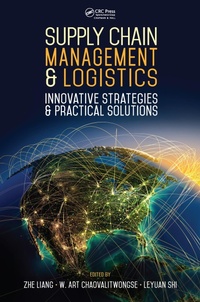
Supply Chain Management and Logistics
Innovative Strategies and Practical Solutions
1st Edition
Published on 8. October 2018
288 pages
978-1-4665-7788-6 (ISBN)
Description

Designed by practitioners for practitioners, Supply Chain Management and Logistics: Innovative Strategies and Practical Solutions provides a wide-spectrum resource on many different aspects involved in supply chain management, including contemporary applications. With contributions from leading experts from all over the world, the book includes innovative strategies and practical solutions that address problems encountered by enterprise in management of supply chain and logistics. It details general techniques and specific approaches to a broad range of important, inspiring, and unanswered questions in the field.
The book is organized around four major research themes in supply chain management: 1) supply chain strategy and coordination, 2) supply chain network optimization, 3) inventory management in supply chain, and 4) financial decisions in supply chain. The sequence of these themes helps transition from an enterprise-wide framework to network design to operational management to financial aspects of the supply chain. Each individual theme also addresses the answer to a challenging question as to how to go about applying quantitative tools to real-life operations, resulting in practical solutions.
As the world moves toward more competitive and open markets, effective supply chain management is of critical importance to the success or failure of an enterprise. Despite a large amount of research achieved in the past decades on the supply chain management topic, many researchers and practitioners are still devoting considerable efforts on the emerging new problems. Designed to give you a collection of topics that bridge the gap between the academic arena and industrial practice, the book supplies a contemporary and up-to-date review on the advanced theory, applications, and practices of supply chain management, making it a rich resource for the design, analysis, and implementation of supply chain management problems arising in a wide range of industries.
The book is organized around four major research themes in supply chain management: 1) supply chain strategy and coordination, 2) supply chain network optimization, 3) inventory management in supply chain, and 4) financial decisions in supply chain. The sequence of these themes helps transition from an enterprise-wide framework to network design to operational management to financial aspects of the supply chain. Each individual theme also addresses the answer to a challenging question as to how to go about applying quantitative tools to real-life operations, resulting in practical solutions.
As the world moves toward more competitive and open markets, effective supply chain management is of critical importance to the success or failure of an enterprise. Despite a large amount of research achieved in the past decades on the supply chain management topic, many researchers and practitioners are still devoting considerable efforts on the emerging new problems. Designed to give you a collection of topics that bridge the gap between the academic arena and industrial practice, the book supplies a contemporary and up-to-date review on the advanced theory, applications, and practices of supply chain management, making it a rich resource for the design, analysis, and implementation of supply chain management problems arising in a wide range of industries.
More details
Series
Edition
1. Auflage
Language
English
Place of publication
Baton Rouge
United States
Publishing group
Taylor & Francis Inc
Target group
College/higher education
Illustrations
37 s/w Abbildungen, 27 s/w Tabellen
27 Tables, black and white; 37 Illustrations, black and white
File size
11,73 MB
ISBN-13
978-1-4665-7788-6 (9781466577886)
Copyright in bibliographic data and cover images is held by Nielsen Book Services Limited or by the publishers or by their respective licensors: all rights reserved.
Schweitzer Classification
Other editions
Additional editions
Zhe Liang | Wanpracha Art Chaovalitwongse | Leyuan Shi
Supply Chain Management and Logistics
Innovative Strategies and Practical Solutions
Book
08/2017
1st Edition
CRC Press
€101.10
Shipment within 10-20 days
Zhe Liang | Wanpracha Art Chaovalitwongse | Leyuan Shi
Supply Chain Management and Logistics
Innovative Strategies and Practical Solutions
Book
10/2015
1st Edition
CRC Press
€205.90
Shipment within 15-20 days
Persons
Zhe Liang is Full Professor of Department of Management Science in School of Economics and Management, Tongji University. His research interests are related to the design and implementation of exact and heuristic algorithms for large-scale combinatorial optimization problems in Supply Chain Management, Transportation, and Telecommunication. He has over 20 referred publications, including his papers appeared in journals such as Transportation Science, INFORMS Journal on Computing, Transportation Research Part B, etc. He has been funded by National Science Foundation of China, Ministry of Education of China, and Ministry of Science and Technology of China.
Wanpracha Art Chaovalitwongse is Professor in the Departments of Industrial & Systems Engineering and Radiology (joint) at the University of Washington, Seattle (UW). He also serves as Associate Director of the Integrated Brain Imaging Center at UW Medical Center. His research group conducts basic computational science, applied, and translational research at the interface of engineering, medicine, and other emerging disciplines with emphasis on (a) computational neuroscience, (b) computational biology, and (c) logistics optimization. He currently serves as Area Editor, Associate Editor and Editorial Board Member of 10 leading international journals. He has edited 4 books and published over 130 research articles including 70+ journal papers.
Leyuan Shi is a Professor with the Department of Industrial Engineering and Management at Peking University. Her research is devoted to the theory and development of large-scale optimization algorithms, discrete event simulation methodology, and modeling and analysis of discrete dynamic systems, with applications to complex systems such as supply chain networks, manufacturing systems, communication networks, and financial engineering. She has published two books: Nested Partitions Method, Theory and Applications (2008), and Modeling, Control and Optimization of Complex Systems (2002). She is currently an Editor of the IEEE Transactions on Automation Science and Engineering, and an Associate Editor of Discrete Event Dynamic Systems. Dr. Shi is a member of INFORMS, and a fellow of IEEE.
Wanpracha Art Chaovalitwongse is Professor in the Departments of Industrial & Systems Engineering and Radiology (joint) at the University of Washington, Seattle (UW). He also serves as Associate Director of the Integrated Brain Imaging Center at UW Medical Center. His research group conducts basic computational science, applied, and translational research at the interface of engineering, medicine, and other emerging disciplines with emphasis on (a) computational neuroscience, (b) computational biology, and (c) logistics optimization. He currently serves as Area Editor, Associate Editor and Editorial Board Member of 10 leading international journals. He has edited 4 books and published over 130 research articles including 70+ journal papers.
Leyuan Shi is a Professor with the Department of Industrial Engineering and Management at Peking University. Her research is devoted to the theory and development of large-scale optimization algorithms, discrete event simulation methodology, and modeling and analysis of discrete dynamic systems, with applications to complex systems such as supply chain networks, manufacturing systems, communication networks, and financial engineering. She has published two books: Nested Partitions Method, Theory and Applications (2008), and Modeling, Control and Optimization of Complex Systems (2002). She is currently an Editor of the IEEE Transactions on Automation Science and Engineering, and an Associate Editor of Discrete Event Dynamic Systems. Dr. Shi is a member of INFORMS, and a fellow of IEEE.
Content
Recent Advances in the Models and Algorithms for Solving the Integrated Production, Inventory, and Distribution Problems in Supply Chains. A Game of Competitive Investment: Over-capacity and Under-Learning. Optimization Approaches for Restoring Disruptions in Supply Chains after Large-Scale Disasters. Air Cargo Transportation in China. Stochastic Inventory Model for a Two Stage Seasonal Product. Nested Partitions and Its Application in Supply Chain Management. Pricing and Revenue Management for E-services. How RFID Can Deliver Cost Savings in Warehousing: A New Strategy. Strategies and Solution Approaches in Supply Chain Management for Electronic Products in China. Optimization and Analytics in the Oil and Gas Industry. A Novel Optimization Algorithms for a Machine Scheduling Problem to Minimize the on Floor Inventory. Scheduling of Integrated Production-Distribution Process in Oil-Gas Industry.
