

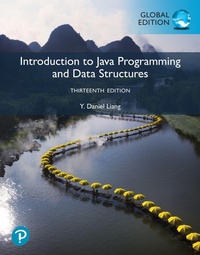
Introduction to Java Programming and Data Structures, Global Edition
13th Edition
Published on 1. April 2025
3206 pages
978-1-292-46997-3 (ISBN)
Description

Introduction to Java Programming and Data Structures seamlessly integrates programming, data structures and algorithms into 1 text. It takes a fundamentals-first approach, helping you build a strong foundation of basic programming concepts and techniques before moving on to object-oriented and advanced Java programming. Author Daniel Liang explains programming in an easy-to-follow, problem-driven way that focuses on problem solving rather than syntax. Basic concepts are illustrated by example, and interesting exercises with various levels of difficulty offer many opportunities for you to practice and apply what you have learned.
The 13th Edition is aligned to the latest Java 18 technology and completely revised in every detail to enhance the clarity, presentation, content, examples, and exercises.
The 13th Edition is aligned to the latest Java 18 technology and completely revised in every detail to enhance the clarity, presentation, content, examples, and exercises.
More details
Edition
13th edition
Language
English
Place of publication
Harlow
United Kingdom
Target group
College/higher education
Edition type
Digital original
File size
57,05 MB
ISBN-13
978-1-292-46997-3 (9781292469973)
Copyright in bibliographic data and cover images is held by Nielsen Book Services Limited or by the publishers or by their respective licensors: all rights reserved.
Schweitzer Classification
Person
About our author Dr. Liang is a professor of Computer Science at Georgia Southern University. He earned his Ph.D. in Computer Science from the University of Oklahoma in 1991. Prior to joining Armstrong State University (now consolidated with Georgia Southern University), Dr. Liang was an Associate Professor in computer science at Purdue University in Fort Wayne, Indiana, where he twice received the Excellence in Research award.
Dr. Liang was trained in theoretical computer science. He has published in the SIAM Journal on Computing, Discrete Applied Mathematics, Acta Informatics, and Information Processing Letters. He has written books on programming, data structures, and computer graphics. His popular computer science texts are widely used in the world.
Dr. Liang was elected a Java Champion by Sun Microsystems (now Oracle) in 2005. He has given lectures on programming internationally.
Dr. Liang was trained in theoretical computer science. He has published in the SIAM Journal on Computing, Discrete Applied Mathematics, Acta Informatics, and Information Processing Letters. He has written books on programming, data structures, and computer graphics. His popular computer science texts are widely used in the world.
Dr. Liang was elected a Java Champion by Sun Microsystems (now Oracle) in 2005. He has given lectures on programming internationally.
Content
Introduction to Computers, Programs, and Java
Elementary Programming
Selections
Mathematical Functions, Characters, and Strings
Loops
Methods
Single-Dimensional Arrays
Multidimensional Arrays
Objects and Classes
Object-Oriented Thinking
Inheritance and Polymorphism
Exception Handling and Text I/O
Abstract Classes and Interfaces
JavaFX Basics
Event-Driven Programming and Animations
JavaFX UI Controls and Multimedia
Binary I/O
Recursion
Generics
Lists, Stacks, Queues, and Priority Queues
Sets and Maps
Developing Efficient Algorithms
Sorting
Implementing Lists, Stacks, Queues, and Priority Queues
Binary Search Trees
AVL Trees
Hashing
Graphs and Applications
Weighted Graphs and Applications
Aggregate Operations for Collection Streams
APPENDICES
Java Keywords
The ASCII Character Set
Operator Precedence Chart
Java Modifiers
Special Floating-Point Values
Number Systems
Bitwise Operations
Regular Expressions
Enumerated types
The Big-O, Big-Omega, and Big-Theta Notations
Elementary Programming
Selections
Mathematical Functions, Characters, and Strings
Loops
Methods
Single-Dimensional Arrays
Multidimensional Arrays
Objects and Classes
Object-Oriented Thinking
Inheritance and Polymorphism
Exception Handling and Text I/O
Abstract Classes and Interfaces
JavaFX Basics
Event-Driven Programming and Animations
JavaFX UI Controls and Multimedia
Binary I/O
Recursion
Generics
Lists, Stacks, Queues, and Priority Queues
Sets and Maps
Developing Efficient Algorithms
Sorting
Implementing Lists, Stacks, Queues, and Priority Queues
Binary Search Trees
AVL Trees
Hashing
Graphs and Applications
Weighted Graphs and Applications
Aggregate Operations for Collection Streams
APPENDICES
Java Keywords
The ASCII Character Set
Operator Precedence Chart
Java Modifiers
Special Floating-Point Values
Number Systems
Bitwise Operations
Regular Expressions
Enumerated types
The Big-O, Big-Omega, and Big-Theta Notations
