

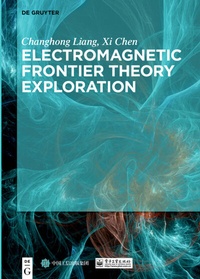
Electromagnetic Frontier Theory Exploration
1st Edition
Published on 5. November 2019
XXIX, 358 pages
978-3-11-052740-7 (ISBN)
Description

This book systematically introduces electromagnetic theories and their applications in practice: electrostatic energy, Poynting theorem, the polarization of waves, the conservation law, the electromagnetic symmetry, the conformal mapping method, the electromagnetic loss. The parameters and theorems of electromagnetic theories are discussed in detail, making the book an essential reference for researchers, and engineers in electromagnetics field.
Reviews / Votes
Tabel of Content Chapter 01:Self-action energy in Electrostatic field Chapter 02:Corresponding Research between Time Harmonic Field and Complex Field Chapter 03:Transformation and Unification between Static Electric Field and Constant Current Field Chapter 04:Electrical Charge Multipole and Electric Current Multipole Chapter 05:Polarization and Application of Electromagnetic Wave Chapter 06:Conservation of Charge and Conservation of Current Chapter 07:Electromagnetic reciprocal symmetry and lossless symmetry Chapter 08:Electromagnetic Symmetry and Symmetric Operator Chapter 09:Plane Mirror Method and Active Conformal Mapping Chapter 10:On the theory of Electromagnetic Loss Chapter 11:Complex Parameters and Complex Theorems of Electromagnetic Theory Chapter 12:The complex operatorand Two-dimensional Electrostatic Field Chapter 13:New Network Theory[C] of Electromagnetic Wave in Multilayered Medium Chapter 14:Matrix Transformation in Electromagnetic Theory Chapter 15:Challenges of the minimum directivity of electromagnetic radiation Chapter 16:Mystery of Fermat Principle Chapter 17:Description of Electromagnetic Inertia Chapter 18:Beauty of Electromagnetic Theory Chapter 19:Several Thoughts of Electromagnetic TheoryMore details
Other editions
Additional editions
Changhong Liang | Xi Chen
Electromagnetic Frontier Theory Exploration
Book
02/2024
1st Edition
De Gruyter
€189.95
Shipment within 7-9 days
Changhong Liang | Xi Chen
Electromagnetic Frontier Theory Exploration
E-Book
11/2019
1st Edition
De Gruyter
€189.95
Available for download
Persons
Content
- Intro
- Content Summary
- An Epigram for Electromagnetic Field Theory Teaching Series by Professor Liang Changhong
- Author's Biography
- Preface
- Contents
- List of Figures
- 1. Self-action energy in electrostatic field
- 2. Corresponding research between time-harmonic field and complex field
- 3. Transformation and unification of electrostatic field and constant current field
- 4. Charge multipoles and current multipoles
- 5. Polarization of electromagnetic wave and its applications
- 6. Conservation of charge and conservation of current
- 7. Electromagnetic reciprocal symmetry and lossless symmetry
- 8. Electromagnetic symmetry and symmetry operator
- 9. Plane image method and active conformal mapping
- 10. Electromagnetic loss
- 11. Complex parameter and complex theorems in electromagnetic theory
- 12. Complex operator w¯ and 2D static field
- 13. New network theory of electromagnetic waves in multilayered media
- 14. Matrix transformation in electromagnetic theory
- 15. Minimum directivity challenge of electromagnetic radiation
- 16. Mysteries of Fermat's principle
- 17. Electromagnetic inertia
- 18. Beauty of electromagnetic theory
- 19. Some thoughts on the electromagnetic theory
- 20. Teaching notes
- References
- Index
