

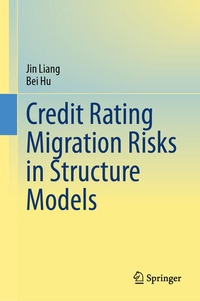
Credit Rating Migration Risks in Structure Models
Description

The book provides the latest research results on measuring Credit Rating Migration by mathematical methods. It brings about most popular mathematical models, methods and applications on this area, especially presents the latest development on structure models. It is systematically collects the models, methods and results in this area.
The book first introduced the financial background and preliminary mathematical theory. Then two mainstream mathematical models for measuring default risks, the reduced form model and structure model, are presented. The structure model for measuring credit rating migration risks is the main part of the book and authors prove the existence, uniqueness, regularities, asymptotic behavior, traveling wave and other properties of the solutions of the model. The structural credit rating migration model is also extended to more general case, such as stochastic interest rate, multiple ratings, region switch and so on. Some credit derivatives, and numerical analysis, parameter calibration and estimate of the migration boundary of the models are given in the last two chapters.
The book focuses on theoretical financial investigators, especially financial mathematical researchers and students. The book is involved various mathematical models, such as PDE, numerical simulation etc., some of them are interesting mathematical problems, so that, and a good reference book to study mathematical modeling in credit rating migration. It might also be used as a textbook for students in financial credit risks.
More details
Other editions
Additional editions
Persons
Content
Financial Background.- Preliminary Mathematical Theory.- Mathematical Models for Measuring Default Risks.- Markov Chain Approach for Measuring Credit Rating Migration Risks.- Application of Reduced Form/Markov Chain Credit Rating Migration Model.- Structure Models for Measuring Credit Rating Migration Risks.- Theoretical Results in the Structural Credit Rating Migration Models.- Extensions for Structural Credit Rating Migration Models.- Credit Derivatives Related to Rating Migrations.- Numerical Simulation, Calibration and Recovery of Credit Rating Boundary.
