

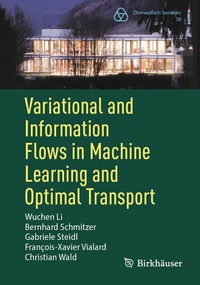
Variational and Information Flows in Machine Learning and Optimal Transport
Description

This book is based on lectures given at the Mathematisches Forschungsinstitut Oberwolfach on "Computational Variational Flows in Machine Learning and Optimal Transport".
Variational and stochastic flows on measure spaces are ubiquitous in machine learning and generative modeling. Optimal transport and diffeomorphic flows provide powerful frameworks to analyze such trajectories of distributions with elegant notions from differential geometry, such as geodesics, gradient and Hamiltonian flows. Recently, mean field control and mean field games offered a general optimal control variational view on learning problems. The four independent chapters in this book address the question of how the presented tools lead us to better understanding and further development of machine learning and generative models.
Reviews / Votes
"This book is a collection of four short monographs exploring the theoretical foundations of optimal transport and its connections with machine learning. Each part can be read independently, but together they form a coherent and well-structured overview of the field. I would recommend this volume both as an accessible entry point for researchers with a strong theoretical background wishing to explore applications in machine learning, and as a rigorous theoretical reference for graduate students in data science or applied mathematics." (Ronan Herry, zbMATH 1576.49001, 2026)
More details
Other editions
Additional editions
Persons
Wuchen Li received his BSc in Mathematics from the Shandong University in 2009. He obtained a Ph.D. in Mathematics from the Georgia Institute of Technology in 2016. He was a CAM Assistant Adjunct Professor in the Department of Mathematics at the University of California, Los Angeles, from 2016 to 2020. Now, he is an assistant professor at the University of South Carolina. His research interests include optimal transport, information geometry, and mean field games with applications in data science and scientific computing.
Bernhard Schmitzer completed his PhD in 2014 at the University of Heidelberg under the direction of Christoph Schnörr. Afterwards he was a postdoc at Université Paris-Dauphine and University of Münster under the mentorship of Gabriel Peyré and Benedikt Wirth. In 2019 he became a junior research group leader at TU Munich and since 2020 he is a professor at the University of Göttingen.
Gabriele Steidl completed her PhD at the University of Rostock under supervision of Manfred Tasche. Afterwards, she held positions as assistant and full professor at the TU Darmstadt, the University of Mannheim and the TU Kaiserslautern. Since 2020, she is Professor at the Department of Mathematics at the TU Berlin. She worked as consultant of the Fraunhofer Institute for Industrial Mathematics and is in the Scientific Advisory Board of the Helmholtz Imaging Platform of the Helmholtz Association. She is a SIAM fellow (2022) and Editor-in-Chief of the SIAM Journal on Imaging Sciences.
François-Xavier Vialard completed his PhD in 2009 at ENS Paris-Saclay under the supervision of Alain Trouve. He was a post-doc at Imperial College, London in a project lead by Darryl D. Holm before he started an assistant professor position at the University Paris-Dauphine in 2011. In 2018, he moved to the University Gustave Eiffel in the Paris area.
Christian Wald studied mathematics at the University of Stuttgart and Humboldt University Berlin. He completed his PhD in algebraic number theory under the supervision of Elmar Groesse-Kloenne. Following his PhD, he was a postdoctoral researcher at Charité Berlin, working on artificial intelligence in cardiac CT imaging. He is currently a postdoc at the TU of Berlin. His research focuses on curves in Wasserstein spaces, gradient flows, generative modeling, and sampling from Boltzmann densities.
Content
- 1. A Dynamic Perspective of Optimal Transport.- 2. A Geometric Perspective on Diffeomorphic and Optimal Transport Flows and Their Applications.- 3. Wasserstein Dynamics in Mathematical Data Sciences.- 4. Flow Matching: Markov Kernels, Stochastic Processes and Transport Plans.
