

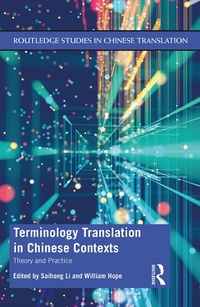
Terminology Translation in Chinese Contexts
Theory and Practice
1st Edition
Published on 22. February 2021
278 pages
978-1-000-35710-3 (ISBN)
Description

Terminology Translation in Chinese Contexts: Theory and Practice investigates the theory and practice of terminology translation, terminology management, and scholarship within the distinctive milieu of Chinese and explores the complex relationship between terminology translation (micro level) and terminology management (macro level).
This book outlines the contemporary challenges of terminology translation and terminology management within Chinese contexts in specialized fields including law, the arts, religion, Chinese medicine, and food products. The volume also examines how the development and application of new technologies such as big data, cloud computing, and artificial intelligence have brought about major changes in the language service industry. Technology such as machine translation and computer-assisted translation has spawned new challenges in terminology management practices and has facilitated their evolution in contexts of ever greater internationalization and globalization. This book recontextualizes terminology translation and terminology management with a special focus on English-Chinese translation.
It is hoped that the volume will enable and enhance dialogue between Chinese and Western scholars and professionals in the field. All chapters have been written by specialists in the different subfields and have been peer-reviewed by the editors.
This book outlines the contemporary challenges of terminology translation and terminology management within Chinese contexts in specialized fields including law, the arts, religion, Chinese medicine, and food products. The volume also examines how the development and application of new technologies such as big data, cloud computing, and artificial intelligence have brought about major changes in the language service industry. Technology such as machine translation and computer-assisted translation has spawned new challenges in terminology management practices and has facilitated their evolution in contexts of ever greater internationalization and globalization. This book recontextualizes terminology translation and terminology management with a special focus on English-Chinese translation.
It is hoped that the volume will enable and enhance dialogue between Chinese and Western scholars and professionals in the field. All chapters have been written by specialists in the different subfields and have been peer-reviewed by the editors.
Reviews / Votes
'The most notable strength of the volume is its efforts to balance thoery and practice, management and scholarship, as well as diachronic and synchronic perspectives.'- Bi Zhao, Shanghai International Studies University, John Benjamins Publishing Company
More details
Series
Edition
1. Auflage
Language
English
Place of publication
London
United Kingdom
Publishing group
Taylor & Francis Ltd
Target group
College/higher education
Product notice
Reflowable
Illustrations
43 Tables, black and white; 4 Line drawings, black and white; 22 Halftones, black and white; 26 Illustrations, black and white
ISBN-13
978-1-000-35710-3 (9781000357103)
Copyright in bibliographic data and cover images is held by Nielsen Book Services Limited or by the publishers or by their respective licensors: all rights reserved.
Schweitzer Classification
Other editions
Additional editions
Book
02/2021
1st Edition
Routledge
€179.81
Shipment within 15-20 days
Book
02/2021
1st Edition
Routledge
€60.50
Shipment within 15-20 days
Persons
Saihong Li is Senior Lecturer in Translation Studies at the University of Stirling. She is an executive council member of the Chartered Institute of Linguists and an associate editor-in-chief of the Academic Journal of Literature and Languages. She has published widely in the areas of translation and interpreting studies, lexicography, and corpus linguistics.
William Hope lectures in Italian at the University of Salford. He is a member of the advisory boards of the journal Transletters and the book series Moving Texts (Peter Lang/Universite Catholique de Louvain). He has headed a project funded by the AHRC entitled A New Italian Political Cinema? and has published extensively on European cinema.
William Hope lectures in Italian at the University of Salford. He is a member of the advisory boards of the journal Transletters and the book series Moving Texts (Peter Lang/Universite Catholique de Louvain). He has headed a project funded by the AHRC entitled A New Italian Political Cinema? and has published extensively on European cinema.
Content
Contents
List of Figures
List of Tables
List of Contributors
Acknowledgements
Introduction: The Role of Terminology Translation in China's Contemporary Identities and Cultures
Saihong Li and William Hope
Part I: Terminology Translation
Introduction: The History and Development of Chinese Terminology
Zhiwei Feng
1 Terminology Translation in Socio-Legal Contexts: A Corpus-based Exploration
Le Cheng and Yuxiu Sun
How Policy Concerns Impose Different Understandings in Legal Transplantation: Terminology Translation in Chinese Corporate Law
Xiaochen Zhang
3 Terminology Translation in Traditional Chinese Medicine: From Standardization of Technical Terms to Interultural Knowledge Transfer
Binhua Wang
4 Translatability and Untranslatability of Religious Terminology: A Hermeneutics Perspective
Jenny Wong
5 Translating Food Terminology as Cultural and Communicative Processes: A Corpus-based Approach
Saihong Li
6 A Study on the Translation of Peking Opera Terminology: A Visual Grammar Perspective
Qin Huang and Yajun Wang
Part II: Terminology Management and Scholarship
Introduction: A Historical Overview of Terminology Management and Scholarship
Saihong Li and William Hope
7 Translator-Oriented Terminology Management
Bingbing Leng
8 Terminology Definition in the Humanities and Social Sciences
Jian Yin
9 Automatically Compiling Bilingual Legal Glossaries Based on Chinese-English Parallel Corpora
Zhao-Ming Gao
10 A Survey on Terminology Management of Language Service Enterprises in China: Problems and Suggestions
Huashu Wan and, Zhi Li
11 Rethinking Translationese and Translation Universals: Insights from Corpus-Based Translation Studies
Xiaolin Yang and Dechao Li
12 The Construction of a Chinese and English Term Database of Manchu Ulabun
Wen Zhao, Xingye Su, and Weizu Huang
Bibliography
Index
List of Figures
List of Tables
List of Contributors
Acknowledgements
Introduction: The Role of Terminology Translation in China's Contemporary Identities and Cultures
Saihong Li and William Hope
Part I: Terminology Translation
Introduction: The History and Development of Chinese Terminology
Zhiwei Feng
1 Terminology Translation in Socio-Legal Contexts: A Corpus-based Exploration
Le Cheng and Yuxiu Sun
How Policy Concerns Impose Different Understandings in Legal Transplantation: Terminology Translation in Chinese Corporate Law
Xiaochen Zhang
3 Terminology Translation in Traditional Chinese Medicine: From Standardization of Technical Terms to Interultural Knowledge Transfer
Binhua Wang
4 Translatability and Untranslatability of Religious Terminology: A Hermeneutics Perspective
Jenny Wong
5 Translating Food Terminology as Cultural and Communicative Processes: A Corpus-based Approach
Saihong Li
6 A Study on the Translation of Peking Opera Terminology: A Visual Grammar Perspective
Qin Huang and Yajun Wang
Part II: Terminology Management and Scholarship
Introduction: A Historical Overview of Terminology Management and Scholarship
Saihong Li and William Hope
7 Translator-Oriented Terminology Management
Bingbing Leng
8 Terminology Definition in the Humanities and Social Sciences
Jian Yin
9 Automatically Compiling Bilingual Legal Glossaries Based on Chinese-English Parallel Corpora
Zhao-Ming Gao
10 A Survey on Terminology Management of Language Service Enterprises in China: Problems and Suggestions
Huashu Wan and, Zhi Li
11 Rethinking Translationese and Translation Universals: Insights from Corpus-Based Translation Studies
Xiaolin Yang and Dechao Li
12 The Construction of a Chinese and English Term Database of Manchu Ulabun
Wen Zhao, Xingye Su, and Weizu Huang
Bibliography
Index
