

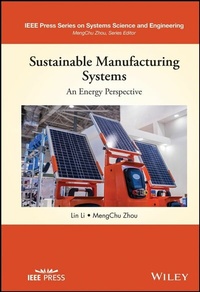
Sustainable Manufacturing Systems: An Energy Perspective
Description

Learn more about energy efficiency in traditional and advanced manufacturing settings with this leading and authoritative resource
Sustainable Manufacturing Systems: An Energy Perspective delivers a comprehensive analysis of energy efficiency in sustainable manufacturing. The book presents manufacturing modeling methods and energy efficiency evaluation and improvement methods for different manufacturing systems. It allows industry professionals to understand the methodologies and techniques being embraced around the world that lead to advanced energy management.
The book offers readers a comprehensive and systematic theoretical foundation for novel manufacturing system modeling, analysis, and control. It concludes with a summary of the insights and applications contained within and a discussion of future research issues that have yet to be grappled with.
Sustainable Manufacturing Systems answers the questions that energy customers, managers, decision makers, and researchers have been asking about sustainable manufacturing. The book's release coincides with recent and profound advances in smart grid applications and will serve as a practical tool to assist industrial engineers in furthering the green revolution. Readers will also benefit from:
* A thorough introduction to energy efficiency in manufacturing systems, including the current state of research and research methodologies
* An exploration of the development of manufacturing methodologies, including mathematical modeling for manufacturing systems and energy efficiency characterization in manufacturing systems
* An analysis of the applications of various methodologies, including electricity demand response for manufacturing systems and energy control and optimization for manufacturing systems utilizing combined heat and power systems
* A discussion of energy efficiency in advanced manufacturing systems, like stereolithography additive manufacturing and cellulosic biofuel manufacturing systems
Perfect for researchers, undergraduate students, and graduate students in engineering disciplines, especially for those majoring in industrial, mechanical, electrical, and environmental engineering, Sustainable Manufacturing Systems will also earn a place in the libraries of management and business students interested in manufacturing system cost performance and energy management.
More details
Other editions
Additional editions
Persons
LIN LI, PHD, is an Assistant Professor in the Department of Mechanical and Industrial Engineering at the University of Illinois at Chicago. Dr. Li has published over sixty scientific papers in scholarly journals and 34 for conferences.
MENGCHU ZHOU, PHD, is a Distinguished Professor of Electrical and Computer Engineering at the New Jersey Institute of Technology (NJIT), in the United States. He is an Associate Editor of IEEE Transactions on Systems, Man, and Cybernetics Systems, and is a Fellow of the IEEE, IFAC, and AAAS.
Content
Author Biography xv
Preface xvii
Acknowledgments xxiii
List of Figures xxv
Part I Introductions to Energy Efficiency in Manufacturing Systems 1
1 Introduction 3
1.1 Definitions and Practices of Sustainable Manufacturing 3
1.1.1 Current Status of Manufacturing Industry 3
1.1.2 Sustainability in the Manufacturing Sector and Associated Impacts 5
1.1.3 Sustainable Manufacturing Practices 10
1.2 Fundamental of Manufacturing Systems 12
1.2.1 Stages of Product Manufacturing 12
1.2.2 Classification of Manufacturing Systems 13
1.2.2.1 Job Shop 13
1.2.2.2 Project Shop 14
1.2.2.3 Cellular System 15
1.2.2.4 Flow Line 15
1.2.2.5 Continuous System 15
1.3 Problem Statement and Scope 18
Problems 19
References 19
2 Energy Efficiency in Manufacturing Systems 23
2.1 Energy Consumption in Manufacturing Systems 23
2.1.1 Energy and Power Basics 23
2.1.2 Energy Generation 24
2.1.2.1 Primary Energy 25
2.1.2.2 Secondary Energy 27
2.1.3 Energy Distribution 27
2.1.3.1 Electricity 28
2.1.3.2 Steam 30
2.1.3.3 Compressed Air 30
2.1.4 Energy Consumption 31
2.1.4.1 Indirect End Use 33
2.1.4.2 Direct Process End Use 33
2.1.4.3 Direct Non-process End Use 34
2.2 Energy Saving Potentials and Energy Management Strategies for Manufacturing Systems 35
2.2.1 Machine Level 39
2.2.1.1 Intrinsic Characteristics of Machine Tools 41
2.2.1.2 Processing Conditions 42
2.2.2 System Level 43
2.2.2.1 Inhomogeneous System 44
2.2.2.2 Machine Maintenance 45
2.2.3 Plant Level 46
2.2.3.1 Indirect End Use 46
2.2.3.2 Direct Non-process End Use 47
2.3 Demand-side Energy Management 49
2.3.1 Electricity Bill Components 50
2.3.1.1 Electricity Cost 51
2.3.1.2 Demand Cost 51
2.3.1.3 Fixed Cost 52
2.3.2 Energy Efficiency Programs 52
2.3.3 Demand Response Programs 55
2.3.3.1 Incentive-based Programs 56
2.3.3.2 Price Base Options 57
Problems 59
References 59
Part II Mathematical Tools and Modeling Basics 65
3 Mathematical Tools 67
3.1 Probability 67
3.1.1 Fundamentals of Probability Theory 67
3.1.1.1 Basics of Probability Theory 67
3.1.1.2 Axioms of Probability Theory 69
3.1.1.3 Conditional Probability and Independence 72
3.1.1.4 Total Probability Theorem 73
3.1.1.5 Bayes' Law 74
3.1.2 Random Variables 74
3.1.2.1 Discrete Random Variables 75
3.1.2.2 Continuous Random Variables 82
3.1.3 Random Process 88
3.1.3.1 Discrete-time Markov Chain 89
3.1.3.2 Continuous-time Markov Chain 92
3.2 Petri Net 94
3.2.1 Formal Definition of Petri Net 95
3.2.1.1 Definition of Petri Net 95
3.2.2 Classical Petri Net 99
3.2.2.1 State Machine Petri Net 101
3.2.2.2 Marked Graph 102
3.2.2.3 Systematic Modeling Methods 105
3.2.3 Deterministic Timed Petri Net 106
3.2.4 Stochastic Petri Net 109
3.3 Optimization Methods 113
3.3.1 Fundamentals of Optimization 113
3.3.1.1 Objective Function 114
3.3.1.2 Decision Variables 114
3.3.1.3 Constraints 115
3.3.1.4 Local and Global Optimum 116
3.3.1.5 Near-optimal Solutions 117
3.3.1.6 Single-objective and Multi-objective Optimization 117
3.3.1.7 Deterministic and Stochastic Optimization 118
3.3.2 Genetic Algorithms 119
3.3.2.1 Initialization 119
3.3.2.2 Evaluation 121
3.3.2.3 Selection 121
3.3.2.4 Crossover 123
3.3.2.5 Mutation 124
3.3.2.6 Termination Criteria 125
3.3.3 Particle Swarm Optimizer (PSO) 126
3.3.3.1 Initialization 126
3.3.3.2 Evaluation 128
3.3.3.3 Personal and Global Best Positions 128
3.3.3.4 Updating Velocity and Position 129
3.3.3.5 Termination Criteria 132
Problems 132
References 134
4 Mathematical Modeling of Manufacturing Systems 139
4.1 Basics in Manufacturing System Modeling 139
4.1.1 Structure of Manufacturing Systems 139
4.1.1.1 Basic Components 139
4.1.1.2 Structural Modeling 140
4.1.1.3 Types of Manufacturing Systems 141
4.1.2 Mathematical Models of Machines and Buffers 142
4.1.2.1 Timing Issues for Machines 143
4.1.2.2 Machine Reliability Models 143
4.1.2.3 Parameters of Aggregated Machines 145
4.1.2.4 Mathematical Model of Buffers 146
4.1.2.5 Interaction Between Machines and Buffers 147
4.1.2.6 Buffer State Transition 147
4.1.2.7 Blockage and Starvation 148
4.1.3 Performance Measures 150
4.1.3.1 Blockage and Starvation 150
4.1.3.2 Production Rate and Throughput 151
4.1.3.3 Work-in-process 151
4.2 Two-machine Production Lines 152
4.2.1 Conventions and Notations 152
4.2.1.1 Assumptions 152
4.2.1.2 Notations 152
4.2.2 State Transition 154
4.2.2.1 State Transition Probabilities 155
4.2.2.2 System Dynamics 157
4.2.3 Steady-state Probabilities 157
4.2.3.1 Identical Machines 159
4.2.3.2 Nonidentical Machines 160
4.2.4 Performance Measures 161
4.2.4.1 Blockage and Starvation 161
4.2.4.2 Production Rate 161
4.2.4.3 Work-in-process 162
4.3 Multi-machine Production Lines 162
4.3.1 Assumptions and Notations 163
4.3.1.1 Assumptions 163
4.3.1.2 Notations 163
4.3.2 State Transition 164
4.3.2.1 State Transition Probabilities 165
4.3.2.2 System Dynamics 167
4.3.3 Performance Measures 167
4.3.3.1 Blockage and Starvation 167
4.3.3.2 Production Rate 168
4.3.3.3 Work-in-process 169
4.3.4 System Modeling with Iteration-based Method 169
4.4 Production Lines Coupled with Material Handling Systems 174
4.4.1 Assumptions and Notations 174
4.4.1.1 Assumptions 175
4.4.1.2 Notations 175
4.4.2 State Transition and Performance 175
4.4.2.1 Blockage and Starvation 175
4.4.2.2 Production Rate 176
Problems 179
References 180
5 Energy Efficiency Characterization in Manufacturing Systems 181
5.1 Energy Consumption Modeling 181
5.1.1 Operation-based Energy Modeling 182
5.1.2 Component-based Energy Modeling 185
5.1.3 System-level Energy Modeling 188
5.2 Energy Cost modeling 191
5.2.1 Energy Cost Under Flat Rate 192
5.2.1.1 Energy Consumption Cost 192
5.2.1.2 Demand Cost 192
5.2.2 Energy Cost Under Time-of-use Rate 196
5.2.2.1 Energy Consumption Cost 196
5.2.2.2 Demand Cost 198
5.2.3 Energy Cost Under Critical Peak Price (CPP) 199
5.2.3.1 Energy Consumption Cost 199
5.2.3.2 Demand Cost 200
Problems 203
References 203
Part III Energy Management in Typical Manufacturing Systems 205
6 Electricity Demand Response for Manufacturing Systems 207
6.1 Time-of-use Pricing for Manufacturing Systems 208
6.1.1 Introduction to TOU 208
6.1.2 Survey of TOU Pricing in US Utilities 209
6.1.3 Comparison of Energy Cost Between Flat Rate and TOU Rates 210
6.2 TOU-Based Production Scheduling for Manufacturing Systems 216
6.2.1 Manufacturing Systems Modeling 216
6.2.2 Energy Consumption and Energy Cost Modeling 218
6.2.3 Production Scheduling for TOU-based Demand Response 219
6.2.3.1 Production Scheduling Problem Formulation 219
6.2.3.2 PSO Algorithm for Near-optimal Solutions 220
6.2.3.3 Case Study Setup 221
6.2.3.4 Optimal Production Schedules 222
6.3 Critical Peak Pricing for Manufacturing Systems 228
6.3.1 Introduction to Critical Peak Pricing (CPP) 228
6.3.2 Comparison of Energy Cost Between TOU and CPP Rates 229
Problems 234
Appendix 3.A Supplementary Information of Demand Response Tariffs 235
References 255
7 Energy Control and Optimization for Manufacturing Systems Utilizing Combined Heat and Power System 257
7.1 Introduction to Combined Heat and Power System 257
7.2 Problem Definition and Modeling 258
7.2.1 Objective Function 260
7.2.1.1 Electricity Cost 260
7.2.1.2 Operation Cost for the CHP System and Boiler 261
7.2.2 Constraints 262
7.3 Solution Approach 263
7.3.1 Initialization 263
7.3.2 Evaluation 264
7.3.3 Updating Process 265
7.4 Case Study 266
7.4.1 Case Study Settings 267
7.4.2 Results and Discussions 269
Problems 270
References 271
8 Plant-level Energy Management for Combined Manufacturing and HVAC System 273
8.1 Definition and Modeling 273
8.1.1 Objective Function 274
8.1.1.1 Calculate TEL(t) 276
8.1.1.2 Estimate q(t) 278
8.1.2 Constraints 279
8.2 Solution Approach 281
8.2.1 Initialization 281
8.2.2 Evaluation 282
8.2.3 Updating Process 282
8.3 Case Study 283
8.3.1 Model Settings 284
8.3.2 Results and Discussions 287
Problems 289
References 290
Part IV Energy Management in Advanced Manufacturing Systems 291
9 Energy Analysis of Stereolithography-based Additive Manufacturing 293
9.1 Introduction to Additive Manufacturing 293
9.1.1 Illustration of MIP SL-based AM Process 294
9.2 Energy Consumption Modeling 296
9.2.1 Energy Consumption of UV Curing Process 297
9.2.2 Energy Consumption of Building Platform Movement 298
9.2.3 Energy Consumption of Cooling System 298
9.3 Experimentation 298
9.3.1 Experiment Design Methodology 298
9.3.2 Experiment Apparatus 299
9.4 Results and Discussions 300
9.4.1 Baseline Case Results Using Default Conditions 300
9.4.2 Factorial Analysis Results 302
9.4.3 Product Quality Comparison 305
Problems 308
References 308
10 Energy Efficiency Modeling and Optimization of Cellulosic Biofuel Manufacturing System 311
10.1 Introduction to Cellulosic Biofuel Manufacturing 311
10.2 Energy Modeling of Cellulosic Biofuel Production 313
10.2.1 Energy Modeling of Biomass Size Reduction Process 314
10.2.2 Energy Modeling of Biofuel Chemical Conversion Processes 314
10.2.2.1 Heating Energy 315
10.2.2.2 Energy Loss 316
10.2.2.3 Reaction Energy 317
10.2.2.4 Energy Recovery 320
10.2.2.5 Total Energy Consumption 321
10.3 Energy Consumption Optimization Using PSO 321
10.3.1 Problem Formulation 321
10.3.2 Solution Procedures 322
10.3.2.1 Initialization 322
10.3.2.2 Evaluation 323
10.3.2.3 Updating Process 323
10.4 Case Study 323
10.4.1 Case Settings 324
10.4.2 Energy Analysis of Baseline Case 324
10.4.2.1 Energy Consumption Breakdown 324
10.4.3 Energy Analysis of Optimal Results 327
Problems 328
References 329
11 Energy-consumption Minimized Scheduling of Flexible Manufacturing Systems 333
11.1 Introduction 334
11.2 Construction of Place-timed PN for FMS Scheduling 335
11.2.1 Basic Definitions of PN 335
11.2.2 Place-timed PN Scheduling Models of FMS 336
11.3 Energy Consumption Functions 338
11.3.1 Calculating the Earliest Firing Time of Transitions 339
11.3.2 Two Energy Consumption Functions 340
11.3.2.1 Energy Consumption Function E1 341
11.3.2.2 Energy Consumption Function E2 341
11.4 Dynamic Programming for Scheduling FMS 344
11.4.1 Formulation of DP for FMSs 344
11.4.1.1 States and Stages 344
11.4.1.2 State Transition Equation 344
11.4.1.3 Bellman Equation 345
11.4.2 Reachability Graph of PNS 345
11.4.3 DP Implementation for Scheduling FMS 347
11.5 Modified Dynamic Programming for Scheduling FMS 348
11.5.1 Evaluation Function of Transition Sequences 349
11.5.2 Heuristic Function 350
11.5.3 MDP Algorithm for FMS Scheduling 351
11.6 Case Study 353
11.7 Summary 358
Problems 358
References 359
Part V Summaries and Conclusions 363
12 Research Trends and Future Directions in Sustainable Industrial Development 365
12.1 Insights into Sustainable Industrial Development 365
12.2 Energy and Resource Efficiency in Manufacturing 366
12.2.1 Equipment Design 366
12.2.2 Smart Manufacturing 367
12.3 Industrial Symbiosis 369
12.4 Supply Chain Management 371
12.5 Circular Economy 373
12.6 Life Cycle Assessment 376
References 378
Glossary 387
Acronyms 391
Index 393
Preface
Sustainable Manufacturing Systems are one of modern technologies and have played a significant role in economic growth worldwide. Currently, the total value added by the global manufacturing industry reaches USD 13.5 trillion, accounting for nearly 16% of the global economy. Despite the continued strength of manufacturing industry, it also faces a pressing concern over energy consumption and environmental sustainability. Approximately, the industry sector possesses near one-quarter of the total energy consumption in the U.S., where over 75% of energy use is primarily attributed to manufacturing activities.
The issues of resource scarcity and environmental impacts are becoming vital due to the constantly rising demand for energy in the manufacturing sector. Several critical questions arise in proposing energy management strategies in manufacturing and evoke different aspects of energy efficiency studies, including (i) improving the energy efficiency of manufacturing systems considering the complex manufacturing conditions, (ii) reducing the energy cost with no sacrifice of manufacturing productivity, and (iii) generating policies or incentives to promote energy efficiency in the manufacturing industry and encourage the manufacturers' transition to environmentally conscious manufacturing. All these questions lead to the joint modeling and analysis of production and energy for manufacturing systems.
This book provides a holistic view of energy efficiency assessment and improvement measures for sustainable manufacturing systems, delivered through the state-of-the-art on sustainable manufacturing and energy efficiency issues, fundamentals and mathematical tools for manufacturing system modeling, and energy management methodologies for different manufacturing systems. Meanwhile, this book transfers the recent academic research results into various representative examples and case studies, which provide insights into the current sustainable practices and energy management strategies in manufacturing systems at different scales and levels. From the application aspect, this book is expected to help (i) energy consumers, participants and administrators in energy efficiency programs, and (ii) research participants embrace the opportunities for advanced energy management. Furthermore, this book is intended to bring about learning initiatives for students in mechanical, industrial, environmental, and electrical engineering programs by effectively integrating concepts in academic research into real-world problem solving, which helps cultivate the student's enthusiasm for energy conservation and green manufacturing.
Organization of the Book
Part I: Introductions to Energy Efficiency in Manufacturing Systems
Chapter 1 provides an overview of this book and introduces background knowledge about manufacturing systems and concepts of sustainable manufacturing. First, it reviews the current status and development of the manufacturing industry and demonstrates a series of representative manufacturing systems. Then, it presents the key concepts of sustainable manufacturing and discusses the existing challenges that may impede sustainable development in manufacturing industries. Finally, it generalizes the problem statements and scopes of research in the context of sustainable manufacturing systems.
Chapter 2 provides more detailed background information on energy efficiency in manufacturing systems. The overall energy consumption and major energy end-users in manufacturing facilities are first introduced, followed by the discussions on the energy-saving potentials and energy management strategies at the machine, system, and plant levels. In addition, the significance of demand-side energy management is illustrated with the detailed explanations of associated techniques.
Part II: Mathematical Tools and Modeling Basics
Chapter 3 introduces the necessary mathematical tools used in the following chapters of this book. Specifically, the fundamentals of probability theory and application scenarios of several common probability distributions used in manufacturing system modeling are introduced, followed by the demonstration of Petri nets for the visual representation of manufacturing systems as discrete event systems and discussions on the optimization problems with metaheuristics algorithms, specifically a particle swarm optimizer.
Chapter 4 presents the mathematical modeling techniques for manufacturing systems, which play a critical role in sustainable manufacturing system design and analysis. This chapter introduces the basics of manufacturing system modeling, followed by detailed discussions on some typical modeling approaches to simple two-machine production lines and complex multi-machine ones.
Chapter 5 extends the modeling and analysis techniques discussed in the previous chapter into energy efficiency characterization in manufacturing systems. First, the energy consumption modeling approaches are discussed based on the inter-process dependency or the machines' operation schemes. Then the energy cost models of manufacturing systems under different electricity tariffs are demonstrated with illustrative examples.
Part III: Energy Management in Typical Manufacturing Systems
Chapter 6 presents the electricity demand response (DR) strategies for manufacturing systems. The instant high demand can hinder the stability of a power grid, and thus the utility providers charge industrial customers specifically for their electricity demand in addition to the total energy consumption. In this chapter, the time-of-use (TOU) and critical peak pricing (CPP) tariffs are first introduced. The production scheduling methods that can respond to electricity price signals based on the system models are then discussed. Finally, case studies are presented to compare the peak demand and energy costs under TOU, CPP, and traditional flat-rate tariffs.
Chapter 7 extends the DR scheduling methods presented in the previous chapter by integrating a combined heat and power (CHP) system with manufacturing systems. As an on-site energy generation method, a CHP system can provide electricity and heat to the manufacturing plant, leading to a reduction in the grid power demand of the manufacturing plant. In this chapter, the key concepts of a CHP system are first reviewed, followed by the formulation of an energy cost optimization model for a combined CHP and manufacturing systems. The case studies are presented to demonstrate the effectiveness of the combined system in demand and energy cost reduction.
Chapter 8 addresses an energy management problem in manufacturing systems considering the heating, ventilation, and air conditioning (HVAC) system, which is one of the primary contributors to the direct non-process end use energy consumption in manufacturing plants. The heat emissions from manufacturing operations can significantly affect the thermal load of an HVAC system, and the relationships between manufacturing and HVAC systems are discussed in this chapter. Specifically, the formulation of an energy cost optimization problem for the integrated systems is first introduced, and then the metaheuristic algorithm used to solve the problem is discussed in detail. Finally, case studies demonstrate the optimal DR strategy for the integrated system.
Part IV: Energy Management in Advanced Manufacturing Systems
Chapter 9 specifically focuses on the energy analysis of additive manufacturing (AM) systems. In this chapter, stereolithography (SL), one of the most commonly used AM technologies, is adopted to demonstrate the energy modeling and analysis methods for an AM process. This chapter starts with the introduction of the technical advantages of AM technologies and a detailed description of an SL process. Then, it presents the energy consumption model of such SL process and its experimental validation results. The impacts of different parameters on the overall energy consumption are revealed through a Design-Of-Experiments (DOE) methodology. Finally, it gives case studies to illustrate the optimal combination of control parameters.
Chapter 10 presents the energy efficiency modeling and optimization of cellulosic biofuel manufacturing systems. The background knowledge and major processes of cellulosic biofuel manufacturing are first introduced. Then, the formulation of the energy consumption model for cellulosic biofuel manufacturing is illustrated by considering the intra-process and inter-process variables. Afterward, the optimization problem is solved through a metaheuristic algorithm, and the energy efficiency improvement under optimal process variables is presented at the end of this chapter.
Chapter 11 demonstrates the energy consumption modeling using Petri nets (PN) and production scheduling optimization for flexible manufacturing systems (FMS). In this chapter, the formulation of a place-timed PN model for FMS is first introduced, followed by a discussion of a dynamic programming (DP) algorithm to find production schedules that can minimize the energy consumption of small-size FMS. Next, a Modified DP (MDP) algorithm is presented to solve large-scale problems by addressing the state explosion issue. Finally, experimental results on FMS are presented to show the effectiveness of MDP.
Part V: Summaries and Conclusions
Chapter 12 summarizes the contribution of this book and highlights...
