

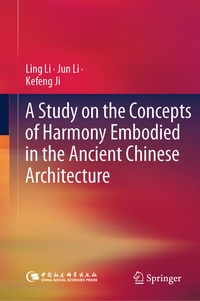
A Study on the Concepts of Harmony Embodied in the Ancient Chinese Architecture
Description

This book explores the core concept of Chinese ancient architecture from a multidisciplinary perspective. It aims to contribute to the development, inheritance, and protection of Chinese ancient architectural culture, while also benefiting the sustainable development of modern architecture. This book follows a main line of inquiry, exploring the rich and harmonious ideas present in Chinese ancient architecture. It combines the traditional Chinese culture and architectural ideas, and examines the original thought that forms the foundation of the traditional Chinese architectural culture of "harmony" from various aspects.
Firstly, the book describes the Taoist theory of the harmony between man and nature, as expressed through different architectural elements. Secondly, it discuses the system of harmony among people influenced by Confucianism. Lastly, it explores the significance of Buddhism in Buddhist architecture. Finally, it also examines the difference in the emodiment of harmonious ideas between Chinese and Western architectures.
This book studies and analyzes the type and characteristics of Chinese ancient architecture, the architectural objects, and the simple ecological environment views contained within the architectural concept. It not only analyzes the historical development context, but also provides physical examples of architectural types, and explores the influence of regional environmental factors.
The target audience for this book includes scholars in universities and scientific research departments, particularly those studying architectural aesthetics, history and philosophy, it is also suitable for the ordinary readers who have interest in Chinese traditional architectural culture.
More details
Other editions
Additional editions
Persons
Li Ling is a research professor at the Shandong Academy of Social Sciences. She got the doctoral degree from Washington University in St. Louis and Shandong University, and she completed a postdoctoral fellowship at the Claremont Process Research Center in California. Her primary focus is on researching architectural aesthetics, ecological architecture and ecological cities. She aims to propose effective methods for the preservation and continuation of Chinese ancient architecture, as well as provide inspiration for China's urban development projects.
Li Jun is a senior engineer at the Shandong Academy of Architectural Science. Her research primarily centers around building materials and technology. She explores the integration of architectural language, technology, and materials to understand the theoretical and practical mechanisms behind achieving the architectural artistry.
Ji Kefeng is a senior chief engineer at the Jinan Zhongjian Architectural Design Institute. He is a first-class registered structural engineer, and serves as the vice chairman of the Shandong Civil and Architectural Association's Professional Committee of Building Structure and the Structural and Seismic Committee. His research primarily focuses on urban planning and architectural design, with a specific emphasis on designing and researching complex structures.
Content
Introduction.- Chapter One Factors Contributing to the Formation of Concepts of Harmony.- Harmony Between Humans and Nature.- Harmony Between Humans and Society: Ethics and Orders.- Harmony Between Mind and Body: Integrated and Distilled Ideals.- Different Concepts of Harmony Between Ancient Chinese and Western Architecture.- Patterns to Establish the Concepts of Harmony in Modern Architecture.
