

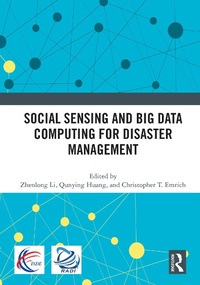
Social Sensing and Big Data Computing for Disaster Management
1st Edition
Published on 17. December 2020
204 pages
978-1-000-26153-0 (ISBN)
Description

Social Sensing and Big Data Computing for Disaster Management captures recent advancements in leveraging social sensing and big data computing for supporting disaster management. Specifically, analysed within this book are some of the promises and pitfalls of social sensing data for disaster relevant information extraction, impact area assessment, population mapping, occurrence patterns, geographical disparities in social media use, and inclusion in larger decision support systems.
Traditional data collection methods such as remote sensing and field surveying often fail to offer timely information during or immediately following disaster events. Social sensing enables all citizens to become part of a large sensor network which is low cost, more comprehensive, and always broadcasting situational awareness information. However, data collected with social sensing is often massive, heterogeneous, noisy, and unreliable in some aspects. It comes in continuous streams, and often lacks geospatial reference information. Together, these issues represent a grand challenge toward fully leveraging social sensing for emergency management decision making under extreme duress. Meanwhile, big data computing methods and technologies such as high-performance computing, deep learning, and multi-source data fusion become critical components of using social sensing to understand the impact of and response to the disaster events in a timely fashion.
This book was originally published as a special issue of the International Journal of Digital Earth.
Traditional data collection methods such as remote sensing and field surveying often fail to offer timely information during or immediately following disaster events. Social sensing enables all citizens to become part of a large sensor network which is low cost, more comprehensive, and always broadcasting situational awareness information. However, data collected with social sensing is often massive, heterogeneous, noisy, and unreliable in some aspects. It comes in continuous streams, and often lacks geospatial reference information. Together, these issues represent a grand challenge toward fully leveraging social sensing for emergency management decision making under extreme duress. Meanwhile, big data computing methods and technologies such as high-performance computing, deep learning, and multi-source data fusion become critical components of using social sensing to understand the impact of and response to the disaster events in a timely fashion.
This book was originally published as a special issue of the International Journal of Digital Earth.
More details
Edition
1. Auflage
Language
English
Place of publication
London
United Kingdom
Publishing group
Taylor & Francis Ltd
Target group
College/higher education
Product notice
Reflowable
ISBN-13
978-1-000-26153-0 (9781000261530)
Copyright in bibliographic data and cover images is held by Nielsen Book Services Limited or by the publishers or by their respective licensors: all rights reserved.
Schweitzer Classification
Other editions
Additional editions
Zhenlong Li | Qunying Huang | Christopher T. Emrich
Social Sensing and Big Data Computing for Disaster Management
Book
09/2023
1st Edition
Routledge
€51.98
Shipment within 15-20 days
Zhenlong Li | Qunying Huang | Christopher T. Emrich
Social Sensing and Big Data Computing for Disaster Management
Book
11/2020
1st Edition
Routledge
€206.90
Shipment within 15-20 days
Persons
Zhenlong Li is Associate Professor in the Department of Geography at the University of South Carolina, USA where he established and leads the Geoinformation and Big Data Research Laboratory. His primary research focuses on geospatial big data analytics, spatiotemporal analysis/modelling, and CyberGIS/GeoAI. By synthesizing advanced computing technologies, geospatial methods, and spatiotemporal principles, his research aims to advance knowledge discovery and decision making to support domain applications including disaster management, climate change, human mobilities, and public health.
Qunying Huang is Associate Professor in the Department of Geography at the University of Wisconsin-Madison, USA. Her fields of expertise include spatial computing, spatial data mining, and spatial data analytics. Dr. Huang's research bridges the gap between computer and information science (CIScience) and GIScience by generating new computational algorithms and methods to make sense of complex big spatial datasets obtained from both the physical sensing (e.g. remote sensing) and social (e.g. social media) sensing networks. The problem domains of her research are related to natural hazards and human mobility.
Christopher T. Emrich is Endowed Associate Professor of Environmental Science and Public Administration within the School of Public Administration and a founding member of the newly formed National Center for Integrated Coastal Research at the University of Central Florida (UCF Coastal), USA. His research/practical service includes applying geospatial technologies to emergency management planning and practice, long-term disaster recovery, and the intersection of social vulnerability and community resilience in the face of catastrophe.
Qunying Huang is Associate Professor in the Department of Geography at the University of Wisconsin-Madison, USA. Her fields of expertise include spatial computing, spatial data mining, and spatial data analytics. Dr. Huang's research bridges the gap between computer and information science (CIScience) and GIScience by generating new computational algorithms and methods to make sense of complex big spatial datasets obtained from both the physical sensing (e.g. remote sensing) and social (e.g. social media) sensing networks. The problem domains of her research are related to natural hazards and human mobility.
Christopher T. Emrich is Endowed Associate Professor of Environmental Science and Public Administration within the School of Public Administration and a founding member of the newly formed National Center for Integrated Coastal Research at the University of Central Florida (UCF Coastal), USA. His research/practical service includes applying geospatial technologies to emergency management planning and practice, long-term disaster recovery, and the intersection of social vulnerability and community resilience in the face of catastrophe.
Content
1. Introduction to social sensing and big data computing for disaster management
Zhenlong Li, Qunying Huang and Christopher T. Emrich
2. Identifying disaster-related tweets and their semantic, spatial and temporal context using deep learning, natural language processing and spatial analysis: a case study of Hurricane Irma
Muhammed Ali Sit, Caglar Koylu and Ibrahim Demir
3. Deep learning for real-time social media text classification for situation awareness - using Hurricanes Sandy, Harvey, and Irma as case studies
Manzhu Yu, Qunying Huang, Han Qin, Chris Scheele and Chaowei Yang
4. A visual-textual fused approach to automated tagging of flood-related tweets during a flood event
Xiao Huang, Cuizhen Wang, Zhenlong Li and Huan Ning
5. Rapid estimation of an earthquake impact area using a spatial logistic growth model based on social media data
Yandong Wang, Shisi Ruan, Teng Wang and Mengling Qiao
6. Mapping near-real-time power outages from social media
Huina Mao, Gautam Thakur, Kevin Sparks, Jibonananda Sanyal and Budhendra Bhaduri
7. Social and geographical disparities in Twitter use during Hurricane Harvey
Lei Zou, Nina S. N. Lam, Shayan Shams, Heng Cai, Michelle A. Meyer, Seungwon Yang, Kisung Lee, Seung-Jong Park and Margaret A. Reams
8. Population distribution modelling at fine spatio-temporal scale based on mobile phone data
Petr Kubicek, Milan Konecny, Zdenek Stachon, Jie Shen, Lukas Herman, Tomas Reznik, Karel Stanek, Radim Stampach and Simon Leitgeb
9. Discovering the relationship of disasters from big scholar and social media news datasets
Liang Zheng, Fei Wang, Xiaocui Zheng and Binbin Liu
10. A cyberGIS-enabled multi-criteria spatial decision support system: A case study on flood emergency management
Zhe Zhang, Hao Hu, Dandong Yin, Shakil Kashem, Ruopu Li, Heng Cai, Dylan Perkins and Shaowen Wang
Zhenlong Li, Qunying Huang and Christopher T. Emrich
2. Identifying disaster-related tweets and their semantic, spatial and temporal context using deep learning, natural language processing and spatial analysis: a case study of Hurricane Irma
Muhammed Ali Sit, Caglar Koylu and Ibrahim Demir
3. Deep learning for real-time social media text classification for situation awareness - using Hurricanes Sandy, Harvey, and Irma as case studies
Manzhu Yu, Qunying Huang, Han Qin, Chris Scheele and Chaowei Yang
4. A visual-textual fused approach to automated tagging of flood-related tweets during a flood event
Xiao Huang, Cuizhen Wang, Zhenlong Li and Huan Ning
5. Rapid estimation of an earthquake impact area using a spatial logistic growth model based on social media data
Yandong Wang, Shisi Ruan, Teng Wang and Mengling Qiao
6. Mapping near-real-time power outages from social media
Huina Mao, Gautam Thakur, Kevin Sparks, Jibonananda Sanyal and Budhendra Bhaduri
7. Social and geographical disparities in Twitter use during Hurricane Harvey
Lei Zou, Nina S. N. Lam, Shayan Shams, Heng Cai, Michelle A. Meyer, Seungwon Yang, Kisung Lee, Seung-Jong Park and Margaret A. Reams
8. Population distribution modelling at fine spatio-temporal scale based on mobile phone data
Petr Kubicek, Milan Konecny, Zdenek Stachon, Jie Shen, Lukas Herman, Tomas Reznik, Karel Stanek, Radim Stampach and Simon Leitgeb
9. Discovering the relationship of disasters from big scholar and social media news datasets
Liang Zheng, Fei Wang, Xiaocui Zheng and Binbin Liu
10. A cyberGIS-enabled multi-criteria spatial decision support system: A case study on flood emergency management
Zhe Zhang, Hao Hu, Dandong Yin, Shakil Kashem, Ruopu Li, Heng Cai, Dylan Perkins and Shaowen Wang
