

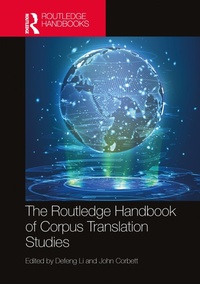
The Routledge Handbook of Corpus Translation Studies
1st Edition
Published on 28. October 2024
660 pages
978-1-040-11670-8 (ISBN)
Description

This Handbook offers a comprehensive grounding in key issues of corpus-informed translation studies, while showcasing the diverse range of topics, applications, and developments of corpus linguistics.
In recent decades there has been a proliferation of scholarly activity that applies corpus linguistics in diverse ways to translation studies (TS). The relative ease of availability of corpora and text analysis programs has made corpora an increasingly accessible and useful tool for practising translators and for scholars and students of translation studies. This Handbook first provides an overview of the discipline and presents detailed chapters on specific areas, such as the design and analysis of multilingual corpora; corpus analysis of the language of translated texts; the use of corpora to analyse literary translation; corpora and critical translation studies; and the application of corpora in specific fields, such as bilingual lexicography, machine translation, and cognitive translation studies. Addressing a range of core thematic areas in translation studies, the volume also covers the role corpora play in translator education and in aspects of the study of minority and endangered languages. The authors set the stage for the exploration of the intersection between corpus linguistics and translation studies, anticipating continued growth and refinement in the field.
This volume provides an essential orientation for translators and TS scholars, teachers, and students who are interested in learning the applications of corpus linguistics to the practice and study of translation.
In recent decades there has been a proliferation of scholarly activity that applies corpus linguistics in diverse ways to translation studies (TS). The relative ease of availability of corpora and text analysis programs has made corpora an increasingly accessible and useful tool for practising translators and for scholars and students of translation studies. This Handbook first provides an overview of the discipline and presents detailed chapters on specific areas, such as the design and analysis of multilingual corpora; corpus analysis of the language of translated texts; the use of corpora to analyse literary translation; corpora and critical translation studies; and the application of corpora in specific fields, such as bilingual lexicography, machine translation, and cognitive translation studies. Addressing a range of core thematic areas in translation studies, the volume also covers the role corpora play in translator education and in aspects of the study of minority and endangered languages. The authors set the stage for the exploration of the intersection between corpus linguistics and translation studies, anticipating continued growth and refinement in the field.
This volume provides an essential orientation for translators and TS scholars, teachers, and students who are interested in learning the applications of corpus linguistics to the practice and study of translation.
Reviews / Votes
Even the most dubious of Doubting Thomases cannot fail to be impressed with this wide-ranging update on progress in corpus-based translation studies. Seasoned researchers and younger colleagues combine here to explain both the practicalities of corpus construction and the many fields of inquiry to which corpus studies can contribute: not just to comparative linguistics, but also to translation quality assessment, translator stylistics, new robust approaches to translator education, critical discourse analysis, and the classical tendencies of translation. Particularly welcome are the extensions to website language, interpreting, and audiovisual translation. Corpus is not dead - here we are invited to touch the actual body of texts in the widest sense.Professor Anthony Pym, School of Languages and Linguistics, University of Melbourne, Australia
More details
Series
Edition
1. Auflage
Language
English
Place of publication
London
United Kingdom
Publishing group
Taylor & Francis Ltd
Target group
College/higher education
Illustrations
63 Tables, black and white; 7 Line drawings, black and white; 93 Halftones, black and white; 100 Illustrations, black and white
ISBN-13
978-1-040-11670-8 (9781040116708)
Copyright in bibliographic data and cover images is held by Nielsen Book Services Limited or by the publishers or by their respective licensors: all rights reserved.
Schweitzer Classification
Other editions
Additional editions
Defeng Li | John Corbett
The Routledge Handbook of Corpus Translation Studies
Book
approx. 06/2026
1st Edition
Routledge
€66.00
Not yet published
Defeng Li | John Corbett
The Routledge Handbook of Corpus Translation Studies
Book
10/2024
1st Edition
Routledge
€310.60
Shipment within 10-20 days

Defeng Li | John Corbett
The Routledge Handbook of Corpus Translation Studies
Book
09/2024
Routledge
Unfortunately, price unknown
Available (delivery time upon request)
Persons
Defeng Li is a Distinguished Professor of Translation Studies, Associate Dean of the Faculty of Arts and Humanities, and Director of the Centre for Studies of Translation, Interpreting and Cognition (CSTIC) at the University of Macau, Macao. He is currently President of World Interpreter and Translator Training Association (WITTA); President of the International Association of Translation, Interpreting and Cognition (IATIC); Vice President of Chinese Corpus Translation Studies Association; and Vice President of the Chinese Cognitive Translation Studies Association.
John Corbett is a Professor of English and Associate Dean of the Faculty of Humanities and Social Sciences at BNU-HKBU United International College in Zhuhai, China. He is an Honorary Visiting Professor at the University of Glasgow, where he was principal investigator of the Scottish Corpus of Texts and Speech and the Corpus of Modern Scottish Writing 1700-1945. He has published articles and books on intercultural language education, literary linguistics, corpus linguistics, Scottish literature, and translation studies.
John Corbett is a Professor of English and Associate Dean of the Faculty of Humanities and Social Sciences at BNU-HKBU United International College in Zhuhai, China. He is an Honorary Visiting Professor at the University of Glasgow, where he was principal investigator of the Scottish Corpus of Texts and Speech and the Corpus of Modern Scottish Writing 1700-1945. He has published articles and books on intercultural language education, literary linguistics, corpus linguistics, Scottish literature, and translation studies.
Content
Introduction - Current and Future Directions in Corpus and Translation Studies Part I: Corpus Methods and Design 1. Empirical and Quantitative Approaches to Corpus Translation Studies 2. Parallel Corpus Design 3. Parallel Corpora of the Bible in Minority Languages 4. Triangulating Multilingual Corpora 5. From Corpus-Based Interpreting Studies to Interpreting Data "Mining": Trials and Perspectives 6. Artificial Intelligence, Corpora and Translation Studies Part II: CBTS and Linguistics 7. Corpora, Translation Studies, and Contrastive Linguistics 8.Corpora and Pragmatics in Translation 9. Lexical Semantics, Corpora and Translation 10. Corpora and Bilingual Lexicography 11. Corpora and the Study of Cognition in Translation Part III: Corpora and Translation Universals 12. Corpora and Cross-Linguistic Research of Translation Universals 13. Corpora and Translatorese 14. Corpus-Based Studies of Explicitation Part IV: Corpora, Translation, Style and Genres 15. Corpus-Assisted Research on Translator Style 16. Corpus Informed Literary Translation 17. Corpora and Translated Drama 18. Corpora and the Translation of Legal Texts 19. Corpora and the Translation of Scientific Texts Part V: CBTS and Teaching 20. Corpora and Translator Education 21. Corpora, Translation and Teaching of Languages for Specific Purposes 22. Teaching Sign Language as Second Language Through Data-Driven Learning 23. Corpora and Interpreter Training Part VI: Audiovisual CBTS 24. Corpora and Translation of Audiovisual Texts 25. Corpora and Audio Description 26. Corpora and Audiovisual Subtitling Part VII: Critical CBTS 27. Corpora and Critical Translation Studies 28. Corpora, Ideology and Interpreting 29. Corpora, Translation and Gender: Feminist Translation and Corpus Linguistics at the Crossroads Part VIII: CBTS and Assessment 30. Corpora and Translation Quality Assessment 31. Corpora and Assessment of Translator Expertise 32. Investigating Machine Translation Quality Across Genres: A Corpus-Based Analysis of Phraseology
