

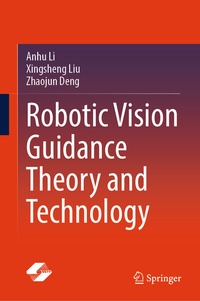
Robotic Vision Guidance Theory and Technology
Description

This book focuses on the basic theories and key technologies for robotic vision. The book features an in-depth demonstration of system parameter calibration, three-dimensional vision measurement, object pose estimation, tracking control strategies, and multi-sensor fusion methods, accompanied by robotic guidance solutions in various applications. The contributed work can help promote the development and application of robotic guidance for autonomous navigation, grasping and manipulation tasks. Researchers and engineers in the field of robotic perception, visual measurement and visual tracking can benefit from the book. The potential users include undergraduates and postgraduates majoring in intelligent manufacturing and artificial intelligence. The basis of English translation of this book, originally in Chinese, was facilitated by artificial intelligence. The content was later revised by the author for accuracy.
More details
Other editions
Additional editions
Persons
Dr. Anhu Li is a full professor with School of Mechanical Engineering, Tongji University, China. His research interests include intelligent machinery, optical tracking and visual perception. He is a standing director of China Construction Machinery Society, an academic committee member of Hunan Provincial Key Laboratory of Health Maintenance for Mechanical Equipment, and a professional committee member of Chinese Optical Society. He has led over 20 projects supported by National Natural Science Foundation of China, Ministry of Science and Technology of China, etc. He was honored with 8 Science and Technology Awards from Shanghai and Ministry of Industry and Information Technology of China, etc. He has published over 110 peer-reviewed papers in Optica, IEEE, AIP and others' journals, and hold over 100 granted patents in China and America.
Dr. Xingsheng Liu is an assistant professor with Pen-Tung Sah Institute of Micro-Nano Science and Technology, Xiamen University, China. He received his Bachelor's degree, Master's degree and Ph.D. degree from Tongji University in 2016, 2019 and 2024, respectively. His research interests include robotic vision and lidar technologies. He has published over 20 papers in peer-reviewed journals, such as Pattern Recognition and Optics Letters, and hold 8 Chinese granted patents.
Dr. Zhaojun Deng received his Ph.D. degree from Tongji University in 2023, where he works as a postdoctoral fellow now. His research interests include visual measurement and pose estimation. He has published about 10 papers in peer-reviewed journals, such as Measurement and Precision Engineering, and hold over 20 Chinese granted patents, and led 5 national and provincial-level projects.
Content
Introduction.- Fundamentals of Robotic Vision Guidance.- Calibration of Robotic Vision Systems.
