

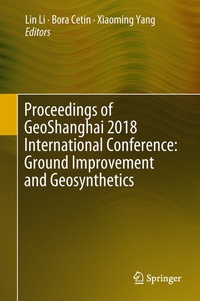
Proceedings of GeoShanghai 2018 International Conference: Ground Improvement and Geosynthetics
Description

This book is the eighth volume of the proceedings of the 4th GeoShanghai International Conference that was held on May 27 - 30, 2018. This book, entitled Ground Improvement and Geosynthetics", presents the latest information on the new technologies and practical applications in various geotechnical engineering projects and advancements on ground improvement and geosynethetics. This volume presents detailed design procedures and examples to demonstrate the applications of the latest ground improvement technologies and innovative geosynethetics in geotechnical engineering. Topics include pile/column technology as foundations, retaining structures, or embankment supports, physical and chemical technologies for soil stabilization and ground improvement, geosynthetic reinforcement for roads, slopes, retaining walls, and foundations.
Each of the papers included in this book received at least two positive peer reviews. The editors would like to express their sincerest appreciation to all of the anonymous reviewers all over the world, for their diligent work.
More details
Other editions
Additional editions
Persons
Bora Cetin completed his PhD in geotechnical engineering at the University of Maryland at College Park. He is currently an Assistant Professor in the Geotechnical and Geoenvironmental Engineering Area in the Department of Civil, Construction and Environmental Engineering at Iowa State University.
Xiaoming Yang completed his PhD in geotechnical engineering at the University of Kansas. He is currently an Assistant Professor at Oklahoma State University. He is a member of American Society of Civil Engineers.
Content
- Intro
- Preface
- Organization
- International Advisory Committee
- Conference Steering Committee
- Technical Committee
- Organizing Committee
- Local Organizing Committee
- Contents
- About the Editors
- Tensile Strains in Geomembrane Landfill Liners
- Abstract
- 1 Introduction
- 2 GMB Tensile Strains from Indentations
- 2.1 GMB Indentations and Laboratory Testing Methods
- 2.2 Strain Calculation Methods
- 2.3 Influence of Gravel Size on Maximum GMB Tensile Strain
- 2.4 Influence of Geotextile Protection on Maximum GMB Tensile Strain
- 2.5 Influence of Alternative Protection Layers on Maximum GMB Tensile Strain
- 2.6 Influence of Time and Temperature on Maximum GMB Tensile Strain
- 3 GMB Tensile Strains on Side Slope
- 3.1 GMB Tears on Side Slope
- 3.2 Numerical Modelling
- 3.3 Centrifuge Testing
- 3.4 Influence of Slope Inclination on GMB Tensile Strains
- 4 Conclusions
- Acknowledgements
- References
- Ground Improvement
- Application of Image Analysis on Two-Dimensional Experiment of Ground Displacement Under Strip Footing
- Abstract
- 1 Introduction
- 2 Experimental Method
- 2.1 Experimental Setup of 2D Ground Failure Under Strip Footing
- 2.2 Image Analysis for Measurement of Ground Displacement
- 3 Result and Discussion
- 3.1 Comparison Between DIC and the Image Analyzing Method
- 3.2 Displacement Measurement of the Highlighted Markers
- 4 Concluding Summary
- References
- Calculation Method for Settlement of Stiffened Deep Mixed Column-Supported Embankment over Soft Clay
- Abstract
- 1 Introduction
- 2 Calculation Model
- 3 Derivation of the Theoretical Method
- 3.1 Compression of Soil in Region I
- 3.2 Compression of Soil in Region II
- 3.3 Compression of Soil in Region III
- 4 Application of the Proposed Method
- 5 Conclusions
- Acknowledgments
- References
- Consolidation Analysis of Soft Soil by Vacuum Preloading Considering Groundwater Table Change
- Abstract
- 1 Introduction
- 2 Analysis on Field Observation
- 3 Calculation Model
- 3.1 Basic Assumptions
- 3.2 Governing Equation
- 4 Analytical Solution
- 5 Analysis of Influence Factors
- 5.1 Effects of Drain Spacing Ratio n
- 5.2 Effects of Groundwater Table Change
- 5.3 Effects of Soil Permeability Coefficient Ratio
- 6 Conclusions
- Acknowledgements
- References
- DEM Analysis of the Effect of Grain Size Distribution on Vibroflotation Without Backfill
- Abstract
- 1 Introduction
- 2 DEM Simulations
- 2.1 Contact Model
- 2.2 Simulation Conditions
- 2.3 The Process of Vibroflotation
- 3 Simulation Results
- 3.1 The Distribution of Void Ratio
- 3.2 The Particle Velocity Field
- 4 Conclusions
- Acknowledgement
- References
- Steel Drilled Displacement Piles (M-Piles) - Overview and Case History
- Abstract
- 1 Introduction
- 2 Generalized Construction Procedure
- 3 Applicability and Installation-Induced Changes
- 4 Benefits and Advantages
- 5 Case History - P-730 Bachelors Enlisted Quarters Project
- 6 Conclusions
- References
- Field Investigation of Highway Subgrade Silty Soil Treated with Lignin
- Abstract
- 1 Introduction
- 2 Field Tests
- 2.1 Site Description
- 2.2 Materials and Methods
- 3 Results and Discussion
- 3.1 CBR Test
- 3.2 Resilient Modulus Test
- 3.3 Benkelman Beam Test
- 3.4 Heavy Metal Concentration
- 4 Conclusions
- References
- Investigation of Ground Displacement Induced by Hydraulic Jetting Using Smoothed Particle Hydrodynamics
- Abstract
- 1 Introduction
- 2 Fundamentals of Smoothed Particle Hydrodynamics (SPH)
- 2.1 Definition
- 2.2 SPH Formulation
- 3 Investigation Methodology
- 4 Simulation Results and Discussion
- 5 Conclusion
- References
- Monte-Carlo Simulation of Post-construction Settlement After Vacuum Consolidation and Design Criterion Calibration
- Abstract
- 1 Introduction
- 2 Analytical Solution of Vacuum Consolidation Combined with Preloading
- 3 Reliability-Based Analysis and Design Approach
- 3.1 Monte-Carlo Simulation Based on Analytical Solution
- 3.2 Reliability-Based Design Approach
- 4 Application in Design Review of the Reclamation of Kalibaru Port
- 4.1 Project Summary
- 4.2 Deterministic Results by Using FEM
- 4.3 Reliability-Based Design Calibration
- 5 Conclusions
- References
- Numerical Investigation on Slope Stability of Deep Mixed Column-Supported Embankments Over Soft Clay Induced by Strength Reduction and Load Increase
- Abstract
- 1 Introduction
- 2 Definition of Factor of Safety
- 3 3-D Finite Element Modeling
- 3.1 Numerical Model
- 3.2 Material Properties
- 4 Results and Discussion
- 4.1 Lateral Displacements
- 4.2 Failure Modes
- 4.3 Slip Surface
- 4.4 Factor of Safety
- 5 Conclusions
- Acknowledgments
- References
- Performance of Clay Bed with Natural and Lightweight Aggregate Stone Columns
- Abstract
- 1 Introduction
- 2 Loading Tests on Stone Columns
- 2.1 Test Materials
- 2.2 Test Setup and Procedure
- 2.3 Test Programme
- 3 Results and Discussion
- 3.1 Effect of Provision of Stone Columns
- 3.2 Effect of Encasement to Stone Columns
- 3.3 Effect of Stone Column Materials on Bearing Capacity
- 4 Conclusions
- Acknowledgement
- References
- Permeability Comparison of MgO-carboanted Soils and Cement-Treated Soils
- Abstract
- 1 Introduction
- 2 Materials and Methods
- 2.1 Materials
- 2.2 Methods
- 3 Results and Discussion
- 4 Conclusions
- Acknowledgments
- References
- Resilient Modulus of Liquid Chemical-Treated Expansive Soils
- Abstract
- 1 Introduction and Background
- 2 Material Properties
- 2.1 Standard Compaction Test
- 3 Specimen Preparation
- 4 Unconfined Compressive Strength Test
- 5 Resilient Modulus Test
- 6 Results and Discussions
- 7 Conclusions
- Acknowledgements
- References
- Stabilization of Marine Soft Clay with Two Industry By-products
- Abstract
- 1 Introduction
- 2 Experimental Program
- 2.1 Marine Soft Clays and Binders
- 2.2 Sample Preparation and Testing
- 3 Results and Interpretation
- 3.1 Unconfined Compressive Strength
- 3.2 X-Ray Diffraction
- 3.3 Scanning Electron Microscopy
- 4 Conclusions
- Acknowledgments
- References
- Study on Strength and Microscopic Properties of Stabilized Silt
- Abstract
- 1 Introduction
- 2 Test Materials and Scheme
- 2.1 Test Materials
- 2.2 Test Scheme
- 3 Results and Analysis
- 3.1 Unconfined Compressive Strength Test
- 3.2 Microscopic Test
- 4 Conclusion
- References
- Stabilisation of Expansive Soil Against Alternate Wetting-Drying
- Abstract
- 1 Introduction
- 2 Materials and Method
- 2.1 Materials
- 2.2 Methods
- 3 Results and Discussion
- 3.1 Atterberg Limits and Compaction
- 3.2 Swelling and Shrinkage
- 4 Conclusions
- References
- Application of Cone Penetration Test Technology in Whole Process Inspection of Reinforcing Hydraulic Fill Sand Foundation
- Abstract
- 1 Introduction
- 2 Project Introduction
- 3 Application of CPT for Reinforcing Hydraulic Fill Sand
- 3.1 Material Source Surveying in Investigation Stage
- 3.2 Raising Target Curve in Design Stage
- 3.2.1 Liquefaction Requirement
- 3.2.2 Compaction Requirement
- 3.2.3 Bearing Capacity Requirement
- 3.2.4 Settlement Requirement
- 3.3 CPT-SPT Establish Relation Established in Field Trial Stage
- 3.4 Material Quality Control in Monitoring Stage
- 3.5 Quality Verification of Reinforcing in Assessment Stage
- 4 Conclusions
- References
- Curing of Sand Stabilized with Alkali Lignin
- Abstract
- 1 Introduction
- 2 Materials
- 3 Methods and Procedures
- 4 Test Results and Discussion
- 5 Conclusions
- References
- Combined Encased Stone Column and Vacuum Consolidation Technique for Soft Clay Improvement
- Abstract
- 1 Introduction
- 2 Description of Experiments
- 2.1 Material Used and Sample Preparation
- 2.2 Unit Cell Arrangement and Installation Procedure for Encased Stone Column
- 2.3 Vacuum Preloading
- 2.4 Surcharge Preloading
- 3 Results and Discussions
- 3.1 Time-Settlement Response
- 3.2 Consolidation Response After Vacuum Treatment
- 3.3 Improvement in Shear Strength
- 3.4 Predicted Improvement in Load Carrying Capacity of Stone Columns
- 4 Conclusions
- Acknowledgement
- References
- Numerical Simulation of Bearing Capacity and Consolidation Characteristics of PHC Pile Foundation
- Abstract
- 1 Ultimate Bearing Capacity of PHC Pile
- 1.1 Research on Stress and Deformation of Pile and Soil in Static Load Test
- 1.2 Research on Working Behavior of PHC Pile Under Design Load
- 2 The Consolidation Characteristics of PHC Pile Foundation
- 3 Conclusion
- References
- Experimental Study on Electro-Osmosis Consolidation with Solar Power for Silt
- Abstract
- 1 Introduction
- 2 Materials and Methods
- 2.1 Experimental Apparatus and Soil
- 2.2 Experimental Procedures
- 3 Results and Discussion
- 3.1 Electric Current and Voltage
- 3.2 Water Discharge
- 3.3 Power Consumption
- 3.4 Carbon Emission
- 4 Conclusions
- References
- Experimental Investigation on Compressive Deformation and Shear Strength Characteristics of Steel Slag in the Geotechnical Engineering
- Abstract
- 1 Introduction
- 2 Test Materials
- 3 Experimental Study on Deformation Characteristics of Pure Steel Slag
- 3.1 Effect of Water Content on Compression Deformation Characteristics of Steel Slag
- 3.2 Comparison with Compression Moduli of Traditional Soils
- 4 Direct Shear Tests on Strength Characteristics of Pure Steel Slag
- 4.1 Test Schemes and Principles
- 4.2 Shear Strength Characteristics of Steel Slag
- 5 Conclusions
- References
- Predicting Compression Index Using Artificial Neural Networks: A Case Study from Dalian Artificial Island
- Abstract
- 1 Introduction
- 2 Data and Preprocessing
- 2.1 Case Study and Sample Preparation
- 2.2 ANN Model
- 2.3 Preprocessing of Database
- 3 Result and Discussion
- 3.1 Results of ANN Model with Nine Parameters as Inputs
- 3.2 Results of ANN Model with Four or Five Parameters as Inputs
- 4 Conclusion
- Appendix (Weights and Bias of 4-15-1 Tansigmoid-Linear ANN Model)
- References
- Scale Influence of Treated Zone Under Vacuum Preloading
- Abstract
- 1 Introduction
- 2 Numerical Simulations on Vacuum Preloading
- 2.1 Numerical Model and Parameters
- 2.2 Numerical Results
- 3 Field Observation of Soil Under Vacuum Preloading
- 4 Conclusions
- References
- Research on Laboratory Mixing Trial of Marine Deposit and Cement in Hongkong
- Abstract
- 1 Introduction
- 2 Insitu Soil Conditions
- 3 Stabilization Mechanism of Cement and Soil
- 4 Lab Mixing Trial for Cement and Natural Soil
- 4.1 Method of Laboratory Mixing
- 4.2 Adopted Parameters of Laboratory Mixing Trial
- 4.3 Analysis of Testing Results
- 5 Conclusion
- References
- Experimental Investigation of Black Cotton Soil Stabilized with Lime and Coconut Coir
- Abstract
- 1 Introduction
- 1.1 Need for Soil Stabilization
- 2 Literature Studies
- 2.1 Stabilization with Lime
- 2.2 Stabilization with Coconut Fibers
- 2.3 Durability Studies
- 3 Experimental Investigations
- 3.1 Materials
- 3.2 Experimental Investigations
- 3.3 Flexural Fatigue Life
- 4 Conclusions
- References
- Influence of Damping Forms on the Behavior of Sand Under Dynamic Compaction
- Abstract
- 1 Introduction
- 2 Numerical Simulation
- 2.1 Constitutive Model
- 2.2 Soil Parameters and Mesh Generation
- 2.3 Boundary Condition
- 2.4 Relationship Between Contact Stress and Time
- 2.5 Numerical Modeling Procedure
- 3 Results and Analysis
- 3.1 Crater Depth
- 3.2 Damping Forms
- 4 Conclusions
- References
- Numerical Investigation on the Effect of Saturated Silty Soils Under Multi-location Tamping
- Abstract
- 1 Introduction
- 2 Coupled Hydro-Mechanical Model for Dynamic Compaction
- 2.1 Governing Equations of Coupled Hydro-Mechanical Analysis
- 2.2 Soil Constitutive Law
- 2.3 Modeling of Impact Load
- 3 Verifications of the Present Model
- 3.1 Numerical Model and Material Parameters
- 3.2 Comparison with Field Data
- 4 Results and Discussion
- 4.1 Effect of Tamping Distance
- 4.2 Effect of Tamping Order
- 4.3 Effect of the Relative Position Between Tamping Locations
- 5 Conclusion
- References
- A Numerical Back Analysis of a Ground Improvement Project on Underconsolidated Clay Under Combined Vacuum and Surcharge Preloading in Macau
- Abstract
- 1 Introduction
- 2 Soil Profile Description
- 3 Construction Sequence of the Soil Improvement Project
- 4 Numerical Modeling
- 5 Undrained Shear Strength Development
- 5.1 At the Beginning of Improvement
- 5.2 At the End of Improvement
- 6 Conclusion
- Acknowledgement
- References
- Geosynthetics
- Application of Large-Size Sandbag Cofferdam in Land Reclamation Engineering
- Abstract
- 1 Introduction
- 2 Guangdong Cofferdam Project
- 2.1 Cofferdam Scale and Layout
- 2.2 Geological Conditions
- 2.3 Cofferdam Design and Construction
- 2.4 Stability Analysis
- 3 Tianjin Cofferdam Project
- 3.1 Cofferdam Scale and Layout
- 3.2 Geological Conditions
- 3.3 Cofferdam Design and Construction
- 3.4 Stability Analysis
- 4 Conclusion
- References
- Centrifuge Model Tests of Basal Reinforcement Effects on Geosynthetic-Reinforced Pile-Supported Embankment
- Abstract
- 1 Introduction
- 2 Centrifuge Model Test
- 3 Analysis of Test Results
- 3.1 Deformation and Stability of Embankment
- 3.2 Soil Arching Effect and Tensioned Membrane Effect
- 3.3 Tensile Force of the Geogrid
- 4 Conclusions
- Acknowledgment
- References
- Comparison Test of Different Drainage in Single Well Model for Vacuum Preloading
- Abstract
- 1 Foreword
- 2 Test Device
- 3 Testing Program
- 3.1 Drainage Parameters
- 3.2 Test Procedure
- 4 Soil Performance Comparison Before and After Reinforcement
- 4.1 Water Content and Wet Density
- 4.2 Shear Strength and Compressive Strength
- 5 Conclusion
- References
- Design Charts for Reinforced Slopes with Turning Corner
- Abstract
- 1 Introduction
- 2 Mechanism and Formulations
- 3 Design Charts
- 4 Illustrative Example
- 5 Conclusions
- References
- Experimental Study on Normalized Stress-Strain Behavior of Geogrid Reinforced Rubber Sand Mixtures
- Abstract
- 1 Introduction
- 2 Materials and Methods
- 2.1 Test Materials and Mixture Preparation
- 2.2 Reinforcement Pattern
- 2.3 Test Procedures
- 3 Experimental Results
- 3.1 Stress - Strain Curves and Reinforcement Effect
- 3.2 The Deformation Modulus of Mixtures
- 3.3 Normalized Stress-Strain Behavior
- 4 Conclusions
- Acknowledgments
- References
- Experimental Study of Static Shear Strength of Geomembrane/Geotextile Interface Under High Shear Rate
- Abstract
- 1 Introduction
- 2 Test Device
- 3 Materials and Procedures
- 3.1 Test Materials
- 3.2 Test Procedures
- 4 Experimental Results
- 4.1 Visual Inspection of the Tested Specimens
- 4.2 Shear Strength of the GM/GT Interface
- 4.3 Thickness Reduction of Tested Specimens
- 5 Conclusions
- References
- Full-Scale Tests on High Narrowed Mechanically Stabilized Roadbed with Wrapped-Around Geogrid Facing
- Abstract
- 1 Introduction
- 2 Description of the Narrowed Mechanically Stabilized Roadbed
- 3 Instrumentation Program
- 4 Results and Discussions
- 4.1 Tensile Strain of Geogrids
- 4.2 Earth Pressure Distributions
- 4.3 Layered Settlement of the Roadbed
- 4.4 Lateral Deformation of the Roadbed
- 5 Conclusion Remarks
- Acknowledgement
- References
- Model Test on the Deformation Behavior of Geogrid Supported by Rigid-Flexible Piles Under Static Load
- Abstract
- 1 Introduction
- 2 Materials and Model Tests
- 2.1 Materials
- 2.2 Model Tests
- 3 Results and Discussion
- 3.1 The Geogrid Strain
- 3.2 The Geogrid Deformation Behavior Discussion
- 4 Conclusions
- Acknowledgments
- References
- Numerical and Experimental Investigation of Tensile Behavior of Geogrids with Circular and Square Apertures
- Abstract
- 1 Introduction
- 2 Experimental Studies
- 2.1 Experimental Instrumentations
- 2.2 Experimental Material
- 2.3 Experimental Procedure and Program
- 3 Tests Results and Analysis
- 4 Numerical Modeling
- 4.1 Model Consideration
- 4.2 Model Verification
- 5 Numerical Results and Analysis
- 6 Conclusion
- Acknowledgments
- References
- Simplified Approach of Seismic Response Simulation of Geosynthetic Reinforced Slope
- Abstract
- 1 Introduction
- 2 FoGuang Geosynthetic Reinforced Slope
- 2.1 Description of the Dynamic Monitoring System Center
- 2.2 Recorded Data from Field Monitoring Program
- 3 PLAXIS FEM Analysis
- 3.1 Introduction of PLAXIS
- 3.2 Model Description
- 3.3 Element Node Explanation
- 4 Simplified Analysis of Seismic Simulation
- 5 Discussion
- Strength Characteristics of Glass Fiber-Reinforced Sand
- Abstract
- 1 Introduction
- 2 Experimental Program
- 2.1 Materials
- 2.2 Sample Preparation and Testing Procedures
- 3 Test Results and Analysis
- 3.1 Failure Shapes of the Glass Fiber-Reinforced Sand Specimens
- 3.2 Maximum Deviatoric Principal Stress - Axial Strain Curves
- 3.3 Failure Envelopes Characteristics Influenced by Main Controlling Factors
- 3.4 Strength Parameters
- 4 Conclusions
- Acknowledgement
- References
- Three-Dimensional Numerical Analysis of Performance of a Geosynthetic-Reinforced Soil Pier
- Abstract
- 1 Introduction
- 2 Overview of GRS Pier Tests
- 3 Numerical Modeling
- 4 Numerical Results
- 5 Conclusions
- Acknowledgements
- References
- Numerical Simulation Analysis of Geogrid-Reinforced Embankment on Soft Clay
- Abstract
- 1 Introduction
- 2 Numerical Calculation Model
- 2.1 Geometric and Constitutive Model
- 2.2 Calculating Process
- 3 Analysis of Numerical Results
- 3.1 Numerical Simulation of Centrifugal Model Test
- 3.2 Numerical Simulation of Prototype Embankment
- 4 Conclusion
- Acknowledgements
- References
- Experimental Study on Geocell-Stabilized Unpaved Shoulders
- Abstract
- 1 Introduction
- 2 Test Material and Setup
- 2.1 Materials
- 3 Test Setup
- 4 Test Results and Discussions
- 5 Conclusions
- Acknowledgments
- References
- Model Tests on Performance of Embankment Reinforced with Geocell Under Static and Cyclic Loading
- Abstract
- 1 Introduction
- 2 Experimental Program and Equipment
- 2.1 Axial Loading System
- 2.2 Experimental Material and Measurement Equipment
- 3 Results and Analysis
- 3.1 Static Loading Test
- 3.2 Cyclic Loading Test
- 4 Conclusions
- Acknowledgments
- References
- Comparison Analysis on Behavior of Geosynthetic Reinforcement in Piled Embankments Under Plane Strain and Three-Dimensional Conditions: Numerical Study
- Abstract
- 1 Introduction
- 2 Numerical Modeling
- 3 Results and Discussion
- 3.1 Effect on Efficiency of Geosynthetic Reinforcement
- 3.2 Effect on Vertical Deflection of Geosynthetic Reinforcement
- 3.3 Effect on Strain in Geosynthetic Reinforcement
- 3.4 Conversion Factor of Strain Between 2-D and 3-D Condition
- 4 Conclusions
- Acknowledgements
- References
- Review of Effects of Poor Gripping Systems in Geosynthetic Shear Strength Testing
- Abstract
- 1 Introduction
- 2 Large Direct Shear Device
- 2.1 Specimen Gripping Systems
- 2.2 Different Gripping Systems Used
- 3 Effects of Different Gripping Systems
- 4 Discussion
- 5 Conclusion
- References
- Hydraulic Performance of Geosynthetic Clay Liners with Mining Solutions
- Abstract
- 1 Introduction
- 2 Methodology
- 2.1 Geosynthetic Clay Liner
- 2.2 Mining Solution
- 2.3 Swell Index Test
- 2.4 Hydraulic Conductivity Test
- 3 Results and Discussion
- 3.1 Swell Index
- 3.2 Hydraulic Conductivity
- 4 Conclusions
- Acknowledgement
- References
- Numerical Analysis of Different Effects of GCL and Horizontal Drainage Material on Moisture Field of Highway Subgrade
- Abstract
- 1 Introduction
- 2 Basic Differential Equations and Boundary Conditions for Saturated - Unsaturated Seepage Flow
- 3 Subgrade Model Establishment and Material Parameters
- 4 Analysis of Subgrade Moisture Field
- 5 Conclusions and Discussion
- References
- DEM Simulation of Pullout Tests of Geogrid-Reinforced Gravelly Sand
- Abstract
- 1 Introduction
- 2 DEM Modeling
- 2.1 General
- 2.2 Backfill and Geogrid
- 2.3 Model Verification
- 3 Analysis of Results
- 4 Conclusions
- Acknowledgement
- References
- Large-Scale Model Analysis on Bearing Characteristics of Geocell-Reinforced Earth Retaining Wall Under Cyclic Dynamic Load
- Abstract
- 1 Introduction
- 2 Materials and Methods
- 2.1 Test Device
- 2.2 Test Material
- 2.3 Test Loading Scheme
- 3 Results and Discussions
- 3.1 Analysis of Earth Pressure Under Dynamic Load
- 3.2 Acceleration Response of Reinforced Earth Retaining Wall
- 4 Conclusions
- References
- Shear Performance of Waste Tires, Geogrid and Geocell Reinforced Soils
- Abstract
- 1 Introduction
- 2 Test Equipment, Materials and Method
- 2.1 Test Equipment
- 2.2 Test Materials
- 2.3 Test Method
- 3 Test Results and Analysis
- 3.1 Test Results
- 3.2 The Analysis of Reinforcement Mechanism
- 4 Conclusions
- Acknowledgements
- References
- Performance of Multi-axial Geogrid-Stabilized Unpaved Shoulders Under Cyclic Loading
- Abstract
- 1 Introduction
- 2 Test Materials and Test Setup
- 2.1 Materials
- 2.2 Test Setup
- 3 Results and Discussion
- 3.1 Dynamic Cone Penetration Tests
- 3.2 Vertical Stress
- 3.3 Permanent Deformation
- 3.4 Resilient Deformation
- 4 Conclusions
- Acknowledgement
- References
- A Comparative Study on Shear Strength of Soil Using Geogrid and Geotextiles
- Abstract
- 1 Introduction
- 2 Experimental Investigations
- 2.1 Geosynthetics
- 2.2 Soil Classification
- 2.3 Tensile Strength Test
- 2.4 Apparent Opening Size Test
- 2.5 Large Scale Direct Shear Test
- 3 Results and Discussions
- 4 Conclusion
- References
- Erratum to: Proceedings of GeoShanghai 2018 International Conference: Ground Improvement and Geosynthetics
- Erratum to: L. Li et al. (Eds.): Proceedings of GeoShanghai 2018 International Conference: Ground Improvement and Geosynthetics, https://doi.org/10.1007/978-981-13-0122-3
- Author Index
