

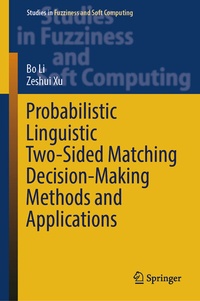
Probabilistic Linguistic Two-Sided Matching Decision-Making Methods and Applications
Description

This book tackles the intricacies of decision-making processes where alternatives stem from distinct, finite sets. Discover the cutting-edge in decision-making with our groundbreaking book on complex two-sided matching methods. Harnessing the power of probabilistic linguistic term sets, it introduces innovative methods that enhance matching efficiency and practicality.
It addresses the pressing question of how to navigate and optimize in scenarios with multifaceted matching challenges, offering an exploration into the psychological perceptions of agents through consistency checks and pairwise comparisons. It delves into the unknowns of static matching with multiple attribute weights, extends its scope to multi-sided agent sets in complex matching, and introduces dynamic screening mechanisms to refine the matching process.
This book is not just a theoretical exploration. It lays the groundwork for intelligent matching algorithms and group mechanisms, providing actionable insights for technical supply and demand allocation, emergency personnel dispatch, and multi-stage medical management scheme selection. The effectiveness of these methods is backed by comparative analyses and simulation experiments, proving their superiority in real-world applications.
Embrace the future of decision-making with our book, a must-read for those seeking to master complex matching scenarios and unlock practical solutions.
More details
Other editions
Additional editions
Persons
Li Bo received the Ph.D. degree in management science and engineering from Sichuan University, Chengdu, China, in 2021. Her research directions include probabilistic preference theory, uncertainty decision-making theory and method, and two-sided matching. Her studies are published in Expert Systems with Applications, Journal of the Operational Research Society, and Applied Soft Computing, etc.
Zeshui Xu received the Ph.D. degree in management science and engineering from Southeast University, Nanjing, China, in 2003. He is Member of AE, EASA, IASCYS, Distinguished Fellow of IETI; Fellow of IEEE, IFSA, IET, BCS, RSA, ORS, IAAM, VEBLEO, AAIA, Distinguished Young Scholar of NSFC, and the Chang Jiang Scholar of the Ministry of Education of China. He ranked 169h among World's Top 100,000 Scientists in 2021 and has been selected as Highly Cited Researchers in both Computer Science and Engineering from 2014-2021. His papers have been cited over 75000 times with the H-index 140. Prof. Xu is Associate Editor of IEEE Transactions on Fuzzy Systems, Information Sciences, Fuzzy Optimization and Decision Making, Journal of the Operational Research Society, etc.
Content
1 Introductio.- 2. Literature review.- 3. Probabilistic linguistic static two-sided matching method based on pairwise compared preference relationship.- 4. Multi-stage probabilistic linguistic matching method based on improved preference relationship consistency algorithm.- 5. Probabilistic linguistic two-sided matching with attribute weights complete unknown.
