

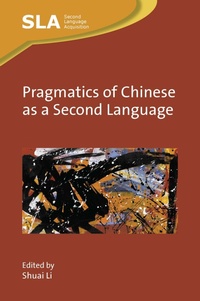
Pragmatics of Chinese as a Second Language
Published on 14. November 2023
376 pages
978-1-80041-022-0 (ISBN)
Description

This book brings together a collection of high-quality empirical studies which examine multiple aspects involved in the acquisition, teaching and assessment of pragmatics in Chinese as a second language (L2). The studies collectively address some of the most cutting-edge issues in the field of L2 pragmatics, such as the acquisition of key pragmatic features, methodological innovations in pragmatics assessment, individual difference factors and virtual learning contexts. The majority of the chapters include detailed descriptions of the instruments used and additional material in the appendices, making it a truly valuable collection for researchers and students alike. Furthermore, the publication includes the most comprehensive, state-of-the-art review of empirical research in L2 Chinese pragmatics published bilingually (in English and Chinese) between 1995 and 2022, along with a supplemental annotated bibliography. While the empirical studies all focus on Chinese as the target language, the issues they address have implications for L2 pragmatics research in general and this book will appeal to those interested in the latest developments in the field.
Reviews / Votes
Shuai Li has made a major contribution to the field with this landmark volume, compiling cutting-edge empirical studies on learning and teaching Chinese pragmatics. The chapters deal with wide-ranging pragmatic features in Chinese, including speech acts, sentence final particles, routines, gratitude expressions and implicature. This book is an exceptional model for further inquiry into pragmatics specific to individual languages. * Naoko Taguchi, Northern Arizona University, USA * Bringing together preeminent scholars in L2 pragmatics, this volume offers innovative empirical studies, as well as a comprehensive state-of-the-art review and a helpful annotated bibliography. This timely and cutting-edge book is an indispensable resource not only for those researching Chinese, but also for researchers in L2 pragmatics more generally. * Rachel L. Shively, Illinois State University, USA * Due to the rapid growth of China's economic and political status, there has been mounting interest in the acquisition of the Chinese language. An important aspect of this acquisition is L2 Chinese pragmatics. This edited volume is the outcome of a timely endeavor made by Shuai Li, a renowned L2 pragmatics researcher, to bring to light the acquisition, instruction, and assessment of L2 Chinese pragmatics. * Zia Tajeddin, Tarbiat Modares University, Iran *More details
Series
Language
English
Place of publication
Bristol
United Kingdom
Target group
College/higher education
Professional and scholarly
Product notice
Reflowable
File size
10,09 MB
ISBN-13
978-1-80041-022-0 (9781800410220)
Copyright in bibliographic data and cover images is held by Nielsen Book Services Limited or by the publishers or by their respective licensors: all rights reserved.
Schweitzer Classification
Other editions
Additional editions
Book
11/2023
Multilingual Matters
€185.90
Shipment within 10-20 days
Person
Shuai Li is Associate Professor of Chinese, Director of Undergraduate Studies and Chinese Program Coordinator in the Department of World Languages and Cultures at Georgia State University, USA. His research interests include the acquisition of L2 Chinese and interlanguage pragmatics. During 2022 and 2023, he served as the President of the Chinese Language Teachers Association, USA.
Content
Contributors
Acknowledgments
Shuai Li: Introduction
Chapter 1. Shuai Li, Ting Wen and Yali Feng: Research on L2 Chinese Pragmatics (1995-2022): A State-of-the-Art Review
Part 1: Acquisition of Key Pragmatic Features
Chapter 2. Wenhao Diao and Chen Chen: 'Softening the Tone?': A Corpus-Based Study of the Utterance-Final Pragmatic Particle BA (?) between L1 and L2 Chinese Speakers
Chapter 3. Li Jin: L2 Chinese Internet Slang Learning: Chinese as a Foreign Language Learners' Knowledge and Motivation
Chapter 4. Mo Chen, Wenxin Zhang, Yazhuo Qiu and Chunyin Li: Effects of Proficiency and Situation Type on the Production of L2 Chinese Request Strategies by Japanese Learners
Part 2: Methodological Innovations for Pragmatics Assessment
Chapter 5. Tianyu (Sophie) Qin: Using a Slide Ruler to Assess Accuracy and Certainty in L2 Chinese Implicature Comprehension
Chapter 6. Qiong Li: An Exploratory Study on a Natural Language Processing Approach to Evaluating L2 Pragmatic Performance
Chapter 7. Shuai Li: Using the Rasch Model to Evaluate Instrument and Data Quality in Assessing Requests in L2 Chinese
Part 3: Individual Difference Factors in Pragmatics Acquisition
Chapter 8. Yunwen Su and Xiao Hu: Proficiency, Motivation and Production of Conventional Expressions in L2 Chinese
Chapter 9. Jia Yang: Learning Strategies for Pragmatic Routines by Learners of L2 Chinese
Part 4: Web-Based Approaches to Teaching and Learning Pragmatics
Chapter 10. Li Yang: Effects of Website-Delivered Instruction on Development of Pragmatic Awareness in L2 Chinese
Chapter 11. Xiaofei Tang: Is a Game More Appealing than an Online Lesson for L2 Pragmatics Learning?
Yali Feng and Shuai Li: Appendix: An Annotated Bibliography of Empirical Studies on L2 Chinese Pragmatics (1995-2022)
Index
Acknowledgments
Shuai Li: Introduction
Chapter 1. Shuai Li, Ting Wen and Yali Feng: Research on L2 Chinese Pragmatics (1995-2022): A State-of-the-Art Review
Part 1: Acquisition of Key Pragmatic Features
Chapter 2. Wenhao Diao and Chen Chen: 'Softening the Tone?': A Corpus-Based Study of the Utterance-Final Pragmatic Particle BA (?) between L1 and L2 Chinese Speakers
Chapter 3. Li Jin: L2 Chinese Internet Slang Learning: Chinese as a Foreign Language Learners' Knowledge and Motivation
Chapter 4. Mo Chen, Wenxin Zhang, Yazhuo Qiu and Chunyin Li: Effects of Proficiency and Situation Type on the Production of L2 Chinese Request Strategies by Japanese Learners
Part 2: Methodological Innovations for Pragmatics Assessment
Chapter 5. Tianyu (Sophie) Qin: Using a Slide Ruler to Assess Accuracy and Certainty in L2 Chinese Implicature Comprehension
Chapter 6. Qiong Li: An Exploratory Study on a Natural Language Processing Approach to Evaluating L2 Pragmatic Performance
Chapter 7. Shuai Li: Using the Rasch Model to Evaluate Instrument and Data Quality in Assessing Requests in L2 Chinese
Part 3: Individual Difference Factors in Pragmatics Acquisition
Chapter 8. Yunwen Su and Xiao Hu: Proficiency, Motivation and Production of Conventional Expressions in L2 Chinese
Chapter 9. Jia Yang: Learning Strategies for Pragmatic Routines by Learners of L2 Chinese
Part 4: Web-Based Approaches to Teaching and Learning Pragmatics
Chapter 10. Li Yang: Effects of Website-Delivered Instruction on Development of Pragmatic Awareness in L2 Chinese
Chapter 11. Xiaofei Tang: Is a Game More Appealing than an Online Lesson for L2 Pragmatics Learning?
Yali Feng and Shuai Li: Appendix: An Annotated Bibliography of Empirical Studies on L2 Chinese Pragmatics (1995-2022)
Index
