

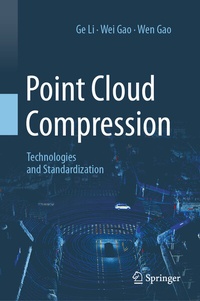
Point Cloud Compression
Description

3D point clouds have broad applications across various industries and have contributed to advancements in fields such as autonomous driving, immersive media, metaverse, and cultural heritage protection. With the fast growth of 3D point cloud data and its applications, the need for efficient compression technologies has become paramount. This book delves into the forefront of point cloud compression, exploring key technologies, standardization efforts, and future prospects.
This comprehensive book uncovers the foundational concepts, data acquisition methods, and datasets associated with point cloud compression. By examining the fundamental compression technologies, readers can obtain a clear understanding of prediction coding, transform coding, quantization techniques, and entropy coding. Through vivid illustrations and examples, the book elucidates how these techniques have evolved over the years and their potentials for the future. To provide a complete picture, the book presents cutting-edge research methods in point cloud compression and facilitates comparisons among them. Readers can be equipped with an in-depth understanding of the latest advancements, and can gain insights into the various approaches employed in this dynamic field.
Another distinguishing aspect of this book is its exploration of standardization works for point cloud compression. Notable standards, such as MPEG G-PCC, AVS PCC, and MPEG V-PCC, are thoroughly illustrated. By delving into the methods used in geometry-based, video-based, and deep learning-based compression, readers become familiar with the latest breakthroughs in the standard communities.
More details
Other editions
Additional editions
Persons
Dr. Ge Li is a professor at the School of Electronic and Computer Engineering, Peking University, Shenzhen, China. He chairs the standardization of point cloud compression in the Audio Video Coding Standard (AVS) working group in China. His research interests include point cloud compression and its standardization, image/video processing and analysis, machine learning, and signal processing.
Dr. Wei Gao is an assistant professor at the School of Electronic and Computer Engineering, Peking University, Shenzhen, China. His research interests include point cloud compression and processing, video coding and processing, deep learning, and artificial intelligence. Dr. Gao actively participates in standardization activities for multimedia compression, and leads the development of the open-source project for point cloud technologies, namely OpenPointCloud. He is a senior member of IEEE.
Dr. Wen Gao is a professor at the School of Computer Science andthe Director of the National Engineering Research Center of Visual Technology, Peking University, Beijing, China. He is also the Director of Peng Cheng Laboratory, Shenzhen, China. His research encompasses multimedia and computer vision, focusing on areas such as video coding, video analysis, multimedia retrieval, face recognition, and multimodal interface. He is a fellow of IEEE, a fellow of ACM, and a member of Chinese Academy of Engineering.
Content
.- Chapter1. Introduction.
.- Chapter 2. Background Knowledge.
.- Chapter 3. Predictive Coding.
.- Chapter 4. Transform Coding.
.- Chapter 5. Quantization Techniques.
.- Chapter 6. Entropy Coding.
.- Chapter 7. MPEG Geometry-based Point Cloud Compression (G-PCC) Standard.
.- Chapter 8. AVS Point Cloud Compression Standard.
.- Chapter 9. MPEG Video-based Point Cloud Compression (V-PCC) Standard.
.- Chapter 10. MPEG AI-based 3D Graphics Coding Standard.
.- Chapter 11. Future Work.
.- Index.
