

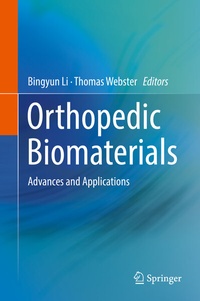
Orthopedic Biomaterials
Description

This book covers the latest advances, applications, and challenges in orthopedic biomaterials. Topics covered include materials for orthopedic applications, including nanomaterials, biomimetic materials, calcium phosphates, polymers, biodegradable metals, bone grafts/implants, and biomaterial-mediated drug delivery. Absorbable orthopedic biomaterials and challenges related to orthopedic biomaterials are covered in detail. This is an ideal book for graduate and undergraduate students, researchers, and professionals working with orthopedic biomaterials and tissue engineering.
This book also:
Describes biodegradable metals for orthopedic applications, such as Zn-based medical implants
Thoroughly covers various materials for orthopedic applications, including absorbable orthopedic biomaterials with a focus on polymers
Details the state-of-the-art research on orthopedic nanomaterials and nanotechnology
More details
Other editions
Additional editions
Persons
Bingyun Li is a full Professor with tenure at School of Medicine West Virginia University. He is a member of the Society for Biomaterials (SFB), Orthopedic Research Society (ORS), American Society for Microbiology (ASM), Materials Research Society (MRS), American Chemical Society (ACS), International Chinese Musculoskeletal Research Society (ICMRS), and Chinese Association for Biomaterials (CAB). Professor Li has served as topic chair of Infection and Inflammation of the ORS Program Committee, vice-chair and chair of Orthopedic Biomaterials Special Interest Group of SFB, Chief Editor of ICMRS Newsletter, and inaugural treasurer of CAB. Professor Li's research focuses on advanced materials, nanomedicine, infection, immunology, and drug delivery. He has supervised 84 trainees, and his lab group has published more than 76 peer-reviewed articles, nine book chapters, 12 provisional/full patents, and 122 abstracts. Professor Li has given 48 invited talks and has received multiple prestigious awards including the Berton Rahn Prize from AO Foundation, the Pfizer Best Scientific Paper Award from Asia Pacific Orthopedic Association, and the Collaborative Exchange Award from Orthopedic Research Society.
Thomas Webster is the Chemical Engineering Department Chair and Art Zafiropoulo Endowed Chair at Northeastern University. Prof. Webster has graduated 144 students. His lab group published 9 textbooks, 48 book chapters, 403 articles, and 32 provisional/full patents. Prof. Webster has received numerous honors: 2012, Fellow, American Institute for Medical and Biological Engineering; 2013, Fellow, Biomedical Engineering Society; 2015, Wenzhou 580 Award; 2015, Zheijang 1000 Talent Program; 2016, IMRC Chinese Academy of Science Lee-Hsun Lecture Award; 2016, Fellow, Biomaterials Science and Engineering; and 2016, Acta Biomaterialia Silver Award. He also frequently appears on the BBC, NBC, ABC, Fox, National Geographic, Discovery Channel and many other news outlets talking about science. Prof. Webster was also recently inducted as a Fellow into the National Academy of Inventors based on the formation of 11 companies with 4 FDA approved products in orthopedics.
