

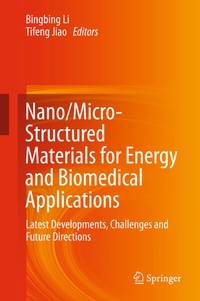
Nano/Micro-Structured Materials for Energy and Biomedical Applications
Description

This book discusses the latest developments of the synthesis, preparation, characterization, and applications of nano/microstructure-based materials in biomedical and energetic fields. It introduces several popular approaches to fabricating these materials, including template-assisted fabrication, electrospinning of organic/inorganic hybrid materials, biomineralization-mediated self-assembly, etc. The latest results in material evaluation for targeted applications are also presented. In particular, the book highlights the latest advances and future challenges in polymer nanodielectrics for energy storage applications. As such, it offers a valuable reference guide for scholars interested in the synthesis and evaluation of nano/microstructure-based materials, as well as their biomedical and energetic applications. It also provides essential insights for graduate students and scientists pursuing research in the broad fields of composite materials, polymers, organic/inorganic hybrid materials, nano-assembly, etc.
More details
Other editions
Additional editions
Persons
Prof Bingbing Li is an Associate Professor at the Department of Chemistry and Biochemistry, Central Michigan University. She received her BS degree in Chemistry from Beijing Normal University in 1998 and her PhD in Chemistry from Virginia Polytechnic Institute and State University in 2007. Prof Li's current research chiefly focuses on the novel design of hierarchically structured polymer materials with an emphasis on the design principle and the fundamental physical chemistry of polymer-based materials, as well as property optimization and the biomedical and environmental applications of these materials. Prof Li is an expert on integrating macromolecular research and macromolecular science and engineering education. She has authored or co-authored more than 40 publications. She has also served as an editorial board member for Scientific Reports (Nature Publishing Group), an active reviewer for journals published by the American Chemical Society, Royal Society of Chemistry, Wiley, and Springer, and as a panel reviewer for the National Science Foundation.
Dr Tifeng Jiao is a Professor and Vice Director of the School of Environmental and Chemical Engineering, Yanshan University. He received his PhD in Physical Chemistry from the Chinese Academy of Sciences in 2006. Afterwards, he worked at the Université Claude Bernard Lyon 1 (France) as a Postdoctoral Associate of the CNRS (Centre National de la Recherche Scientifique). His current research interests focus on the preparation, assembly and applications of nanomaterials and nanocomposites. He has published 130 papers in academic journals, including more than 100 SCI-indexed papers. He is a member of the Chinese Chemical Society (CCS) and American Chemical Society (ACS) and is an active peer reviewer for more than 20 journals, such as Nanoscale, Nano Research, JACS, JMCA, Langmuir, The Journal of Physical Chemistry B, Journal of Nanoscience and Nanotechnology, Colloids and Surfaces A: Physicochemical andEngineering Aspects, etc.
Content
Polymer Nanodielectrics: Current Accomplishments and Future Challenges for Electric Energy Storage.- Magnetoelectric effect in single phase multiferroic materials.- Recent Advances in Electrospun Poly(e-caprolactone)-Based Materials and their Biomedical Applications.- Biomorphic mineralization Mediated Self-Assembly Nanomaterial and Activity Study.- Polymer Nanostructures Using Nanoporous Templates.- Peptide-Based Hydrogels/Organogels: Assembly and Application.- Self-Assembled Graphene/Graphene Oxide-Based Nanocomposites toward Photodynamic Therapy Applications.- Nanostructured Materials in Tissue Engineering.
