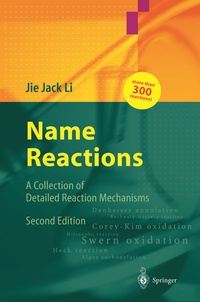
Name Reactions
Description

Reviews / Votes
from S.R. Waldvogel, Adv. Synth. Catal. 2004, 346, 91:
"Since the second edition has increased tremendously in quality, it is highly recommended to all synthetically oriented chemists as compulsory reading. With a relativele comprehensive collection of modern named reactions, including more recent discoveries that are not found in standard works, this book surpasses previous monographs on this topic and should find its way into every good scientific library."
The best books are very reader friendly and this publication is heading in that direction. Organic chemistry researchers, students and teachers will make good use of this book.
Helmut Huegel, FRACI, RMIT University
Chemistry in Australia, Magazine of the Royal Australian Chemical Institute, April 2004
From the reviews of the third edition:
"Like its predecessors, this edition of Name Reactions covers over 300 classical and contemporary name reactions, with each entry including the name of the reaction, a short description of it, the step-by-step mechanism, and a list of references. Improvements to this edition include updated references, two to three examples of applications of the featured reaction . brief biographical sketches of the discoverers and developers of the reaction in question, and an expanded subject index." (JACS, Vol. 129 (2), 2007)
"Name Reactions . has been expanded significantly as compared to the Second Edition. The book contains a multitude of new name reactions and, as a new feature, reaction examples from the current literature. Each name reaction is illustrated with a reaction scheme, an accurate and detailed mechanism, and two interesting examples from current work. In addition, numerous up-to-date citations are provided that can facilitate an initial literature search. . 'Name Reactions' is an especially useful book for obtaining a first introduction to a multitude of important and also current name reactions.Moreover, the mechanistic explanations in the form of excellent schemes provide a basis for advanced students to practice these mechanisms. A number of errors from the Second Edition have been corrected, and this fact together with the successful enhancements make a good case for purchasing this latest edition." (www.organic.chemistry.org, March, 2007)
More details
Other editions
New editions
Additional editions
Previous edition