

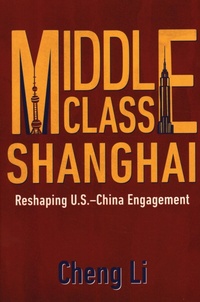
Middle Class Shanghai
Reshaping U.S.-China Engagement
1st Edition
Published on 11. May 2021
484 pages
978-0-8157-4319-4 (ISBN)
Description

The United States may be headed toward a disastrous conflict with China unless Washington updates its understanding of contemporary Chinese society
After four decades of engagement, the United States and China now appear to be locked on a collision course that has already fomented a trade war, seems likely to produce a new cold war, and could even result in dangerous military conflict. The current deterioration of the bilateral relationship is the culmination of years of disputes, disillusionment, disappointment, and distrust between the two countries. Washington has legitimate concerns about Beijing's excessive domestic political control and aggressive foreign policy stances, just as Chinese leaders believe the United States still has futile designs on blocking their country's inevitable rise to great-power status.
Cheng Li's Middle Class Shanghai argues that American policymakers must not lose sight of the expansive dynamism and diversity in present-day China. The caricature of the PRC as a monolithic Communist apparatus set on exporting its ideology and development model is simplistic and misguided. Drawing on empirical research in the realms of higher education, avant-garde art, architecture, and law, this unique study highlights the strong, constructive impact of bilateral exchanges.
Combining eclectic human stories with striking new data analysis, this book addresses the possibility that the development of China's class structure and cosmopolitan culture¿exemplified and led by Shanghai¿could provide a force for reshaping U.S.-China engagement. Both countries should build upon the deep cultural and educational exchanges that have bound them together for decades. The author concludes that U.S. policymakers should neither underestimate the role and strength of the Chinese middle class, nor ostracize or alienate this force with policies that push it toward jingoistic nationalism to the detriment of both countries and the global community.
With its unique focus, this book will enlighten policymakers, scholars, business leaders, and anyone interested in China and its increasingly fraught relations with the United States.
After four decades of engagement, the United States and China now appear to be locked on a collision course that has already fomented a trade war, seems likely to produce a new cold war, and could even result in dangerous military conflict. The current deterioration of the bilateral relationship is the culmination of years of disputes, disillusionment, disappointment, and distrust between the two countries. Washington has legitimate concerns about Beijing's excessive domestic political control and aggressive foreign policy stances, just as Chinese leaders believe the United States still has futile designs on blocking their country's inevitable rise to great-power status.
Cheng Li's Middle Class Shanghai argues that American policymakers must not lose sight of the expansive dynamism and diversity in present-day China. The caricature of the PRC as a monolithic Communist apparatus set on exporting its ideology and development model is simplistic and misguided. Drawing on empirical research in the realms of higher education, avant-garde art, architecture, and law, this unique study highlights the strong, constructive impact of bilateral exchanges.
Combining eclectic human stories with striking new data analysis, this book addresses the possibility that the development of China's class structure and cosmopolitan culture¿exemplified and led by Shanghai¿could provide a force for reshaping U.S.-China engagement. Both countries should build upon the deep cultural and educational exchanges that have bound them together for decades. The author concludes that U.S. policymakers should neither underestimate the role and strength of the Chinese middle class, nor ostracize or alienate this force with policies that push it toward jingoistic nationalism to the detriment of both countries and the global community.
With its unique focus, this book will enlighten policymakers, scholars, business leaders, and anyone interested in China and its increasingly fraught relations with the United States.
More details
Other editions
Additional editions
Book
05/2021
Brookings Institution
€42.50
Shipment within 10-20 days
Person
Cheng Li is director and a senior fellow at the Brookings Institution's John L. Thornton China Center. He is also a director of the National Committee on U.S.-China Relations. His previous books include Chinese Politics in the Xi Jinping Era: Reassessing Collective Leadership and Bridging Minds Across the Pacific: The Sino-US Educational Exchange. He is the principal editor of the Thornton Center Chinese Thinkers Series published by the Brookings Institution Press.
Content
Contents:
List of Figures and Tables
Abbreviations
Acknowledgments
Prologue: Rethinking Global Integration at a Time of Destructive Confrontation
I. Introduction
1. Shanghai's Middle Class and China's Future Trajectory
II. The Rise of Middle-Class China: Issues and Debates
2. A Failure of U.S.-China Engagement? Policy Debates in Washington and Beijing
3. Social Stratification and Cultural Pluralism in Reform-Era China: Scholarly Debates
III. Shanghai: the Pacesetter in China's Search for Global Power
4. Haipai: Shanghai Exceptionalism and Cultural Transnationalism
5. The "Magic Capital" and the "Head of the Dragon": The Birth of China's Manhattan
6. From Jiang to Xi: The Enduring Power and Influence of the "Shanghai Gang"
IV. Education and Art in Global Shanghai: Views, Values, and Voices
7. "Sea Turtles": The Study Abroad Movement and the Tidal Wave of Returnees
8. The Impact of Educational Exchanges: Returnees in Shanghai
9. Attitudes and Values: A Longitudinal Survey of Foreign-Educated Elites in Shanghai
10. Western Influence and Illusion: Shanghai's Booming Contemporary Art Scene
11. Dialoguing with the West: Critiques of Globalization by Shanghai's Avant-Garde Artists
V. Conclusion and Recommendations
12. Toward a Dynamic and Diverse Society: Implications for China and the United States
Notes
Bibliography (English)
Bibliography (Chinese)
Index
Artwork plates follow page 294.
List of Figures and Tables
Abbreviations
Acknowledgments
Prologue: Rethinking Global Integration at a Time of Destructive Confrontation
I. Introduction
1. Shanghai's Middle Class and China's Future Trajectory
II. The Rise of Middle-Class China: Issues and Debates
2. A Failure of U.S.-China Engagement? Policy Debates in Washington and Beijing
3. Social Stratification and Cultural Pluralism in Reform-Era China: Scholarly Debates
III. Shanghai: the Pacesetter in China's Search for Global Power
4. Haipai: Shanghai Exceptionalism and Cultural Transnationalism
5. The "Magic Capital" and the "Head of the Dragon": The Birth of China's Manhattan
6. From Jiang to Xi: The Enduring Power and Influence of the "Shanghai Gang"
IV. Education and Art in Global Shanghai: Views, Values, and Voices
7. "Sea Turtles": The Study Abroad Movement and the Tidal Wave of Returnees
8. The Impact of Educational Exchanges: Returnees in Shanghai
9. Attitudes and Values: A Longitudinal Survey of Foreign-Educated Elites in Shanghai
10. Western Influence and Illusion: Shanghai's Booming Contemporary Art Scene
11. Dialoguing with the West: Critiques of Globalization by Shanghai's Avant-Garde Artists
V. Conclusion and Recommendations
12. Toward a Dynamic and Diverse Society: Implications for China and the United States
Notes
Bibliography (English)
Bibliography (Chinese)
Index
Artwork plates follow page 294.
