

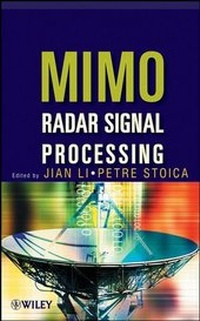
MIMO Radar Signal Processing
Description

More details
Other editions
Additional editions
Persons
Content
CONTRIBUTORS.
1 MIMO Radar - Diversity Means Superiority (Jian Li and Petre Stoica).
1.1 Introduction.
1.2 Problem Formulation.
1.3 Parameter Identifiability.
1.4 Nonparametric Adaptive Techniques for Parameter Estimation.
1.5 Parametric Techniques for Parameter Estimation.
1.6 Transmit Beampattern Designs.
1.7 Conclusions.
Appendix IA Generalized Likelihood Ratio Test.
Appendix 1B Lemma and Proof.
Acknowledgments.
References.
2 MIMO Radar: Concepts, Performance Enhancements, and Applications (Keith W. Forsythe and Daniel W. Bliss).
2.1 Introduction.
2.2 Notation.
2.3 MIMO Radar Virtual Aperture.
2.4 MIMO Radar in Clutter-Free Environments.
2.5 Optimality of MIMO Radar for Detection.
2.6 MIMO Radar with Moving Targets in Clutter: GMTI Radars.
2.7 Summary.
Appendix 2A A Localization Principle.
Appendix 2B Bounds on R(N).
Appendix 2C An Operator Norm Inequality.
Appendix 2D Negligible Terms.
Appendix 2E Bound on Eigenvalues.
Appendix 2F Some Inner Products.
Appendix 2G An Invariant Inner Product.
Appendix 2H Krönecker and Tensor Products.
Acknowledgments.
References.
3 Generalized MIMO Radar Ambiguity Functions (Geoffrey San Antonio, Daniel R. Fuhrmann, and Frank C. Robey).
3.1 Introduction.
3.2 Background.
3.3 MIMO Signal Model.
3.4 MIMO Parametric Channel Model.
3.5 MIMO Ambiguity Function.
3.6 Results and Examples.
3.7 Conclusion.
References.
4 Performance Bounds and Techniques for Target Localization Using MIMO Radars (Joseph Tabrikian).
4.1 Introduction.
4.2 Problem Formulation.
4.3 Properties.
4.4 Target Localization.
4.5 Performance Lower Bound for Target Localization.
4.6 Simulation Results.
4.7 Discussion and Conclusions.
Appendix 4A Log-Likelihood Derivation.
Appendix 4B Transmit-Receive Pattern Derivation.
Appendix 4C Fisher Information Matrix Derivation.
References.
5 Adaptive Signal Design For MIMO Radars (Benjamin Friedlander).
5.1 Introduction.
5.2 Problem Formulation.
5.3 Estimation.
5.4 Detection.
5.5 MIMO Radar and Phased Arrays.
Appendix 5A Theoretical SINR Calculation.
References.
6 MIMO Radar Spacetime Adaptive Processing and Signal Design (Chun-Yang Chen and P. P. Vaidyanathan).
6.1 Introduction.
6.2 The Virtual Array Concept.
6.3 Spacetime Adaptive Processing in MIMO Radar.
6.4 Clutter Subspace in MIMO Radar.
6.5 New STAP Method for MIMO Radar.
6.6 Numerical Examples.
6.7 Signal Design of the STAP Radar System.
6.8 Conclusions.
Acknowledgments.
References.
7 Slow-Time MIMO SpaceTime Adaptive Processing (Vito F. Mecca, Dinesh Ramakrishnan, Frank C. Robey, and Jeffrey L. Krolik).
7.1 Introduction.
7.2 SIMO Radar Modeling and Processing.
7.3 Slow-Time MIMO Radar Modeling.
7.4 Slow-Time MIMO Radar Processing.
7.5 OTHr Propagation and Clutter Model.
7.6 Simulations Examples.
7.7 Conclusion.
Acknowledgment.
References.
8 MIMO as a Distributed Radar System (H. D. Griffiths, C. J. Baker, P. F. Sammartino, and M. Rangaswamy).
8.1 Introduction.
8.2 Systems.
8.3 Performance.
8.4 Conclusions.
Acknowledgment.
References.
9 Concepts and Applications of A MIMO Radar System with Widely Separated Antennas (Hana Godrich, Alexander M. Haimovich, and Rick S. Blum).
9.1 Background.
9.2 MIMO Radar Concept.
9.3 NonCoherent MIMO Radar Applications.
9.4 Coherent MIMO Radar Applications.
9.5 Chapter Summary.
Appendix 9A Deriving the FIM.
Appendix 9B Deriving the CRLB on the Location Estimate Error.
Appendix 9C MLE of Time Delays - Error Statistics.
Appendix 9D Deriving the Lowest GDOP for Special Cases.
Acknowledgments.
References.
10 SpaceTime Coding for MIMO Radar (Antonio De Maio and Marco Lops).
10.1 Introduction.
10.2 System Model.
10.3 Detection In MIMO Radars.
10.4 Spacetime Code Design.
10.5 The Interplay Between STC and Detection Performance.
10.6 Numerical Results.
10.7 Adaptive Implementation.
10.8 Conclusions.
Acknowledgment.
References.
INDEX.
