

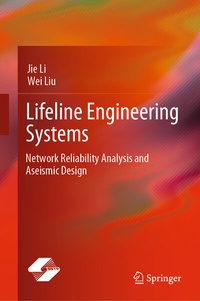
Lifeline Engineering Systems
Description

This book, for the first time, introduces comprehensively all main topics of lifeline earthquake engineering, including the structure analysis, network evaluation, and network design. The distinctive features involved in this book are the construction of theories and methods for stochastic analysis of structures based the physical idea, probability analytical algorithms for network evaluation by employing Boolean Algebra, functional evaluation of water distribution networks using hydraulic analysis, and network design methods by employing genetic, simulated annealing, and hybrid algorithms.
More details
Other editions
Additional editions
Persons
Jie Li is currently a distinguished University Professor at Tongji University in the College of Civil Engineering. He specializes in the area of earthquake engineering and stochastic mechanics of structures. Prof. Li received a Ph.D. in Civil Engineering from Tongji University, China, in 1988, and received an honorary doctorate in engineering from Aalborg University, Denmark, in 2013. He received the 2014 Alfred M. Freudenthal Medal from ASCE. Prof. Li has been one of the first groups of Cheung Kong Scholar Professors entitled by the Ministry of Education of China since 1999. He is the author of 7 monographs and is the co-author of over 400 technical publications, including over 300 peer-reviewed journal papers. Prof. Li currently serves as the President of International Association for Structural Safety and Reliability (IASSAR) and as one of board directors of International Civil Engineering Risk and Reliability Association (CERRA). He simultaneously serves as the Chairman of the Committee of Structural Computational Theory and Engineering Applications of the Architectural Society of China and the Chairman of the Random Vibration Committee of Chinese Society of Vibration Engineering. He is the Editor-in-Chief of the Journal of Tongji University (Natural Science Series) and is in the editorial boarding committee of over 10 international and Chinese academic journals, including the Probabilistic Engineering Mechanics and Structural Safety.
Wei Liu is currently an Associate Professor on the faculty at Tongji University in the School of Civil Engineering. Supervised by Prof. Jie Li, Prof. Liu received a Ph.D. in Structural Engineering from Tongji University, China, in 2007 and specializes in the area of lifeline earthquake engineering. In 2009, Prof. Liu visited Rensselaer Polytechnic Institute as a visiting scholar and worked on lifeline earthquake engineering for one year. More than 50 peer-reviewed papers he co-authored are presentlypublished. Prof. Liu received the First Prize of the Science & Technology Advance Award of Shanghai in 2013.
