

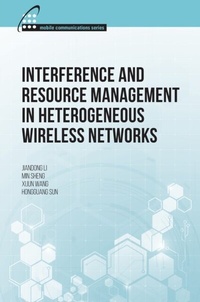
Interference and Resource Management in Heterogeneous Wireless Networks
1st Edition
Published on 1. January 2017
224 pages
978-1-63081-509-7 (ISBN)
Description

This authoritative resource offers a comprehensive overview of heterogeneous wireless networks, small cells, and device-to-device (D2D) communications. The book provides insight into network modeling and performance analysis of heterogeneous wireless networks. Interference management framework and design issues are covered as well as details about resource mobility, channel models, and typical and statistical interference modeling. This resource explains leveraging resource heterogeneity in interference mitigation and presents the challenges and feasible solutions for concurrent transmission.Moreover, complete coverage of interference alignment in MIMO heterogeneous networks for both downlink and uplink is presented. This book provides performance results for an ideal partially connected interference network as well as a practical heterogeneous network. Readers find practical guidance for LTE and LTE-Advanced as well as 5G in this resource. New techniques and designs for heterogeneous wireless networks are included.
More details
Other editions
Additional editions
Jiandong Li | Min Sheng | HongGuang Sun
Interference and Resource Management in Heterogeneous Wireless Networks
Book
11/2017
Artech House Publishers
€170.84
Shipment within 10-20 days
Content
- Interference and Resource Management in Heterogeneous Wireless Networks
- Contents
- Chapter 1 Overview of 5G Heterogeneous Wireless Networks
- 1.1 Architecture of 5G Heterogeneous Wireless Networks
- 1.2 Radio Access Networks in 5G
- 1.2.1 Traditional Cellular Architecture in the Long-Term Evolution System
- 1.2.2 Cloud RAN Architecture
- 1.2.3 Fog RAN Architecture
- 1.2.4 Cloudlet RAN Architecture
- 1.3 5G Heterogeneous Wireless Networks
- 1.3.1 Small Cell Underlaying Cellular Networks
- 1.3.1.1 Details of Small Cell Underlaying Cellular Networks
- 1.3.1.2 Challenges in Small Cell Underlaying Cellular Network from Resource Management and Interference Management Perspective
- 1.3.2 D2D Communications Underlaying Cellular Networks
- 1.3.2.1 Details of D2D Communications Underlaying Cellular Networks
- 1.3.2.2 Challenges in D2D Underlaying Cellular Network from a Resource Management and Interference Management Perspective
- REFERENCES
- Chapter 2 Network Modeling and Performance Analysis of Heterogeneous Wireless Networks
- 2.1 Multi-tier Cellular Networks: Modeling, Analysis, and Guidelines
- 2.1.1 Introduction
- 2.1.2 MHCN Model
- 2.1.3 Coverage Probability of MHCN
- 2.1.3.1 Coverage Probability of Users in Infrastructure Mode
- 2.1.3.2 Coverage Probability of Users in Ad Hoc Mode
- 2.1.4 Capacity of MHCNs
- 2.1.4.1 Average Throughput of Users in Infrastructure Mode
- 2.1.4.2 Average Throughput of Users in Ad Hoc Mode
- 2.1.4.3 The Capacity of MHCNs
- 2.1.4.4 Special Cases of Interest
- 2.1.5 Numerical Analysis and Discussions
- 2.1.6 Conclusions
- 2.2 D2D Enhanced Cellular Networks: Spectrum Sharing Schemes
- 2.2.1 Introduction
- 2.2.2 D2D Enhanced HCN
- 2.2.3 A Decoupled Cell Association Scheme
- 2.2.4 CSMA Model for D2D Transmissions
- 2.2.5 Coverage Probability
- 2.2.5.1 No D2D Transmissions
- 2.2.5.2 No Sensing for Small Cell Transmissions
- 2.2.6 Network Throughput of D2D Enhanced HCN
- 2.2.7 Validation of Network Model
- 2.2.8 Numerical Analysis and Discussion
- 2.2.9 Conclusion
- REFERENCES
- Chapter 3 Interference Management Framework and Design Issues
- 3.1 Interference Management Framework Based on Resource Mobility
- 3.1.1 Resource Mobility
- 3.1.1.1 Resource Migration Scenario
- 3.1.1.2 Resource Aggregation Scenario
- 3.1.1.3 Resource Interchange Scenario
- 3.1.2 Resource Mobility Enabled Interference Management Framework
- 3.2 Interference Modeling for Heterogeneous Wireless Networks
- 3.2.1 Channel Model
- 3.2.2 Typical Interference Models
- 3.2.3 Statistical Interference Model
- 3.2.3.1 Interference Characterization
- 3.2.3.2 Poisson Point Process
- 3.2.3.3 Important Properties of PPP
- 3.2.3.4 Application of PPP to Interference
- 3.3 Techniques for Interference Management
- 3.3.1 Interference Migration
- 3.3.2 Interference Mitigation
- 3.3.3 Interference Alignment
- 3.4 Technical Challenges in Interference Management
- REFERENCES
- Chapter 4 Interference Migration:Leveraging Resource Heterogeneity
- 4.1 Introduction
- 4.2 HetNet Model with Single RAT
- 4.2.1 Interference Distribution Model
- 4.2.2 Energy Efficiency of HetNet
- 4.3 Interference Migration Strategy
- 4.3.1 EE Maximization via Interference Migration
- 4.3.2 Interference Migration via Concurrent Transmission
- 4.4 Performance Evaluation for Single RAT
- 4.5 HetNet Model with Multiple RATs
- 4.6 EE Maximization via Concurrent Transmission
- 4.6.1 Problem Formulation
- 4.6.2 Existence of Feasible Solutions
- 4.6.3 MECT Scheme
- 4.7 Comparison of Solutions
- 4.8 Conclusions
- REFERENCES
- Chapter 5 Distributed Resource Allocation for Interference Mitigation
- 5.1 Introduction
- 5.2 Distributed Subchannel Allocation
- 5.2.1 System Model and Problem Formulation
- 5.2.2 Distributed Algorithm Design
- 5.2.2.1 Utility-Based Learning Models
- 5.2.2.2 Utility-Based Distributed Subchannel Allocation
- 5.2.2.3 Performance Analysis of UDSA
- 5.2.3 Results and Analysis
- 5.2.3.1 Simulation Scenario
- 5.2.3.2 Convergence
- 5.2.3.3 Performance Evaluation
- 5.2.3.4 A More Realistic Scenario
- 5.3 Distributed Power Control and Subchannel Allocation
- 5.3.1 System Model and Problem Formulation
- 5.3.2 Distributed Algorithm Design
- 5.3.2.1 NE for NTCG
- 5.3.2.2 Utility-Based Distributed Transmission Control Algorithm
- 5.3.2.3 Performance Analysis of UTC
- 5.3.3 Results and Analysis
- 5.3.3.1 Simulation Scenario
- 5.3.3.2 Convergence of UTC
- 5.3.3.3 Performance Comparison
- 5.4 Conclusions
- REFERENCES
- Chapter 6 Interference Alignment inMIMO Heterogeneous Networks
- 6.1 Introduction
- 6.2 Interference Alignment in Downlink Heterogeneous Networks
- 6.2.1 System Model
- 6.2.2 Two-Stage IA
- 6.2.2.1 IA Feasibility Conditions
- 6.2.2.2 Design of Two-Stage IA
- 6.2.2.3 One Macro User or Multiple Macro Users?
- 6.2.3 Extending to General Scenarios
- 6.2.3.1 One Macro User
- 6.2.3.2 Multiple Macro Users
- 6.2.4 Performance Results
- 6.2.4.1 Performance in an Ideal Partially Connected Interference Network
- 6.2.4.2 Performance in a Practical HetNet
- 6.3 Interference Alignment in Uplink Heterogeneous Networks
- 6.3.1 System Model
- 6.3.2 IAC Scheme
- 6.3.2.1 Construct Directed Conflict Graph
- 6.3.2.2 Design of IAC Scheme
- 6.3.2.3 Precoding Vector Design
- 6.3.2.4 Feasibility of the IAC Scheme
- 6.3.3 Determining the Optimal IAC Scheme
- 6.3.4 Performance Evaluation
- 6.4 Conclusions
- REFERENCES
- About the Authors
- Index
