

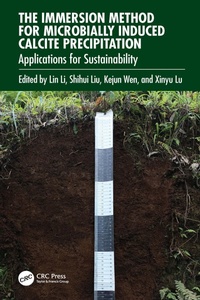
The Immersion Method for Microbially Induced Calcite Precipitation:
Applications for Sustainability
1st Edition
Published on 28. July 2025
308 pages
978-1-040-37862-5 (ISBN)
Description

The Immersion Method for Microbially Induced Calcite Precipitation: Applications for Sustainability comprehensively explores the synergy between microbiology and engineering, focusing on MICP and its applications in material improvement and environmental remediation. Highlighting the immersion method, the book elucidates MICP's ability to enhance mechanical properties uniformly throughout treated materials, offering a sustainable alternative for various engineering challenges. Emphasizing its applications in civil engineering and environmental management, the book showcases MICP's efficacy in ground improvement, crack repair, and soil stabilization, alongside its potential for mitigating environmental contamination.
Examines the potential to create environmentally sustainable and resilient construction materials.
Discusses various applications of MICP across critical areas of civil engineering and environmental management, including ground improvement, crack repair, and remediation of contaminated environments.
Provides a detailed examination of MICP-treated materials' long-term durability and performance under various environmental conditions.
Examines the potential to create environmentally sustainable and resilient construction materials.
Discusses various applications of MICP across critical areas of civil engineering and environmental management, including ground improvement, crack repair, and remediation of contaminated environments.
Provides a detailed examination of MICP-treated materials' long-term durability and performance under various environmental conditions.
More details
Edition
1. Auflage
Language
English
Place of publication
London
United Kingdom
Publishing group
Taylor & Francis Ltd
Target group
Professional and scholarly
Illustrations
60 Tables, black and white; 252 Line drawings, black and white; 125 Halftones, black and white; 377 Illustrations, black and white
File size
35,01 MB
ISBN-13
978-1-040-37862-5 (9781040378625)
Copyright in bibliographic data and cover images is held by Nielsen Book Services Limited or by the publishers or by their respective licensors: all rights reserved.
Schweitzer Classification
Other editions
Additional editions
Lin Li | Shihui Liu | Kejun Wen
The Immersion Method for Microbially Induced Calcite Precipitation:
Applications for Sustainability
Book
07/2025
1st Edition
CRC Press
€157.20
Shipment within 10-20 days
Persons
Dr. Lin Li is Professor in the Department of Civil and Architectural Engineering at Tennessee State University (TSU). He is serving as Dean of the College of Engineering at TSU. Dr. Li received his PhD in Civil Engineering from the University of Wisconsin-Madison. He is a PE in three states and a Fellow of ASCE. He teaches geotechnical engineering courses, including foundation engineering, unsaturated soil mechanics, geoenvironmental engineering, advanced soil mechanics, and soil dynamics. His expertise is in innovative levee testing and protection, bio-mediated ground improvement, sustainable infrastructure, and geo-environmental area. He is recognized as a leading expert in the research field. He chairs and speaks at international conferences on those subjects and has published 5 books and book chapters and over 150 heavily cited referred journal papers. He has served as the principal investigator or co-principal investigator on over 30 sponsored research projects representing well over $11.5 Million from National Science Foundation, Department of Homeland Security, US Army Corps of Engineer, US Department of Transportation, US Department of Housing and Urban Development, Tennessee DOT, Mississippi DOT, Recycled Materials Resource Center under Federal Highway Administration, Institute for Multimodal Transportation under Federal Transit Administration.
Dr. Shihui Liu is Assistant Professor in the Department of Civil and Architectural Engineering at Tennessee State University. Dr. Liu holds a Ph.D. in Civil Engineering from Jackson State University and completed her postdoctoral research at Tennessee State University. Her research interests are ground improvement, sandy soil remediation, and bio-inspired and smart construction materials and development. Dr. Shihui Liu is an accomplished educator and researcher. With a passion for advancing knowledge and a commitment to academic excellence, Dr. Liu has made significant contributions to the field of innovative building and construction materials. Dr. Liu won three research grants during her first academic year at Tennessee State University.
Dr. Kejun Wen, serving as an Assistant Professor within the Department of Civil and Environmental Engineering at JSU, is a dedicated educator and accomplished researcher. Holding a Ph.D. in Civil Engineering from Jackson State University, Dr. Wen also holds a professional engineering license in the state of Texas. In her role, Dr. Wen imparts knowledge across a spectrum of civil engineering courses, catering to both undergraduate and graduate students. Her expertise spans topics ranging from foundational Engineering Mechanics to specialized areas such as Strength of Materials, Introduction to Geotechnical Engineering, and Introduction to Transportation Engineering. With a comprehensive curriculum that includes Water Resource Engineering, Foundation Engineering, Advanced Foundation Engineering, and Traffic Engineering. Dr. Wen boasts over a decade of research experience, particularly in the development of innovative bio-inspired construction materials and nature-based solutions for ground improvement.
Xinyu Lu is a research associate in the Department of Civil and Architectural Engineering at Tennessee State University (TSU). She received her graduate degree in civil engineering at TSU. She previously earned a Master of Science in Resource and Environmental Engineering and a Bachelor of Science in Engineering Management from Chongqing University of Science and Technology (CQUST), China. Her research interests include sustainable construction materials, bio-mediated ground improvement, and the recycling of agricultural and industrial waste. She is particularly focused on developing sustainable innovative materials such as hempcrete and microbial-induced carbonate precipitation (MICP) bio-bricks. Her expertise lies in blending biotechnology with civil engineering to promote sustainable construction practices, reduce carbon emissions, and enhance soil stability. Xinyu Lu is the author or co-author of 8 peer-reviewed published articles with total citation of 148, and 5 articles are under review. She has published extensively on topics such as rubberized concrete, recycled aggregate concrete, and bio-mediated soil improvement. She has also contributed to practical advancements, holding six invention patents related to sustainable construction technologies. Her academic excellence is reflected in her numerous awards, including the prestigious China National Scholarship (Top 0.2%) for both undergraduate and graduate studies, and the Academic First-Class Scholarship (awarded four times, Top 1%). She also graduated with the highest honors from CQUST. Beyond her academic achievements, Xinyu actively contributes to the scholarly community as a peer reviewer for renowned journals, including Environmental Science and Pollution Research and Geomicrobiology Journal. She has participated in several high-impact workshops and symposia, fostering collaborations and advancing research in sustainable civil engineering.
Dr. Shihui Liu is Assistant Professor in the Department of Civil and Architectural Engineering at Tennessee State University. Dr. Liu holds a Ph.D. in Civil Engineering from Jackson State University and completed her postdoctoral research at Tennessee State University. Her research interests are ground improvement, sandy soil remediation, and bio-inspired and smart construction materials and development. Dr. Shihui Liu is an accomplished educator and researcher. With a passion for advancing knowledge and a commitment to academic excellence, Dr. Liu has made significant contributions to the field of innovative building and construction materials. Dr. Liu won three research grants during her first academic year at Tennessee State University.
Dr. Kejun Wen, serving as an Assistant Professor within the Department of Civil and Environmental Engineering at JSU, is a dedicated educator and accomplished researcher. Holding a Ph.D. in Civil Engineering from Jackson State University, Dr. Wen also holds a professional engineering license in the state of Texas. In her role, Dr. Wen imparts knowledge across a spectrum of civil engineering courses, catering to both undergraduate and graduate students. Her expertise spans topics ranging from foundational Engineering Mechanics to specialized areas such as Strength of Materials, Introduction to Geotechnical Engineering, and Introduction to Transportation Engineering. With a comprehensive curriculum that includes Water Resource Engineering, Foundation Engineering, Advanced Foundation Engineering, and Traffic Engineering. Dr. Wen boasts over a decade of research experience, particularly in the development of innovative bio-inspired construction materials and nature-based solutions for ground improvement.
Xinyu Lu is a research associate in the Department of Civil and Architectural Engineering at Tennessee State University (TSU). She received her graduate degree in civil engineering at TSU. She previously earned a Master of Science in Resource and Environmental Engineering and a Bachelor of Science in Engineering Management from Chongqing University of Science and Technology (CQUST), China. Her research interests include sustainable construction materials, bio-mediated ground improvement, and the recycling of agricultural and industrial waste. She is particularly focused on developing sustainable innovative materials such as hempcrete and microbial-induced carbonate precipitation (MICP) bio-bricks. Her expertise lies in blending biotechnology with civil engineering to promote sustainable construction practices, reduce carbon emissions, and enhance soil stability. Xinyu Lu is the author or co-author of 8 peer-reviewed published articles with total citation of 148, and 5 articles are under review. She has published extensively on topics such as rubberized concrete, recycled aggregate concrete, and bio-mediated soil improvement. She has also contributed to practical advancements, holding six invention patents related to sustainable construction technologies. Her academic excellence is reflected in her numerous awards, including the prestigious China National Scholarship (Top 0.2%) for both undergraduate and graduate studies, and the Academic First-Class Scholarship (awarded four times, Top 1%). She also graduated with the highest honors from CQUST. Beyond her academic achievements, Xinyu actively contributes to the scholarly community as a peer reviewer for renowned journals, including Environmental Science and Pollution Research and Geomicrobiology Journal. She has participated in several high-impact workshops and symposia, fostering collaborations and advancing research in sustainable civil engineering.
Content
Introduction. MICP Overview. Immersion Method and MICP Sample Preparation. Application of MICP in Construction Materials. Application of MICP in Erosion Control and Durability. Application of MICP in Environmental Remediation. Conclusion.
