

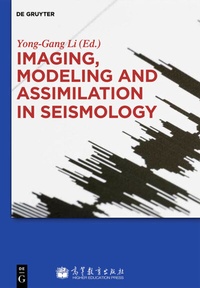
Imaging, Modeling and Assimilation in Seismology
1st Edition
Published on 22. February 2012
X, 262 pages
978-3-11-025903-2 (ISBN)
Description

This work presents current approaches in geophysical research of earthquakes. A global authorship from top institutions presents case studies to model, measure, and monitor earthquakes. Among others a full-3D waveform tomography method is introduced, as well as propagator methods for modeling and imaging. In particular the earthquake prediction method makes this book a must-read for researchers in the field.
More details
Language
English
Place of publication
Berlin/Boston
Germany
Target group
Professional and scholarly
US School Grade: College Graduate Student
Illustrations
58 farbige Abbildungen, 100 s/w Abbildungen
100 b/w and 58 col. ill.
File size
22,69 MB
ISBN-13
978-3-11-025903-2 (9783110259032)
DOI
10.1515/9783110259032
Schweitzer Classification
Other editions
Additional editions

Yong-Gang Li
Imaging, Modeling and Assimilation in Seismology
Book
02/2012
1st Edition
De Gruyter
€239.00
Article exhausted; check different version
Yong-Gang Li
Imaging, Modeling and Assimilation in Seismology
Book
02/2012
1st Edition
De Gruyter
€250.00
Shipment within 7-9 days
Persons
Edited by Yong-Gang Li, University of Southern California, Los Angeles, USA.
Content
Frontmatter
Preface
Contents
Imaging, Modeling and Assimilation in Seismology: An Overview
Chapter 1. Full-Wave Seismic Data Assimilation: A Unified Methodology for Seismic Waveform Inversion
Chapter 2. One-Return Propagators and the Applications in Modeling and Imaging
Chapter 3. Fault-Zone Trapped Waves: High-Resolution Characterization of the Damage Zone of the Parkfield San Andreas Fault at Depth
Chapter 4. Fault-Zone Trapped Waves at a Dip Fault: Documentation of Rock Damage on the Thrusting Longmen-Shan Fault Ruptured in the 2008 M8 Wenchuan Earthquake
Chapter 5. Ground-Motion Simulations with Dynamic Source Characterization and Parallel Computing
Chapter 6. Load-Unload Response Ratio and Its New Progress
Chapter 7. Discrete Element Method and Its Applications in Earthquake and Rock Fracture Modeling
Preface
Contents
Imaging, Modeling and Assimilation in Seismology: An Overview
Chapter 1. Full-Wave Seismic Data Assimilation: A Unified Methodology for Seismic Waveform Inversion
Chapter 2. One-Return Propagators and the Applications in Modeling and Imaging
Chapter 3. Fault-Zone Trapped Waves: High-Resolution Characterization of the Damage Zone of the Parkfield San Andreas Fault at Depth
Chapter 4. Fault-Zone Trapped Waves at a Dip Fault: Documentation of Rock Damage on the Thrusting Longmen-Shan Fault Ruptured in the 2008 M8 Wenchuan Earthquake
Chapter 5. Ground-Motion Simulations with Dynamic Source Characterization and Parallel Computing
Chapter 6. Load-Unload Response Ratio and Its New Progress
Chapter 7. Discrete Element Method and Its Applications in Earthquake and Rock Fracture Modeling
