

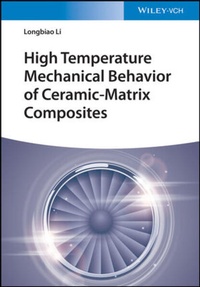
High Temperature Mechanical Behavior of Ceramic-Matrix Composites
Description

More details
Other editions
Additional editions
Person
Content
1.1. Tensile behavior of CMCs at elevated temperature
1.2. Fatigue behavior of CMCs at elevated temperature
1.3. Stress-rupture behavior of CMCs at elevated temperature
1.4. Vibration behavior of CMCs at elevated temperature
1.5 Conclusion
2 FIRST MATRIX CRACKING OF CERAMIC-MATRIX COMPOSITES AT ELEVATED TEMPERATURE
2.1. Introduction
2.2. Temperature-dependent matrix cracking stress of C/SiC composites
2.3. Temperature-dependent matrix cracking stress of SiC/SiC composite
2.4. Time-dependent matrix cracking stress of C/SiC composites
2.5. Time-dependent matrix cracking stress of Si/SiC composites
2.6 Conclusion
3 MATRIX MULTIPLE CRACKING EVOLUTION OF FIBER-REINFORCED CERAMIC-MATRIX COMPOSITES AT ELEVATED TEMPERATURE
3.1. Introduction
3.2. Temperature-dependent matrix multiple cracking evolution of C/SiC composites
3.3. Temperature-dependent matrix multiple cracking evolution of SiC/SiC composites
3.4. Time-dependent matrix multiple cracking evolution of C/SiC composites
3.5. Time-dependent matrix multiple cracking evolution of SiC/SiC composites
3.6 Conclusion
4 TIME-DEPENDENT TENSILE BEHAVIOR OF CERAMIC-MATRIX COMPOSITES
4.1. Introduction
4.2. Theoretical analysis
4.3 Results and discussion
4.4 Experimental comparisons
4.5 Conclusion
5 FATIGUE BEHAVIOR OF CERAMIC-MATRIX COMPOSITES AT ELEVATED TEMPERATURE
5.1. Introduction
5.2. Theoretical analysis
5.3. Experimental comparisons
5.4 Conclusion
6 STRESS-RUPTURE OF CERAMIC-MATRIX COMPOSITES AT ELEVATED INTEMPERATURE
6.1. Introduction
6.2. Stress-rupture of ceramic-matrix composites under constant stress at intermediate temperature
6.3. Stress-rupture of ceramic-matrix composites under stochastic loading stress and time at intermediate temperature
6.4. Stress-rupture of ceramic-matrix composites under multiple load sequence at intermediate temperature
6.5 Conclusion
7 VIBRATION DAMPING OF CERAMIC-MATRIX COMPOSITES AT ELEVATED TEMPERATURE
7.1. Introduction
7.2. Temperature-dependent vibration damping of CMCs
7.3. Time-dependent vibration damping of CMCs
7.4 Conclusion
1
Introduction
Monolithic ceramic is a kind of brittle material. The properties of the material will be greatly reduced by microdefects, which limit the practical application of ceramics in many fields. However, the inherent brittleness of ceramic materials can be improved by continuous or discontinuous ceramic fiber or carbon fiber reinforcement, namely, ceramic-matrix composites (CMCs). This dispersed second phase can improve the fracture toughness of ceramic materials. The main mechanism is that the crack bridging effect in the process of fracture can make the matrix materials connect with each other, disperse the fracture energy by the way of fiber debonding, and fiber pulling out to prevent the fracture of the material [1, 2].
Compared with the superalloy, fiber-reinforced CMCs can withstand higher temperature, reduce cooling air flow, and improve the turbine efficiency. The density of fiber-reinforced CMCs is 2.0-2.5 g/cm3, which is only 1/4-1/3 of superalloy. CMCs have already been applied to aeroengine combustion chambers, nozzle flaps, turbine vanes, and blades. For example, the CMC nozzle flaps and seals manufactured by SNECMA have already been used for more than 10 years in the M88 and M53 aeroengines. The CMC tail nozzle designed by SAFRAN Group of France passed the commercial flight certification of European Union Aviation Safety Agency (EASA) and completed its first commercial flight on the CFM56-5B aeroengine on 16 June 2015. National Aeronautics and Space Administration (NASA) has prepared and tested the CMC turbine guide vanes and turbine blade disc components in the Ultra-Efficient Engine Technology (UEET) project. General Electric (GE) tested the CMC combustor and high-pressure turbine components in the ground test of GEnx aeroengine. The CMC turbine blades were successfully tested on the F414 engine, which are planned to be used in GE90 series aeroengines. The engine weight is expected to be reduced by 455 kg, accounting for about 6% of the total weight of GE90-115 aeroengine. The LEAP (Leading Edge Aviation Propulsion) series aeroengine developed by CFM company adopts CMC components. The LEAP-1A, 1B, and 1C aeroengine provides power for Airbus A320, Boeing 737MAX, and COMAC C919, respectively.
Compared with polymer matrix composites (PMCs), CMCs have some similarities, including anisotropy, braided structure, high strength/high modulus fibers, manufacturing process sensitivity, and diversity, but there are also differences, such as high operation temperature (>500 °C), diversity of material constituents (i.e. oxide matrix, nonoxidized matrix, carbide matrix, silicon nitride matrix, carbon matrix, etc.) and processing methods (i.e. reaction bonding [RB], hot pressing sintering [HPS], precursor infiltration and pyrolysis [PIP], reactive melt infiltration [RMI], chemical vapor infiltration [CVI], slurry infiltration and hot pressing [SIPH], CVI-PIP, CVI-RMI, and PIP-HP), low matrix failure strain, complex degradation/damage/failure mechanisms at elevated temperature, difficult connection of structures in high-temperature environment, and high requirement of nondestructive testing and repair technology.
To ensure the reliability and safety of their use in aircraft and aeroengine structures, it is necessary to investigate the tensile, fatigue, stress rupture, and vibration behavior of CMCs at elevated temperature.
1.1 Tensile Behavior of CMCs at Elevated Temperature
The stress-strain curve of CMCs under tensile load appears obviously nonlinear. The tensile stress-strain curve can be divided into three regions, i.e. elastic region, nonlinear region, and secondary linear region before failure. In region I, there is no damage in the material during initial loading, and the tensile stress-strain curve is linear. With the increase of stress, microcracks appear in the matrix-rich area or matrix defects. The initial matrix cracking stress is defined as smc. These microcracks can only be detected by means of acoustic emission (AE), microscopic observation of specimen surface, and temperature measurement of sample surface. When the stress reaches the proportional limit stress, the accumulation of matrix cracks makes the stress-strain curve deflect, and the stress-strain curve is nonlinear, which marks the beginning of region II. In region II, the matrix cracks propagate along the vertical load direction while the number of matrix cracks increases. When the cracks extend to the fiber/matrix interface, the cracks deflect along the fiber/matrix interface, and debonding occurs at the fiber/matrix interface. With the increase of stress, when the slip zones of adjacent matrix cracks overlap each other, the matrix cracks reach saturation. The saturated stress of matrix cracks is defined as ssat. When the matrix crack is saturated, the region III of the stress-strain curve starts, and the external load is mainly borne by the fiber. The tangent modulus of the stress-strain curve is about VfEf (Vf is the volume content of the fiber and Ef is the elastic modulus of the fiber). With the increase of the stress, some fibers fail, and the failed fibers continue to carry through the shear stress at the fiber/matrix interface. When the fibers broken fraction reaches the critical value, the composite fracture occurs.
The tensile stress-strain behavior reflects the strength of the composite material to resist the damage of external tensile loading. The tensile properties (i.e. proportional limit stress, matrix crack spacing, tensile strength, and fracture strain) can be obtained from the tensile stress-strain curves and can be used for component design [3-5]. Jia et al. [6] investigated the relationship between the interphase and tensile strength of SiC fiber monofilament. The tensile strength of the SiC fiber monofilament decreases with the increasing coating layers. The SiC fibers with single boron nitride (BN) coating have the high monofilament strength retention of about 70%, 42.1% with two BN coatings, and 32.3% with four BN coatings. The minicomposite comprises one single fiber tow, interphase, and matrix and can be used to optimize the fiber-matrix interfacial zone and to generate micromechanical data necessary for modeling the mechanical behavior [7]. Almansour [8], Sauder et al. [9], and Yang et al. [10] performed investigations on the tensile behavior of SiC/SiC minicomposites with different fiber types and interface properties. Shi et al. [11] performed an investigation on the variability in tensile behavior of SiC/SiC minicomposite. The tensile strength of the SiC/SiC minicomposite satisfied the Weibull distribution. He et al. [12] performed an investigation on the tensile behavior of SiC/SiC minicomposites with different interphase thickness. The tensile strength and fiber pullout length increase with the interphase thickness. Chateau et al. [13] investigated the damage evolution and final fracture in SiC/SiC minicomposite using the in situ X-ray microtomography under tensile loading. Zeng et al. [14] performed experimental and theoretical investigations on the tensile damage evolution of unidirectional C/SiC composite at room temperature. Ma et al. [15], Wang et al. [16], Liang and Jiao [17], and Hu et al. [18] performed investigations on the tensile damage and fracture of 2.5D and 3D CMCs. The nonlinearity appears in the tensile curves along both the warp and weft directions. Under tensile loading, the matrix cracking first occurs because of the local stress concentration of the pores inside of the composite, and the transverse cracks and longitudinal interlaminar cracks result in the final brittle fracture of the composite. The acoustic emission technique is used to monitor the damage evolution of a 3D needled C/SiC composite [19]. The damage signal contained three main frequencies of 240, 370, and 455 kHz corresponding to the damage mechanisms of the interface damage, matrix damage, and fiber fracture, respectively. Wang et al. [20] compared the tensile behavior of C/SiC composites with different fiber preforms. The minicomposite has the largest strength, modulus, and strain energy density to failure in contrast to the lowest values of the 2D composite and the intermediate properties of the 3D composite. The tensile behavior of CMCs is affected by temperature [21-23]. For the unidirectional C/SiC composite at 1300 °C, the composite tensile strength was sUTS = 374 MPa and the composite tensile modulus was Ec = 134 GPa, and at 1450 °C, the composite tensile strength was sUTS = 338 MPa and the composite tensile modulus was Ec = 116 GPa. For the 2D SiC/SiC composite, the fracture strain at 1200 °C is higher than that at room temperature because of the interface oxidation. For the 3D C/SiC composite, when the temperature increases from room temperature to 1500 °C, the composite elastic modulus and the strain for saturation matrix cracking remained unchanged; the first matrix cracking...
