

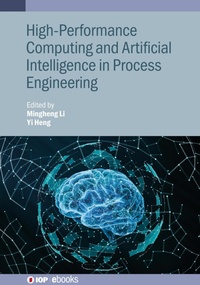
High-Performance Computing and Artificial Intelligence in Process Engineering
Description

High-performance computing (HPC) and artificial intelligence (AI) have revolutionized process engineering, enabling complex system modeling, data analysis, optimization design, and real-time monitoring. This book offers a thorough review of state-of-the-art AI technologies, HPC, and their applications in process engineering.
The text delves into the development of traditional process simulators and introduces new numerical solvers based on data-driven and physics-informed neural network approaches. It covers a range of applications in science and engineering, such as multiscale modeling and optimal design in reverse osmosis desalination, model-based experimental analysis to enhance boiling heat transfer, and the inverse identification of high-resolution spatiotemporal contaminant source distributions in atmospheric pollution.
This book is an invaluable resource for researchers, postgraduate students, and industrial practitioners in the fields of process engineering, manufacturing, data science, artificial intelligence, and high-performance computing.
More details
Other editions
Additional editions

Persons
Mingheng Li is a professor of chemical engineering specializing in process systems engineering, with a focus on materials, energy, and environmental applications. He has pioneered innovations in the processing of low-emissivity and self-cleaning coatings and advanced non-conventional dynamic and cyclic reverse osmosis techniques. He has served as an editor for the American Institute of Physics Publishing.
Yi Heng obtained his Ph.D. degree from RWTH Aachen University, Germany. He is a professor of applied mathematics. His work focuses on inverse problems, high performance computing, artificial intelligence, and their applications to various areas of science and engineering. He has served as an executive member of the editorial board for Science Bulletin.
Content
Chapter 1: Artificial intelligence and the future of process engineering
Chapter 2: Machine learning in optimal control and process modeling
Chapter 3: Graph-based control invariant set approximation and its applications
Chapter 4: Machine learning-based multiscale modeling and control of quantum dot manufacturing and their applications
Chapter 5: The rise of time-travelers: are transformer-based models the key to unlocking a new paradigm in surrogate modeling for dynamic systems?
Chapter 6: Optimization-based algorithms for solving inverse problems of parabilic PDEs
Chapter 7: Deep learning-based approach for solving forward and inverse partial differential equation problems
Chapter 8: An active subspace based swarm intelligence method with its application in an optimal design problem
Chapter 9: Supercomputing and machine-learning-aided optimal design of high permeability seawater reverse osmosis membrane systems
Chapter 10: Supercomputing-based inverse identification of high-resolution atmospheric pollutant source intensity deistributions
Chapter 11: Enhancing boiling heat transfer via model-based experimental analysis
