

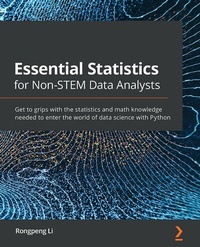
Essential Statistics for Non-STEM Data Analysts
Get to grips with the statistics and math knowledge needed to enter the world of data science with Python
Published on 23. September 2024
392 pages
978-1-83898-756-5 (ISBN)
Description

Reinforce your understanding of data science and data analysis from a statistical perspective to extract meaningful insights from your data using Python programming
Key Features
Work your way through the entire data analysis pipeline with statistics concerns in mind to make reasonable decisions
Understand how various data science algorithms function
Build a solid foundation in statistics for data science and machine learning using Python-based examples
Book DescriptionStatistics remain the backbone of modern analysis tasks, helping you to interpret the results produced by data science pipelines. This book is a detailed guide covering the math and various statistical methods required for undertaking data science tasks. The book starts by showing you how to preprocess data and inspect distributions and correlations from a statistical perspective. You'll then get to grips with the fundamentals of statistical analysis and apply its concepts to real-world datasets. As you advance, you'll find out how statistical concepts emerge from different stages of data science pipelines, understand the summary of datasets in the language of statistics, and use it to build a solid foundation for robust data products such as explanatory models and predictive models. Once you've uncovered the working mechanism of data science algorithms, you'll cover essential concepts for efficient data collection, cleaning, mining, visualization, and analysis. Finally, you'll implement statistical methods in key machine learning tasks such as classification, regression, tree-based methods, and ensemble learning. By the end of this Essential Statistics for Non-STEM Data Analysts book, you'll have learned how to build and present a self-contained, statistics-backed data product to meet your business goals.What you will learn
Find out how to grab and load data into an analysis environment
Perform descriptive analysis to extract meaningful summaries from data
Discover probability, parameter estimation, hypothesis tests, and experiment design best practices
Get to grips with resampling and bootstrapping in Python
Delve into statistical tests with variance analysis, time series analysis, and A/B test examples
Understand the statistics behind popular machine learning algorithms
Answer questions on statistics for data scientist interviews
Who this book is forThis book is an entry-level guide for data science enthusiasts, data analysts, and anyone starting out in the field of data science and looking to learn the essential statistical concepts with the help of simple explanations and examples. If you're a developer or student with a non-mathematical background, you'll find this book useful. Working knowledge of the Python programming language is required.
Key Features
Work your way through the entire data analysis pipeline with statistics concerns in mind to make reasonable decisions
Understand how various data science algorithms function
Build a solid foundation in statistics for data science and machine learning using Python-based examples
Book DescriptionStatistics remain the backbone of modern analysis tasks, helping you to interpret the results produced by data science pipelines. This book is a detailed guide covering the math and various statistical methods required for undertaking data science tasks. The book starts by showing you how to preprocess data and inspect distributions and correlations from a statistical perspective. You'll then get to grips with the fundamentals of statistical analysis and apply its concepts to real-world datasets. As you advance, you'll find out how statistical concepts emerge from different stages of data science pipelines, understand the summary of datasets in the language of statistics, and use it to build a solid foundation for robust data products such as explanatory models and predictive models. Once you've uncovered the working mechanism of data science algorithms, you'll cover essential concepts for efficient data collection, cleaning, mining, visualization, and analysis. Finally, you'll implement statistical methods in key machine learning tasks such as classification, regression, tree-based methods, and ensemble learning. By the end of this Essential Statistics for Non-STEM Data Analysts book, you'll have learned how to build and present a self-contained, statistics-backed data product to meet your business goals.What you will learn
Find out how to grab and load data into an analysis environment
Perform descriptive analysis to extract meaningful summaries from data
Discover probability, parameter estimation, hypothesis tests, and experiment design best practices
Get to grips with resampling and bootstrapping in Python
Delve into statistical tests with variance analysis, time series analysis, and A/B test examples
Understand the statistics behind popular machine learning algorithms
Answer questions on statistics for data scientist interviews
Who this book is forThis book is an entry-level guide for data science enthusiasts, data analysts, and anyone starting out in the field of data science and looking to learn the essential statistical concepts with the help of simple explanations and examples. If you're a developer or student with a non-mathematical background, you'll find this book useful. Working knowledge of the Python programming language is required.
More details
Edition
Digital original
Language
English
Place of publication
Birmingham
United Kingdom
Target group
Adult education
Professional and scholarly
US School Grade: College Graduate Student
Edition type
Digital original
File size
12,32 MB
ISBN-13
978-1-83898-756-5 (9781838987565)
Copyright in bibliographic data and cover images is held by Nielsen Book Services Limited or by the publishers or by their respective licensors: all rights reserved.
Schweitzer Classification
Other editions
Additional editions
Rongpeng Li
Essential Statistics for Non-STEM Data Analysts
Get to grips with the statistics and math knowledge needed to enter the world of data science with Python
Book
11/2020
Packt Publishing
€51.90
Shipment within 3-4 weeks
Person
Li Rongpeng :
Rongpeng Li is a Research Programmer at the Information Science Institute, University of Southern California. He has also been the host and organizer of the Data Analysis Workshop Designed for Non-Stem Busy Professionals at LA.
Rongpeng Li is a Research Programmer at the Information Science Institute, University of Southern California. He has also been the host and organizer of the Data Analysis Workshop Designed for Non-Stem Busy Professionals at LA.
Content
Table of Contents
Fundamentals of Data Collection, Cleaning and Preprocessing
Essential Statistics for Data Assessment
Visualization with Statistical Graphs
Sampling and Inferential Statistics
Common Probability Distributions
Parametric Estimation
Statistical Hypothesis Testing
Statistics for Regression
Statistics for Classification
Statistics for Tree-based Methods
Statistics for Ensemble Method
A Collection of Best Practices
Exercises and Projects
Fundamentals of Data Collection, Cleaning and Preprocessing
Essential Statistics for Data Assessment
Visualization with Statistical Graphs
Sampling and Inferential Statistics
Common Probability Distributions
Parametric Estimation
Statistical Hypothesis Testing
Statistics for Regression
Statistics for Classification
Statistics for Tree-based Methods
Statistics for Ensemble Method
A Collection of Best Practices
Exercises and Projects
