

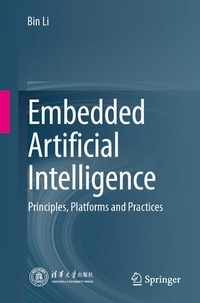
Embedded Artificial Intelligence
Description

This book focuses on the emerging topic of embedded artificial intelligence and provides a systematic summary of its principles, platforms, and practices. In the section on principles, it analyzes three main approaches for implementing embedded artificial intelligence: cloud computing mode, local mode, and local-cloud collaborative mode. The book identifies five essential components for implementing embedded artificial intelligence: embedded AI accelerator chips, lightweight neural network algorithms, model compression techniques, compiler optimization techniques, and multi-level cascaded application frameworks. The platform section introduces mainstream embedded AI accelerator chips and software frameworks currently used in the industry. The practical part outlines the development process of embedded artificial intelligence and showcases real-world application examples with accompanying code.
As a comprehensive guide to the emerging field of embedded artificial intelligence, the book offers rich and in-depth content, a clear and logical structure, and a balanced approach to both theoretical analysis and practical applications. It provides significant reference value and can serve as an introductory and reference guide for researchers, scholars, students, engineers, and professionals interested in studying and implementing embedded artificial intelligence.
More details
Other editions
Additional editions
Person
Bin Li held chief technical positions in several Fortune 500 companies, and he earned a Master's degree in pattern recognition and artificial intelligence from Beijing Institute of Technology. His research areas include artificial intelligence, distributed computing, and data communication. He is the first inventor of over 20 Chinese and international invention patents.
Content
PART I. PRINCIPLES.- Chapter 1. Embedded Artificial Intelligence.- Chapter 2. Principle of Embedded AI Chips.- Chapter 3. Lightweight Neural Networks.- Chapter 4. Compression of Deep Neural Network.- Chapter 5. Framework for Embedded Neural Network Applications .- Chapter 6. Lifelong Deep Learning.- PART II. PLATFORMS. - Chapter 7. Embedded AI Accelerator Chips.- Chapter 8. Software Framework for Embedded Neural Networks.- PART III. PRACTICES .- Chapter 9. Embedded AI Development Process.- Chapter 10. Optimizing Embedded Neural Network Models.- Chapter 11. Examples of Embedded Neural Network Application.- Chapter 12. Conclusion: Intelligence in Everything.
