

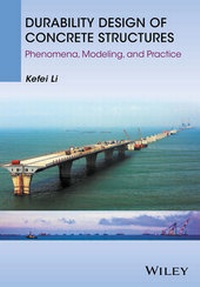
Durability Design of Concrete Structures
Description

Reviews / Votes
"The book follows abasic logic line from concrete materialsto structural design, and the content isaccordingly divided into three parts...Overall, the book provides good coverageof the topic and valuable information for theunderstanding of deterioration processesof concrete structures. The book canserve as a reference for civil and structuralengineering students, as well as practisingengineers". (The Structural Engineer/The Institution of Structural Engineers, May 2017)More details
Other editions
Additional editions
Person
Content
Preface
Durability of Concrete Structures: State of the Art
Durability is a term related to both performance and time, reflecting the degree to which a structure/infrastructure meets its intended functions for a given duration of time. This description applies to all types of structure and infrastructures in civil engineering. Actually, during the service life a structure displays time-dependent behaviors by ageing of the structural materials. The ageing processes can be intrinsic to the structural materials or induced by the interactions between the service conditions and the structural materials. This picture holds for all structures and their constitutive materials. In fact, concrete structures have transient behaviors due to some well-known time-dependent properties of structural concrete, such as shrinkage and creep. Take creep, for example. Engineers had been challenged by this evolving property as early as the 1900s, the very beginning of concrete structures coming into use. During the following years the lack of consideration of creep, surely due to lack of knowledge, had caused some serious accidents in structural engineering; for example, the collapse of the Koror-Babelthuap Bridge, Palau, in 1996. The past century has witnessed considerable research efforts dedicated to this subject, and the colossal creep models and established databases. The awareness of the deterioration of concrete properties by environmental actions comes much later. In the early 1990s, field investigations from various sources showed that concrete structures, massively constructed during 1950s and 1960s, were in very poor condition. The cost of the maintenance works due to deterioration by environmental actions was reported to be reaching an alarming level and generated heavy financial burdens on the structure owners. This situation makes durability a worldwide concern for decision-makers, structural designers, and material suppliers. Accordingly, the past three decades witnessed enormous efforts dedicated to intensive research on deterioration processes of structural elements and concretes, and the durability specifications for concrete structures at the design level.
Today, the term "durability" is somewhat standardized in a technical sense. The standard ISO-13823 provided the definition as the "capability of a structure or any component to satisfy, with planned maintenance, the design performance requirements over a specified period of time under the influence of the environmental actions, or as a result of a self-ageing process"; the ACI Concrete Terminology gives the definition as the "ability of a material to resist weathering action, chemical attack, abrasion, or any other process of deterioration." Evidently, the former definition is more adapted to structural engineering, while the latter is more oriented to concrete materials. However, one can notice that both definitions exclude the most evident time-dependent properties of structural concrete: shrinkage and creep. This is doubtless due to the fact that the recent engineering concern, as well as the corresponding efforts, mainly focuses on the environmental actions, the reason why the term "environmental actions" is explicitly expressed in both definitions. In this book, this established terminology is also followed, though shrinkage and creep remain the most important transient properties of structural concretes. The awareness of structural durability leads to two important changes in structural design. First, the design changes from a "static" mode to an "evolving" mode and the evolution of certain structural and materials properties must be taken into account through appropriate approaches. The design service life, or design working life, becomes an independent design parameter and target for the design procedure. Hence, the design changes from a loading-based procedure to a service life-based one. Second, durability awareness enables the life-cycle concept in structural design and management. Modern civil engineering is a highly multidisciplinary domain, connected with more fundamental social stakes, such as sustainability and ecological impacts. The life-cycle concept introduces into the structural design procedure, besides the structural requirements, the requirements of structural demolition, reuse, material recycling, and other ecological considerations.
Durability Design: Multilevel Procedure and Challenge
Performing a design for durability is by no means a trivial task. First of all, durability design is by nature a multilevel problem: durability design has different meanings for the whole structure, structural elements, and structural materials. For a structure as a whole, the durability design aims, for a given service life, given environmental actions and given budgetary constraints, to ensure the most rational structural element assemblage and global layout so that the transient performance can always be maintained to an expected level. Furthermore, a rational partition of initial investment in the construction phase and subsequent investment on maintenance works is also expected. For structural elements, the durability design, following the design strategy at the whole structure level, is to fulfill the design service life through more specified requirements, such as bearing capacity, section details, concrete cover thickness, and material properties. On this level, the durability design focuses on the technical requirements, and less on the budgetary factors. Structural design transfers also on this level the technical requirements on durability onto the material level through specified material properties. Then comes the material design part. On this level, material engineers should design the concrete mixture appropriately, both in order to satisfy the specified material properties transferred from the structural design, and to ensure good workability of the concrete mixture for in-place operation. Good workmanship is crucial to achieving durability of concrete structures in construction, since concretes need in-place operation and curing to grow into a structural materials.
This multilevel design process necessitates good communication between the structural design part and the material design part. This procedure is a performance-based one and also an ideal one. Although easy to understand, this performance-based procedure relies heavily on the available knowledge of the deterioration processes. Thus far, the state-of-the-art of the knowledge on durability is unfortunately far from homogeneous. For the processes such as concrete carbonation and chloride ingress, the available knowledge can provide models and support quantitative requirements for design of given service life and environmental actions. This is by no means the case for other processes, like salt attack and pore crystallization. As a result, only empirical and qualitative requirements can be formulated for the material design against these processes. Actually, this empirical format of durability design existed long before the performance-based format was established, and is still used in design codes such as ACI-318 code and Eurocode2.
The second challenge comes from the concrete material itself. Modern concretes change., and quite radically. Owing to the importance of CO2 emission from cement clinker production, modern concretes incorporate more and more secondary cementitious materials into the binder, including fly ash, ground granulated blast-furnace slag, and lime powder. The alkali-activated binder even contains no Portland cement clinkers. Also, from ecological considerations, recycled and artificial aggregates are incorporated into concrete to replace natural aggregates. Concretes made from these composites can have quite different properties and behaviors compared with ordinary Portland cement (OPC) concretes. Historically, it is the OPC concretes that have undergone intensive research and own more return of experiences from existing structures. The technical requirements, quantitative or qualitative, are based heavily on the accumulation of such data. With the dearth of systematic data and experiences with these new concrete composites, extrapolation from the available knowledge to the appropriate specification of these new composites for durability design seems highly challenging. The knowledge on the deterioration process in time scale constitutes the last challenge. To establish a reliable deterioration law, one needs to have a reliable model formulated from correct mechanisms and validated by real-scale tests or in-place structural investigations. Here, the term "scale" refers to time. Normally, the deterioration process under natural environmental actions is extremely slow; for example, it takes normally 15-30 years to obtain meaningful chloride ingress results for specimens stored in marine exposure stations. However, most deterioration research is conducted in the laboratory under artificial environmental actions to accelerate the process to obtain measurable data within an acceptable time scale. Since the similarity between these accelerated tests and the natural deteriorations is rather low, how to extrapolate the laboratory observations to natural processes remains always a tricky problem.
Given all the realistic aspects related to the multilevel design process, we can find ourselves in a dilemma, between the need to formulate requirements and specification for a given service life and the constant lack of sufficient data and experiences to support them due to the...
