

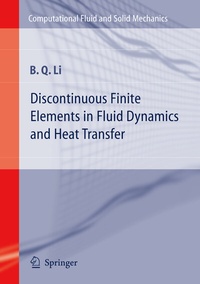
Discontinuous Finite Elements in Fluid Dynamics and Heat Transfer
Description

Reviews / Votes
From the reviews:
"This monograph is written as an introductory textbook on the discontinuous finite element method for senior undergraduate and graduate students in the area of thermal science and fluid dynamics. The book covers the applications of the method for the simulation of both macroscopic and micro/nanoscopic fluid flows and heat transfer phenomena. . present textbook provides scientists, applied mathematicians and research engineerings with a throughout treatment of basic concepts and specific techniques for the use of discontinuous Galerkin methods in computational fluid dynamics and heat transfer."
(Titus Petrila, Zentralblatt MATH, Vol. 1110 (12), 2007)
"Li...offers a very rigorous, accurate introduction to this topic...This book is quite comprehensive and mathematically rigorous enough to impart the basics of discontinuous finite element methods...
Summing Up:
Recommended."
(S. E. Haupt, Choice, November 2006)
"This book contains a rather detailed description of the discontinuous finite element methods (mainly discontinuous Galerkin methods) in the context of fluid dynamics and heat transfer. . The book under review is written for practitioners of the discontinuous finite element method in science and engineering. . a valuable addition to the literature. It is suitable to serve as a textbook for a graduate course, or a reference book for researchers or engineers who would like to learn this effective numerical method . ." (Chi-Wang Shu, SIAM Review, Vol. 49 (1), 2007)
More details
Other editions
Additional editions
Person
Dr. Ben Q. Li is Professor of Mechanical Engineering, Washington State University, Pullman, WA, USA. He has a Ph.D. in engineering from the University of California at Berkeley. His teaching and research is in computational fluid dynamics and heat transfer for thermofluids engineering and biological systems. He has published over 150 technical papers in his research area.
