

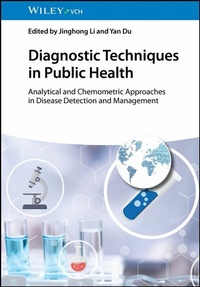
Diagnostic Techniques in Public Health
Analytical and Chemometric Approaches in Disease Detection and Management
1st Edition
Published on 5. March 2026
496 pages
978-3-527-84793-8 (ISBN)
Description

Provides a comprehensive overview of the various diagnosis techniques employed in disease detection and public health crisis management.
More details
Other editions
Additional editions
Jinghong Li | Yan Du
Diagnostic Techniques in Public Health
Analytical and Chemometric Approaches in Disease Detection and Management
Book
04/2026
1st Edition
Wiley-VCH
€159.00
Available immediately
Persons
Dr. Jinghong Li is an Academician of Chinese Academy of Sciences, a Cheung Kong Professor in Department of Chemistry at Tsinghua University, China. He is the Director of Academic Committee of Department of Chemistry, the Head of Analysis Center, Tsinghua University. His current research interests include electroanalytical chemistry and bioanalysis, nanoanalysis and biosensing, physical electrochemistry and interfacial electrochemistry, material electrochemistry and nanoscopic electrochemistry, energy conversion and storage.
Dr. Yan Du is Professor at Changchun Institute of Applied Chemistry, Chinese Academy of Sciences (CAS). She has been working on biosensing and molecular diagnosis for more than fifteen years and devoted herself into the development and application of new portable molecular diagnostic methods.
Dr. Yan Du is Professor at Changchun Institute of Applied Chemistry, Chinese Academy of Sciences (CAS). She has been working on biosensing and molecular diagnosis for more than fifteen years and devoted herself into the development and application of new portable molecular diagnostic methods.
Content
CHAPTER 1: ANALYTICAL AND CHEMOMETRIC APPROACHES IN PUBLIC HEALTH EMERGENCIES: GLOBAL SIGNIFICANCE, CHALLENGES, AND DISEASE DETECTION STRATEGIES
1.1 Beyond Infectious Threats: Expanding the Horizons of Global Health Challenges
1.2 Tracing the Seven Public Health Emergencies of International Concerns (PHEICs) Announcements by WHO: From H1N1 to Monkeypox
1.3 A Close Look at Smallpox, Severe Acute Respiratory Syndrome (SARS) and Influenza Variations
1.4 Analytical and Chemometric Approaches in Major Public Health Emergencies
1.5 Conclusion and Discussion
CHAPTER 2: MASTERING CLINICAL DIAGNOSTICS: MODERN STRATEGIES FOR PHEIC RESPONSES
2.1 Clinical Evaluation Comprehensive Pathway: From Cutting-edge Laboratory Analysis
2.2 Recombinase-aided isothermal amplification of nucleic acids: A New Dawn in Detection and Analysis
2.3 Conclusion
CHAPTER 3: DIVING INTO THE ELISA TECHNIQUE: ITS ROLE AND INNOVATIONS IN PUBLIC HEALTH
3.1 Introduction to ELISA and its components
3.2 Recognition molecules
3.3 Signaling molecules, enzymes, nanozymes
3.4 Different assay formats
3.5 ELISA for viral detection: SARS-CoV-2 as an example
3.6 ELISA for bacterial identification
3.7 ELISA in microfluidic devices and other advanced applications
3.8 ELISA using aptamers
3.9 Conclusions and future directions
CHAPTER 4: METALLIC NANOMATERIALS FOR PLASMONIC BIOSENSORS AND FLEXIBLE BIOELECTRONICS
4.1 Overview of Plasmonic Nanostructures
4.2 Plasmonic ?meta-crystals?
4.3 Plasmonic Biosensors
4.4 Soft Bioelectronics
4.5 Challenges and Future Perspectives
CHAPTER 5: THE ART OF MOLECULAR DIAGNOSIS: TECHNIQUES AND IMPLICATIONS FOR PUBLIC HEALTH
5.1 Introduction
5.2 Criteria for developing molecular diagnostic technologies
5.3 Amplifying the invisible: PCR?s pivotal role in genetic detection
5.4 Isothermal amplification: revolutionizing molecular diagnostics with constant temperature
5.5 Isothermal and enzyme-free nucleic acid amplification
5.6 Summary and outlook
CHAPTER 6: CRISPR-BASED MOLECULAR DIAGNOSTICS: A REVOLUTION IN DETECTION AND MANAGEMENT OF DISEASES
6.1 Dissecting CRISPR: Its Classification, Tools, and Mechanisms
6.2 Pinpoint Accuracy: Utilizing CRISPR/Cas Systems for Pathogen Detection
6.3 The CRISPR-Based Diagnosis: Opportunities and Challenges.
CHAPTER 7: PRECISION AND SPEED: THE RISE OF HIGH-THROUGHPUT MICROFLUIDIC SYSTEMS IN DIAGNOSTICS OF INFECTIOUS DISEASES
7.1. Introduction
7.2. The origins and developments of microfluidics
7.3 Applications of microfluidic technology in detection of public infectious diseases
7.4. Limitations, Current trends, and Future prospects
CHAPTER 8: DECIPHERING PATHOGENS: THE POWER OF GENOMIC SEQUENCING IN PUBLIC HEALTH
8.1 Introduction
8.2 History of DNA sequencing technology
8.3 The principle and history of nanopore sequencing
8.4 Nanopore technology used in genomic sequencing
8.5 Nanopore technology used in pathogens? diagnosis
8.6 Conclusion
CHAPTER 9: THE FUTURE OF DETECTION: INSTRUMENTATION AND TECHNIQUES ON THE HORIZON
9.1 The Electrifying World of Detection: New-age Electrochemical Methods
9.2 Probing the minuscule: SERS in enhanced vibrational spectroscopy
9.3 Sensor synthesis: merging technologies for superior diagnostic proficiency ELISA
CHAPTER 10 REDEFINING POINT-OF-CARE TESTING: RAPID DIAGNOSTIC INNOVATIONS
10.1 A New Wave in POCT: Tracking the Advances in Instruments and Methods
10.2 Enhancing the Existing: Integrating Viral Detection in Current POCT Platforms
10.3 Challenges in POCT
10.4 Conclusion and Future Perspectives
CHAPTER 11: LOOKING FORWARD: PERSPECTIVES ON THE FUTURE OF DIAGNOSTIC TECHNIQUES
11.1 Introduction: The Evolution of Diagnostic Techniques
11.2 The Paradigm Shift in Molecular Diagnostics
11.3 Advancements in Biosensing and Bioelectronics
11.4 The Fusion of Chemometric Approaches with AI-driven in Future Diagnostics
11.5 Overlook: Challenges and Future Directions in Diagnostic Techniques
1.1 Beyond Infectious Threats: Expanding the Horizons of Global Health Challenges
1.2 Tracing the Seven Public Health Emergencies of International Concerns (PHEICs) Announcements by WHO: From H1N1 to Monkeypox
1.3 A Close Look at Smallpox, Severe Acute Respiratory Syndrome (SARS) and Influenza Variations
1.4 Analytical and Chemometric Approaches in Major Public Health Emergencies
1.5 Conclusion and Discussion
CHAPTER 2: MASTERING CLINICAL DIAGNOSTICS: MODERN STRATEGIES FOR PHEIC RESPONSES
2.1 Clinical Evaluation Comprehensive Pathway: From Cutting-edge Laboratory Analysis
2.2 Recombinase-aided isothermal amplification of nucleic acids: A New Dawn in Detection and Analysis
2.3 Conclusion
CHAPTER 3: DIVING INTO THE ELISA TECHNIQUE: ITS ROLE AND INNOVATIONS IN PUBLIC HEALTH
3.1 Introduction to ELISA and its components
3.2 Recognition molecules
3.3 Signaling molecules, enzymes, nanozymes
3.4 Different assay formats
3.5 ELISA for viral detection: SARS-CoV-2 as an example
3.6 ELISA for bacterial identification
3.7 ELISA in microfluidic devices and other advanced applications
3.8 ELISA using aptamers
3.9 Conclusions and future directions
CHAPTER 4: METALLIC NANOMATERIALS FOR PLASMONIC BIOSENSORS AND FLEXIBLE BIOELECTRONICS
4.1 Overview of Plasmonic Nanostructures
4.2 Plasmonic ?meta-crystals?
4.3 Plasmonic Biosensors
4.4 Soft Bioelectronics
4.5 Challenges and Future Perspectives
CHAPTER 5: THE ART OF MOLECULAR DIAGNOSIS: TECHNIQUES AND IMPLICATIONS FOR PUBLIC HEALTH
5.1 Introduction
5.2 Criteria for developing molecular diagnostic technologies
5.3 Amplifying the invisible: PCR?s pivotal role in genetic detection
5.4 Isothermal amplification: revolutionizing molecular diagnostics with constant temperature
5.5 Isothermal and enzyme-free nucleic acid amplification
5.6 Summary and outlook
CHAPTER 6: CRISPR-BASED MOLECULAR DIAGNOSTICS: A REVOLUTION IN DETECTION AND MANAGEMENT OF DISEASES
6.1 Dissecting CRISPR: Its Classification, Tools, and Mechanisms
6.2 Pinpoint Accuracy: Utilizing CRISPR/Cas Systems for Pathogen Detection
6.3 The CRISPR-Based Diagnosis: Opportunities and Challenges.
CHAPTER 7: PRECISION AND SPEED: THE RISE OF HIGH-THROUGHPUT MICROFLUIDIC SYSTEMS IN DIAGNOSTICS OF INFECTIOUS DISEASES
7.1. Introduction
7.2. The origins and developments of microfluidics
7.3 Applications of microfluidic technology in detection of public infectious diseases
7.4. Limitations, Current trends, and Future prospects
CHAPTER 8: DECIPHERING PATHOGENS: THE POWER OF GENOMIC SEQUENCING IN PUBLIC HEALTH
8.1 Introduction
8.2 History of DNA sequencing technology
8.3 The principle and history of nanopore sequencing
8.4 Nanopore technology used in genomic sequencing
8.5 Nanopore technology used in pathogens? diagnosis
8.6 Conclusion
CHAPTER 9: THE FUTURE OF DETECTION: INSTRUMENTATION AND TECHNIQUES ON THE HORIZON
9.1 The Electrifying World of Detection: New-age Electrochemical Methods
9.2 Probing the minuscule: SERS in enhanced vibrational spectroscopy
9.3 Sensor synthesis: merging technologies for superior diagnostic proficiency ELISA
CHAPTER 10 REDEFINING POINT-OF-CARE TESTING: RAPID DIAGNOSTIC INNOVATIONS
10.1 A New Wave in POCT: Tracking the Advances in Instruments and Methods
10.2 Enhancing the Existing: Integrating Viral Detection in Current POCT Platforms
10.3 Challenges in POCT
10.4 Conclusion and Future Perspectives
CHAPTER 11: LOOKING FORWARD: PERSPECTIVES ON THE FUTURE OF DIAGNOSTIC TECHNIQUES
11.1 Introduction: The Evolution of Diagnostic Techniques
11.2 The Paradigm Shift in Molecular Diagnostics
11.3 Advancements in Biosensing and Bioelectronics
11.4 The Fusion of Chemometric Approaches with AI-driven in Future Diagnostics
11.5 Overlook: Challenges and Future Directions in Diagnostic Techniques
