

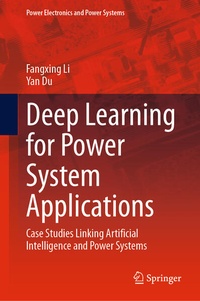
Deep Learning for Power System Applications
Description

Deep Learning for Power System Applications: Case Studies Linking Artificial Intelligence and Power Systems is an ideal resource for professors, students, and industrial and government researchers in power systems, as well as practicing engineers and AI researchers.
- Provides a history of AI in power grid operation and planning;
-
Introduces deep learning algorithms and applications in power systems;
-
Includes several representative case studies.
More details
Other editions
Additional editions
Persons
Fangxing "Fran" Li received his B.S.E.E. and M.S.E.E. degrees from Southeast University, Nanjing, in 1994 and 1997, respectively, and his Ph.D. from Virginia Tech, Blacksburg, VA, in 2001. He is the James McConnell Professor with the University of Tennessee, Knoxville, TN. His research interests include power system artificial intelligence, renewable energy integration, demand response, power markets, and power system control. He is a registered Professional Engineer (P.E.) in the State of North Carolina, a Fellow of the IEEE (Class of 2017), the current Editor-In-Chief of IEEE Open Access Journal of Power and Energy (OAJPE), the current Chair of the IEEE/PES Power System Operation, Planning and Economics (PSOPE) committee, and the current Chair of the IEEE/PES Task Force on Machine Learning in Power Systems. He received the 2020 Best Paper Award from the Journal of Modern Power Systems and Clean Energy (MPCE), the Third Prize Paper Award from CSEE Journal of Powerand Energy Systems (JPES) in 2019, the 2019 IEEE/PES Technical Committee Prize Paper Award, the Applied Energy Highly Cited Paper Awards three times for papers published in 2016, 2020, and 2021, and six Best Conference Papers/Posters awards. As a Principal Investigator, he received the prestigious 2020 R&D 100 Finalist honor for the project "DCNNN (Deep Convolutional Neural Network for N-1)" which is closely related to this book. Also, as a Principal Investigator, he received the prestigious R&D 100 Award in 2020 for the project "CURENT LTB (Large-scale Test Bed)".
Yan Du received her B.S. degree from Tianjin University, Tianjin, in 2013, an M.S. degree from the Institute of Electrical Engineering, Chinese Academy of Sciences, Beijing, in 2016, and her Ph.D. degree from The University of Tennessee (UT) in 2020. She received the UT EECS Department Outstanding Graduate Research Assistant award in 2019, the UT Chancellor's Citation Award in Extraordinary Professional Promise in 2020, and the UT Min Kao Fellowship in 2019-2020. Presently, she is a software engineer at Google, Seattle, WA. Her research interest is deep learning in power systems. As the lead developer, she was a co-recipient of the prestigious R&D 100 Finalist honor in 2020 for the project "DCNNN (Deep Convolutional Neural Network for N-1)" which is closely related to this book.