

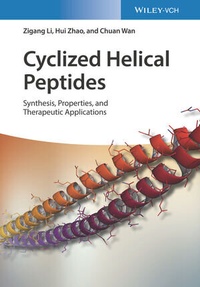
Cyclized Helical Peptides
Synthesis, Properties and Therapeutic Applications
1st Edition
Published on 28. June 2021
240 pages
978-3-527-34347-8 (ISBN)
Description

Offers a review of the most current methodologies of constructing constrained helices.
More details
Other editions
Additional editions
Zigang Li | Hui Zhao | Chuan Wan
Cyclized Helical Peptides
Synthesis, Properties and Therapeutic Applications
Book
07/2021
1st Edition
Wiley-VCH
€145.00
Shipment within 5-7 days
Persons
Zigang Li is now a professor in School of Chemical Biology and Biotechnology of Peking University. Before joining Peking University, Li worked as a postdoctoral fellow with Professor Gregory L. Verdine at Harvard University where he focused on discovery of new targets from human cancer cells for stapled peptides. Li received his PhD with Professor Chuan He at the University of Chicago in 2008 where he investigated global regulator functions on the pathogenesis of Staphylococcus aureus. Before that, Li performed his master studies at Tulane University, where he studied with Professor Chao-Jun Li on imine reactivity in aqueous media. Li completed his undergraduate degree of biophysics at The University of Science and Technology of China. Li's research interests include peptide based drug discovery and new strategies against infectious disease.
Hui Zhao is now a postdoc in Shenzhen GTJA Investment Group (GIG), with 3 years of experience in industry research and investment, in the field of innovative drugs and medical devices. He obtained his PhD degree in chemical genomics from Peking University under the supervision of Prof. Zigang Li in 2017. His main research direction was peptide science, with papers published in academic journals and patents applied.
Chuan Wan is a post-doc under the supervision of Prof. Zigang Li. He got his BS and Ph.D degree from China Agricultural University in 2012 and 2018, respectively. His main research interests focus on development of novel bio-orthogonal chemistry, research on peptide-stapling methodology and self-assembled materials based on stabilized a-helical peptide.
Hui Zhao is now a postdoc in Shenzhen GTJA Investment Group (GIG), with 3 years of experience in industry research and investment, in the field of innovative drugs and medical devices. He obtained his PhD degree in chemical genomics from Peking University under the supervision of Prof. Zigang Li in 2017. His main research direction was peptide science, with papers published in academic journals and patents applied.
Chuan Wan is a post-doc under the supervision of Prof. Zigang Li. He got his BS and Ph.D degree from China Agricultural University in 2012 and 2018, respectively. His main research interests focus on development of novel bio-orthogonal chemistry, research on peptide-stapling methodology and self-assembled materials based on stabilized a-helical peptide.
Content
CHAPTER 1: INTRODUCTION
1.1 Protein-protein interactions and their small molecule modulators
1.1.1 Characteristics of protein-protein interactions
1.1.2 Intervention of protein-protein interactions using small molecules
1.2 Features of peptide as molecular tools
1.2.1 Advantages of peptides as molecular tools
1.2.2 Disadvantages of peptides as molecular tools
1.3 Helical structures and their characterization
1.3.1 Different types of helices
1.3.2 Characterization of helical peptides
1.4 Stabilization of peptides
1.4.1 Peptide stabilization via cyclization
1.4.2 Peptide stabilization via backbone reconstruction
References
CHAPTER 2. CONSTRUCTION OF CONSTRAINED HELICES
2.1 Side-chain crosslinking
2.1.1 Disulfide bond
2.1.2 Amide and ester
2.1.3 All-hydrocarbon stapled peptide
2.1.4 Thiol-ether
2.1.5 Azole
2.2 End nucleation
2.2.1 Macrocycle based N-cap templates
2.2.2 Hydrogen Bond Mimic Approaches
2.2.3 N-terminal side chain constrains as Helix-Nucleating Templates
References
CHAPTER 3. PROPERTITIES OF STABILIZED PEPTIDES
3.1 Helicity
3.1.1 Ring size
3.1.2 Rigidity
3.1.3 Comparison
3.2 Binding affinity
3.2.1 Helicity
3.2.2 Cyclization position
3.2.3 Substitution
3.3 Cell permeability
3.3.1 Amphiphilicity: hydrophobicity & isoelectric point
3.3.2 Helicity
3.3.3 Summary
3.4 Nonspecific toxicity
3.5 Stability
3.5.1 Proteolytic stability
3.5.2 Pharmacokinetic properties
3.6 Additional features
References
CHAPTER 4. APPLICATIONS OF CONSTRAINED HELICES
4.1 Cancer
4.1.1 MDM2/X
4.1.2 B-cell lymphoma 2 (MCL-1/BCL-2/BCL-XL)-BID/Noxa/BAX/BIM/PUMA
4.1.3 NOTCH
4.1.4 Insulin receptor substrate
4.1.5 Ras
4.1.6 Rab
4.1.7 ß-catenin BCL-9/AXIN
4.1.8 Epidermal growth factor receptor
4.1.9 Estrogen Receptor
4.1.10 Hypoxia-Inducible Factor
4.1.11 Embryonic ectoderm development - Enhancer of zeste homolog
4.2 Infectious Disease
4.2.1 HIV
4.2.2 Respiratory syncytial virus F (RSV)
4.3 Metabolic Disease
4.3.1 Glucokinase-phospho-BAD
References
CHAPTER 5. STABILIZED PEPTIDE COVALENT INHIBITORS
5.1 Methodologies of peptide covalent inhibitor
5.1.1 Covalent warhead
5.1.2 Stapling method
5.2 Applications
5.2.1 BCL2 family proteins as target
5.2.2 MDM2 and MDM4 as target
5.2.3 Sulfonium tethered peptide
5.2.4 Others
CHAPTER 6. STABILIZED PEPTIDE PROTAC
6.1 Proteolysis-targeting chimera (PROTAC)
6.2 Design of peptide PROTAC
6.2.1 Exploitation of E3 ubiquitin ligase-recruiting ligand
6.2.2 Design of stabilized peptide ligand
6.2.3 Impact of linker
6.3 Therapeutic applications of stabilized peptide PROTAC
6.3.1 Targeting ERa
6.3.2 Targeting ß-catenin
CHAPTER 7. STABILIZED PEPTIDE FOR DRUG DELIVERY
7.1 Cell-permeable peptides (CPPs)
7.1.1 Classification of CPPs
7.1.2 Mechanism of cell penetration of CPPs
7.1.3 Applications of CPPs
7.2 Cell-permeable cyclic peptides (cyclic CPPs)
7.2.1 Cyclic CPPs mediated drug delivery
7.2.2 Cyclo-RGD
7.3 Co-assembly nanocarrier system
7.4 Examples of stabilized peptide drugs
CHAPTER 8. Outlook
8.1 The development of peptide-stabilizing methods
8.2 Applications of stabilized helical peptides
References
1.1 Protein-protein interactions and their small molecule modulators
1.1.1 Characteristics of protein-protein interactions
1.1.2 Intervention of protein-protein interactions using small molecules
1.2 Features of peptide as molecular tools
1.2.1 Advantages of peptides as molecular tools
1.2.2 Disadvantages of peptides as molecular tools
1.3 Helical structures and their characterization
1.3.1 Different types of helices
1.3.2 Characterization of helical peptides
1.4 Stabilization of peptides
1.4.1 Peptide stabilization via cyclization
1.4.2 Peptide stabilization via backbone reconstruction
References
CHAPTER 2. CONSTRUCTION OF CONSTRAINED HELICES
2.1 Side-chain crosslinking
2.1.1 Disulfide bond
2.1.2 Amide and ester
2.1.3 All-hydrocarbon stapled peptide
2.1.4 Thiol-ether
2.1.5 Azole
2.2 End nucleation
2.2.1 Macrocycle based N-cap templates
2.2.2 Hydrogen Bond Mimic Approaches
2.2.3 N-terminal side chain constrains as Helix-Nucleating Templates
References
CHAPTER 3. PROPERTITIES OF STABILIZED PEPTIDES
3.1 Helicity
3.1.1 Ring size
3.1.2 Rigidity
3.1.3 Comparison
3.2 Binding affinity
3.2.1 Helicity
3.2.2 Cyclization position
3.2.3 Substitution
3.3 Cell permeability
3.3.1 Amphiphilicity: hydrophobicity & isoelectric point
3.3.2 Helicity
3.3.3 Summary
3.4 Nonspecific toxicity
3.5 Stability
3.5.1 Proteolytic stability
3.5.2 Pharmacokinetic properties
3.6 Additional features
References
CHAPTER 4. APPLICATIONS OF CONSTRAINED HELICES
4.1 Cancer
4.1.1 MDM2/X
4.1.2 B-cell lymphoma 2 (MCL-1/BCL-2/BCL-XL)-BID/Noxa/BAX/BIM/PUMA
4.1.3 NOTCH
4.1.4 Insulin receptor substrate
4.1.5 Ras
4.1.6 Rab
4.1.7 ß-catenin BCL-9/AXIN
4.1.8 Epidermal growth factor receptor
4.1.9 Estrogen Receptor
4.1.10 Hypoxia-Inducible Factor
4.1.11 Embryonic ectoderm development - Enhancer of zeste homolog
4.2 Infectious Disease
4.2.1 HIV
4.2.2 Respiratory syncytial virus F (RSV)
4.3 Metabolic Disease
4.3.1 Glucokinase-phospho-BAD
References
CHAPTER 5. STABILIZED PEPTIDE COVALENT INHIBITORS
5.1 Methodologies of peptide covalent inhibitor
5.1.1 Covalent warhead
5.1.2 Stapling method
5.2 Applications
5.2.1 BCL2 family proteins as target
5.2.2 MDM2 and MDM4 as target
5.2.3 Sulfonium tethered peptide
5.2.4 Others
CHAPTER 6. STABILIZED PEPTIDE PROTAC
6.1 Proteolysis-targeting chimera (PROTAC)
6.2 Design of peptide PROTAC
6.2.1 Exploitation of E3 ubiquitin ligase-recruiting ligand
6.2.2 Design of stabilized peptide ligand
6.2.3 Impact of linker
6.3 Therapeutic applications of stabilized peptide PROTAC
6.3.1 Targeting ERa
6.3.2 Targeting ß-catenin
CHAPTER 7. STABILIZED PEPTIDE FOR DRUG DELIVERY
7.1 Cell-permeable peptides (CPPs)
7.1.1 Classification of CPPs
7.1.2 Mechanism of cell penetration of CPPs
7.1.3 Applications of CPPs
7.2 Cell-permeable cyclic peptides (cyclic CPPs)
7.2.1 Cyclic CPPs mediated drug delivery
7.2.2 Cyclo-RGD
7.3 Co-assembly nanocarrier system
7.4 Examples of stabilized peptide drugs
CHAPTER 8. Outlook
8.1 The development of peptide-stabilizing methods
8.2 Applications of stabilized helical peptides
References
