

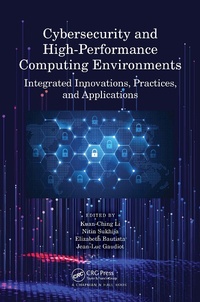
Cybersecurity and High-Performance Computing Environments
Integrated Innovations, Practices, and Applications
1st Edition
Published on 8. May 2022
394 pages
978-1-000-55366-6 (ISBN)
Description

In this fast-paced global economy, academia and industry must innovate to evolve and succeed. Today's researchers and industry experts are seeking transformative technologies to meet the challenges of tomorrow. Cutting-edge technological advances in cybersecurity solutions aid in enabling the security of complex heterogeneous high-performance computing (HPC) environments. On the other hand, HPC facilitates powerful and intelligent innovative models for reducing time to response to identify and resolve a multitude of potential, newly emerging cyberattacks.
Cybersecurity and High-Performance Computing Environments provides a collection of the current and emergent research innovations, practices, and applications focusing on the interdependence of cybersecurity and HPC domains for discovering and resolving new emerging cyber-threats.
KEY FEATURES
Represents a substantial research contribution to the state-of-the-art solutions for addressing the threats to confidentiality, integrity, and availability (CIA triad) in HPC environments
Covers the groundbreaking and emergent solutions that utilize the power of the HPC environments to study and understand the emergent, multifaceted, anomalous, and malicious characteristics
The content will help university students, researchers, and professionals understand how HPC research fits broader cybersecurity objectives and vice versa.
Cybersecurity and High-Performance Computing Environments provides a collection of the current and emergent research innovations, practices, and applications focusing on the interdependence of cybersecurity and HPC domains for discovering and resolving new emerging cyber-threats.
KEY FEATURES
Represents a substantial research contribution to the state-of-the-art solutions for addressing the threats to confidentiality, integrity, and availability (CIA triad) in HPC environments
Covers the groundbreaking and emergent solutions that utilize the power of the HPC environments to study and understand the emergent, multifaceted, anomalous, and malicious characteristics
The content will help university students, researchers, and professionals understand how HPC research fits broader cybersecurity objectives and vice versa.
More details
Edition
1. Auflage
Language
English
Place of publication
London
United Kingdom
Publishing group
Taylor & Francis Ltd
Target group
College/higher education
Illustrations
21 Tables, black and white; 66 Line drawings, black and white; 66 Illustrations, black and white
ISBN-13
978-1-000-55366-6 (9781000553666)
Copyright in bibliographic data and cover images is held by Nielsen Book Services Limited or by the publishers or by their respective licensors: all rights reserved.
Schweitzer Classification
Other editions
Additional editions
Kuan-Ching Li | Nitin Sukhija | Elizabeth Bautista
Cybersecurity and High-Performance Computing Environments
Integrated Innovations, Practices, and Applications
Book
05/2022
1st Edition
Chapman & Hall/CRC
€156.80
Shipment within 15-20 days
Persons
Jean-Luc Gaudiot received the Diplome d'Ingenieur from the Ecole Superieure d'Ingenieurs en Electronique et Electrotechnique, Paris, France in 1976 and the M.S. and Ph.D. degrees in Computer Science from UCLA in 1977 and 1982, respectively. He is currently a Distinguished Professor in the Department of Electrical Engineering and Computer Science at UC Irvine. Prior to joining UCI in 2002, he was Professor of Electrical Engineering at the University of Southern California since 1982. His research interests include multithreaded architectures, fault-tolerant multiprocessors, and the implementation of reconfigurable architectures. He has published over 250 journal and conference papers.
His research has been sponsored by NSF, DoE, and DARPA, as well as a number of industrial companies. He has served the community in various positions and was the President of the IEEE Computer Society in 2017.
Kuan-Ching Li is a Distinguished Professor in the Dept of Computer Science and Information Engineering at Providence University, Taiwan, where he also serves as the Director of the High-Performance Computing and Networking Center. He published more than 320 scientific papers and articles and is co-author or co-editor of more than 30 books published by leading publishers. In addition, he is the Editor in Chief of the Connection Science (Taylor & Francis) and serves as an associate editor for several leading journals, as also actively involved in various capacities in the organization of several national and international conferences in several countries. He is a Fellow of IET and a Senior Member of the IEEE. Professor Li's research interests include parallel and distributed computing, Big Data, and emerging technologies.
Dr. Nitin Sukhija is an associate professor in Dept. of Computer Science and the director of Center for Cybersecurity and Advanced Computing (C2AC) at SRU. He received his doctorate in Computer Science from Mississippi State University majoring in High Performance Computing in 2015. His areas of expertise are high performance computing, dynamic load balancing, performance modeling, prediction and evaluation, robustness and resilience analysis, cybersecurity and big data analytics. Dr. Sukhija received his MBA degree in Information Systems from San Diego State University (2009), and MS degree in Computer Science majoring in Computing from National University, San Diego (2010). Dr. Sukhija has been involved in research and management of various projects pertaining to the HPC and cybersecurity challenges in industry and academia for over two decades. Dr. Sukhija's research is recognized by publications in high impact peer reviewed IEEE and ACM conferences, journals and book chapters. Dr. Sukhija is recipient of research, career awards and fellowships. He is currently serving as organizing committee member and reviewer for many esteemed conferences. He is currently serving as the co-chair for the ACM SIGHPC Education Chapter workshop committee and has been active in the planning and participation in Workshops series at the SC, ISC and other conferences.
Elizabeth Bautista is the manager for the Operations Technology Group (OTG) at Lawrence Berkeley National Lab's National Energy Research Scientific Computing (NERSC) Center (www.nersc.gov). The group of Site Reliability Engineers ensures 24x7 accessibility, reliability, and security of NERSC's High Performance Systems, data storage systems, and the facility environment. Bautista's Data Team manages a 125 TB Elastic/VictoriaMetrics based data warehouse infrastructure that collects at a rate of 25,000 - 400,000 data points/second depending on the source. The types of datasets range from the facility environment (power, temperature, humidity) to storage I/O to system logs of the HPC systems and support services. The analysis of the real-time data provides alerts to manage the facility, and the archived data is correlated to provide business decisions and future trends. Bautista supports programs that seek to involve minorities and women in STEM and advocates that the next generation of professionals has practical hands-on training as part of their education. In her career, she has served as a member of the Lab's Computing Science Diversity Group, is a member of Women Scientists and Engineers, was a delegate in the Council of University of California Staff Assemblies (CUCSA), a staff advocate group, she champions issues of retention and diversity and is the founder of Filipinas in Computing, a community in the Grace Hopper Conference. Bautista was named one of the 100 most influential Filipina Women Globally in 2015. She has a B.S. in Computer Information Systems and an M.B.A. in Technical Management both from Golden Gate University.
His research has been sponsored by NSF, DoE, and DARPA, as well as a number of industrial companies. He has served the community in various positions and was the President of the IEEE Computer Society in 2017.
Kuan-Ching Li is a Distinguished Professor in the Dept of Computer Science and Information Engineering at Providence University, Taiwan, where he also serves as the Director of the High-Performance Computing and Networking Center. He published more than 320 scientific papers and articles and is co-author or co-editor of more than 30 books published by leading publishers. In addition, he is the Editor in Chief of the Connection Science (Taylor & Francis) and serves as an associate editor for several leading journals, as also actively involved in various capacities in the organization of several national and international conferences in several countries. He is a Fellow of IET and a Senior Member of the IEEE. Professor Li's research interests include parallel and distributed computing, Big Data, and emerging technologies.
Dr. Nitin Sukhija is an associate professor in Dept. of Computer Science and the director of Center for Cybersecurity and Advanced Computing (C2AC) at SRU. He received his doctorate in Computer Science from Mississippi State University majoring in High Performance Computing in 2015. His areas of expertise are high performance computing, dynamic load balancing, performance modeling, prediction and evaluation, robustness and resilience analysis, cybersecurity and big data analytics. Dr. Sukhija received his MBA degree in Information Systems from San Diego State University (2009), and MS degree in Computer Science majoring in Computing from National University, San Diego (2010). Dr. Sukhija has been involved in research and management of various projects pertaining to the HPC and cybersecurity challenges in industry and academia for over two decades. Dr. Sukhija's research is recognized by publications in high impact peer reviewed IEEE and ACM conferences, journals and book chapters. Dr. Sukhija is recipient of research, career awards and fellowships. He is currently serving as organizing committee member and reviewer for many esteemed conferences. He is currently serving as the co-chair for the ACM SIGHPC Education Chapter workshop committee and has been active in the planning and participation in Workshops series at the SC, ISC and other conferences.
Elizabeth Bautista is the manager for the Operations Technology Group (OTG) at Lawrence Berkeley National Lab's National Energy Research Scientific Computing (NERSC) Center (www.nersc.gov). The group of Site Reliability Engineers ensures 24x7 accessibility, reliability, and security of NERSC's High Performance Systems, data storage systems, and the facility environment. Bautista's Data Team manages a 125 TB Elastic/VictoriaMetrics based data warehouse infrastructure that collects at a rate of 25,000 - 400,000 data points/second depending on the source. The types of datasets range from the facility environment (power, temperature, humidity) to storage I/O to system logs of the HPC systems and support services. The analysis of the real-time data provides alerts to manage the facility, and the archived data is correlated to provide business decisions and future trends. Bautista supports programs that seek to involve minorities and women in STEM and advocates that the next generation of professionals has practical hands-on training as part of their education. In her career, she has served as a member of the Lab's Computing Science Diversity Group, is a member of Women Scientists and Engineers, was a delegate in the Council of University of California Staff Assemblies (CUCSA), a staff advocate group, she champions issues of retention and diversity and is the founder of Filipinas in Computing, a community in the Grace Hopper Conference. Bautista was named one of the 100 most influential Filipina Women Globally in 2015. She has a B.S. in Computer Information Systems and an M.B.A. in Technical Management both from Golden Gate University.
Content
PREFACE. EDITORS. CONTRIBUTORS. Chapter 1 Cybersecurity and High-Performance Computing Ecosystems: Opportunities and Challenges. Chapter 2 Approaches to Working with Large-Scale Graphs for Cybersecurity Applications. Chapter 3 OMNI at the Edge. Chapter 4 Optimized Voronoi-Based Algorithms for Parallel Shortest Vector Computation. Chapter 5 Attribute-Based Secure Keyword Search for Cloud Computing. Chapter 6 Understanding Cybersecurity Risk in FMI Using HPC. Chapter 7 Live Migration in HPC. Chapter 8 Security-Aware Real-Time Transmission for Automotive CAN-FD Networks. Chapter 9 OntoEnricher: A Deep Learning Approach for Ontology Enrichment from Unstructured Text. Chapter 10 Intelligent Connected Vehicles. Chapter 11 Toward Robust Deep Learning Systems against Deepfake for Digital Forensics. Chapter 12 Monitoring HPC Systems against Compromised SSH. Index.
