

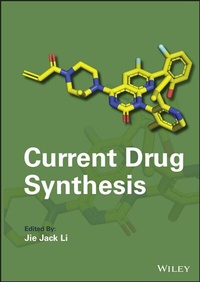
Current Drug Synthesis
Description

The latest entry in the widely read Drug Synthesis series
In Current Drug Synthesis, accomplished medicinal chemist and researcher Dr. Jie Jack Li and 27 expert coauthors deliver an authoritative and comprehensive discussion of the medicinal chemistry of current drugs, as well as the cutting-edge science involved in their synthesis. The book demystifies the process of modern drug discovery for both industry practitioners and students, while capturing the state-of-the-art techniques used to discover some of the most impactful medicines on the market today.
Covering six different disease areas - including infectious disease, cancer, cardiovascular and metabolic disease, the central nervous system, anti-inflammatory disease, and a miscellaneous section - the book explores 18 different drugs before concluding with chapters on computational drug discovery and peptide drugs.
Each chapter includes coverage of background material on a relevant drug class or disease indication and key aspects of drug discovery, including structure-activity relationships, pharmacokinetics, drug metabolism, efficacy, and safety.
Readers will also find:
* Thorough introductions to drugs for infectious diseases, including relebactam, vaborbactam, and baloxavir marboxil
* In-depth treatments of cancer-treating drugs, including darolutamide, venetoclax, and osimertinib
* Comprehensive explorations of central nervous system drugs, including zuranolone and risdiplam
* Extensive discussions of computational drug discovery and peptide drugs
Perfect for medicinal, organic, synthetic, and process chemists, Current Drug Synthesis will also earn a place in the libraries of research scientists working in lead optimization and process development, as well as graduate students studying organic chemistry, heterocyclic chemistry, or medicinal chemistry.
More details
Other editions
Additional editions
Person
Jie Jack Li, PhD, is the CSO of GenHouse Bio. Previously, he was VP of Discovery Chemistry at ChemPartner, an Associate Professor of Chemistry at the University of San Francisco and a Medicinal Chemist at Pfizer and Bristol-Myers Squibb. He has authored or edited over 30 books, including Medicinal Chemistry for Practitioners published by Wiley in 2020.
Content
Contributing Authors xiii
Part I Infectious Disease Drugs 1
Chapter 1 Relebactam (Recarbrio), A ß-Lactamase Inhibitor for the Treatment of cIAI/cUTI/HABP/ VABP 3
1 Background 3
2 Pharmacology 5
3 Structure-Activity Relationship (SAR) 6
4 Pharmacokinetics and Drug Metabolism 9
5 Efficacy and Safety 10
6 Syntheses 10
7 Summary 14
8 References 14
Chapter 2 Vaborbactam (in Combination with Meropenem as Vabomere), a Non-ß-Lactam ß-Lactamase Inhibitor for Treatment of Complicated Urinary Tract Infections and Pyelonephritis 17
1 Background 17
2 Discovery Medicinal Chemistry 21
3 Vaborbactam/Vabomere Clinical Trials 27
4 Vaborbactam Medicinal Chemistry Synthesis 29
5 Vaborbactam Process Chemistry Synthesis 30
6 Conclusions 37
7 References 38
Chapter 3 Baloxavir Marboxil (Xofluza), A Cap-Dependent Endonuclease Inhibitor for Treating Influenza 41
1 Background 41
2 Mechanism of Action 43
3 Structure-Activity Relationship 45
4 Pharmacokinetics and Drug Metabolism 49
5 Efficacy and Safety 50
6 Syntheses 50
7 Summary 54
8 References 54
Chapter 4 Process Chemistry Development of the HIV Protease Inhibitor Drug Kaletra: A Mixture of Ritonavir and Lopinavir 57
1 Background 58
2 Ritonavir Portion of Kaletra Synthesis 58
3 Discovery Synthesis of the Ritonavir Core 60
4 Discovery Synthesis of Ritonavir Wing Pieces 63
5 Large-Scale Process Chemistry Synthesis of the Ritonavir Core 65
6 Large-Scale Syntheses of the 5-Hydroxymethyl Thiazole Wing Portion 69
7 The Large-Scale Coupling of the Thiazole Wing Pieces to the Core 70
8 Lopinavir Portion of Kaletra- Discovery Synthesis and Process Development 72
9 Discovery Synthesis of Lopinavir 73
10 Discovery Synthesis of Wing Pieces 74
11 Process Improvements to the Wing Pieces 76
12 Optimization of Lopinavir Synthesis with Intermediates 78
13 Conclusions 81
14 References 81
Chapter 5 Eravacycline (Xerava), A Novel and Completely Synthetic Fluorocycline Antibiotic 85
1 Background 85
2 Pharmacology 89
3 Structure-Activity Relationship (SAR) 91
4 Pharmacokinetics and Drug Metabolism 93
5 Efficacy and Safety 93
6 Syntheses 93
7 Summary 98
8 References 99
Chapter 6 Albuvirtide (Aikening), A gp41 Analog as an HIV-1 Fusion Inhibitor 101
1 Background 101
2 Pharmacology 102
3 Structure-Activity Relationship (SAR) 106
4 Pharmacokinetics and Drug Metabolism 107
5 Efficacy and Safety 110
6 Syntheses 112
7 Summary 114
8 References 115
Part II Cancer Drugs 119
Chapter 7 Darolutamide (Nubeqa): An Androgen Receptor Antagonist for Treating Nonmetastatic, Castration-Resistant 121
1 Background 121
2 Pharmacology 124
3 Structure-Activity Relationship (SAR) 126
4 Pharmacokinetics and Drug Metabolism 132
5 Efficacy and Safety 134
6 Syntheses 135
7 The Future 137
8 References 138
Chapter 8 Venetoclax (Venclexta): A BCL-2 Antagonist for Treating Chronic Lymphocytic Leukemia 143
1 Background 143
2 Pharmacology 144
3 Structure-Activity Relationship (SAR) 147
4 Pharmacokinetics and Drug Metabolism 153
5 Efficacy and Safety 154
6 Syntheses 155
7 Summary 160
8 References 161
Chapter 9 Osimertinib (Tagrisso), A Potent and Selective Third-Generation EGFR Inhibitor for the Treatment of Both Sensitizing and T790M-Resistance Mutations 165
1 Background 165
2 Pharmacology 167
3 Structure-Activity Relationship (SAR) 170
4 Pharmacokinetics and Drug Metabolism 173
5 Efficacy and Safety 174
6 Syntheses 175
7 Summary 180
8 References 180
Chapter 10 Sotorasib (LUMAKRA), An Irreversible Covalent Inhibitor of KRASG12C 183
1 Background 183
2 Pharmacology 184
3 Structure-Activity Relationship (SAR) 186
4 Pharmacokinetics and Drug Metabolism 191
5 Efficacy and Safety 191
6 Syntheses 192
7 Summary 196
8 References 196
Chapter 11 Lorlatinib (Lorbrena), An ALK Inhibitor for Treating NSCLC 201
1 Background 201
2 Pharmacology 203
3 Structure-Activity Relationship (SAR) 205
4 Pharmacokinetics and Drug Metabolism 210
5 Efficacy and Safety 211
6 Syntheses 213
7 Summary 226
8 References 227
Chapter 12 Niraparib (Zejula) A Small Molecule, PARP1/2 Inhibitor for Treating Breast, Ovarian, and Pancreatic Cancers 231
2 Pharmacology 235
3 Structure-Activity Relationship (SAR) 238
4 Pharmacokinetics and Drug Metabolism 243
5 Efficacy and Safety 243
6 Syntheses 244
7 Summary 248
8 References 248
Chapter 13 Selinexor (Xpovio), An XPO1 Inhibitor and a New Class of Therapeutics for Treating Multiple Myeloma 253
1 Exportin1 (XPO1) 253
2 Overview of Multiple Myeloma 255
3 Development of Selinexor 256
4 Pharmacology and Mechanism 257
5 Pharmacokinetics, Pharmacodynamics and Drug Metabolism 258
6 Efficacy and Safety 259
7 Syntheses 259
8 Summary and Future 262
9 References 262
Part III Cns Drugs 265
Chapter 14 Sage 217 (Zuranolone) for Treating Major of Depressive Disorder267
1 Background 267
2 Pharmacology 270
3 Structure-Activity Relationship (SAR) 272
4 Pharmacokinetics and Drug Metabolism 279
5 Efficacy and Safety 280
6 Syntheses 281
7 Summary 282
8 References 283
Chapter 15 Risdiplam (Evrysdi), A Small Molecule, SMN2-directed RNA Splicing Modifier for Treating Spinal Muscular Atrophy 287
1 Background 287
2 Pharmacology 289
3 Structure-Activity Relationship (SAR) 290
4 Pharmacokinetics and Drug Metabolism 297
5 Efficacy and Safety 297
6 Syntheses 298
7 Summary 300
8 References 301
Part IV Miscellaneous Drugs 305
Chapter 16 Esaxerenone (Minnebro), An Oral, Non-steroidal, Selective Mineralocorticoid Receptor Blocker for the Treatment of Essential Hypertension307
1 Background 307
2 Pharmacology 310
3 Structure-Activity Relationship (SAR) 311
4 Pharmacokinetics and Drug Metabolism 313
5 Efficacy and Safety 315
6 Syntheses 316
7 Summary 320
8 References 321
Chapter 17 Voclosporin (Lupkynis), A Macrocyclic Peptide Inhibitor of Calcineurin for the Treatment of Lupus Nephritis 323
1 Background 323
2 Pharmacology 326
3 Structure-Activity Relationship (SAR) 326
4 Pharmacokinetics and Drug Metabolism 329
5 Efficacy and Safety 331
6 Syntheses 333
7 References 336
Chapter 18 Computational-Aided Drug Design 339
1 Background 339
2 Structure-based Drug Design (SBDD) 341
3 Ligand-based Drug Design (LBDD) 352
4 Summary 361
5 References 362
Index 373
1
Relebactam (Recarbrio), A ß-Lactamase Inhibitor for the Treatment of cIAI/cUTI/HABP/VABP
Dexi Yang
1. Background
The discovery of antibiotics is revolutionary in chemotherapy against infectious diseases in modern medicine history. Unfortunately, after its golden era from the 1950s to 1970s, antimicrobial resistance among common bacterial pathogens became a new threat to public health. Recently, WHO enlisted antibiotic resistance in the top three public health threats. Infections caused by multidrug-resistant organism became a new economic burden in health-care system. In the United States alone, it costs over 20 billion dollars per year, and more than 23,000 people died of infection with antibiotic-resistant annually. With this continuing, CDC estimated that victims will culminate to more than 300 million globally with loss of over 100 trillion dollars by 2050. The stake is high enough to draw more attention to invent new therapeutics to treat infected patients.1
Of all known antimicrobial resistance, carbapenem resistance in gram-negative pathogens is the most critical. Clinically, carbapenems are considered the most active and potent agents against MDR gram-negative pathogens. They are the last silver bullets to kill superbugs. However, according to the global priority list of antibiotic-resistant bacteria published by WHO in 2017, three of the top four pathogens critical for developing antibiotics are carbapenem-resistant, and they are Enterobacteriaceae (CRE), Pseudomonas aeruginosa, and Acinetobacter baumannii.2,3 In the 1990s, research on MDR revealed that antibiotic resistance of gram-negative bacteria is mainly caused by three mechanisms. The major mechanism of resistance to carbapenems is the production of ß-lactamase. It has been identified that MDR gram-negative pathogens produces at least four classes of ß-lactamases: A, B, C, and D.4 They all can degrade antibacterial agents and make them ineffective. In addition to these enzymes, these pathogens also developed other mechanisms to make antibiotics less efficient. One is porin mutation caused by porin expression. This renders the outer bacterial membrane impermeable to antibacterial. The other is efflux pump upregulation. Via efflux pump, antibiotics are pumped out of the membrane of bacteria and lose their therapeutic efficacy.3,4 Based on all these three mechanisms, new generations of ß-lactamase inhibitors should not only have high potency to help carbapenem restore potency, but also possess appropriate physicochemical properties to increase permeability and decrease efflux rate.
Guided by this strategy, in the past decade, several combinations of antibiotic with ß-lactamase inhibitors, such as polymyxins, ceftazidime-avibactam, ceftolozane- tazobactam, metropenem-veborbactam, etc., have been discovered and approved by FDA.5-7 But most of them are only effective against a small portion of pathogens, and with no surprise, gradually loose efficacy due to evolved resistance. As a result, new therapeutic options against gram-negative organisms with resistance are still urgently needed.
Recarbrio was approved in July 2019 as an alternative treatment option of adults with complicated urinary tract infections (cUTI), including pyelonephritis, and complicated intra-abdominal infections (cIAI) caused by susceptible gram-negative bacteria.8,9 Recarbrio is a three-drug combination injection containing imipenem, cilastatin, and relebactam (1). Imipenem is a carbapenem that inhibits cross-linking of peptidoglycan during cell wall synthesis by deactivating penicillin binding proteins. It is co-administered with cilastatin, a dehydro-peptidase-I inhibitor to reduce renal metabolism of imipenem. Cilastatin itself does not have antibacterial activity. Relebactam (1) is a novel ß-lactamase inhibitor. It alone has no antibacterial activity either. Its function is to protect imipenem by inhibiting Ambler class A (e.g., KPCs), class C (e.g., AmpC) ß-lactamases, and PDC. In vitro, the addition of relebactam (1) significantly improves the antibacterial activity of imipenem by lowering the minimum inhibitory concentration of imipenem by 2- to 128-folds against ESBL or KPC producing enterobacterales, as well as MDR or imipenem-resistant isolates.10
In June 2020, FDA further approved a supplemental new drug application (sNDA) for Recarbrio for the treatment of patients 18 years of age and older with hospital-acquired bacterial pneumonia and ventilator-associated bacterial pneumonia (HABP/VABP), caused by a group of susceptible gram-negative microorganism.9
It worth mentioning that relebactam (1) is inactive against class B metallo-ß-lactamases (e.g., NDM, VIM, and IMP) and class D oxacillinases (e.g., OXA-48). This leaves space for further development of novel BLIs with expanded coverage of class B metallo-ß-lactamase and class D ß-lactamase to secure efficacy of new antibiotics.
2. Pharmacology
Imipenem (trade name Primaxin) is an intravenous ß-lactam antibiotic discovered by Merck scientists Burton Christensen, William Leanza, and Kenneth Wildonger in the mid-1970s.10 As a carbapenem, it is highly resistant to the ß-lactamases produced by MDR gram-negative bacteria. It inhibits cross-linking of peptidoglycan during cell wall synthesis by deactivating penicillin binding proteins, thereby causing bacterial cell lysis and death.11 Since it rapidly degraded by the renal enzyme dehydropeptidase-I when administered alone, imipenem is always co-administered with cilastatin, a dehydropeptidase-I inhibitor to reduce renal metabolism. Ever since its approval, it played a key role in treating infections caused by susceptible strains when other antibiotics failed. However, since more and more bacteria developed drug-resistance via production of ß-lactamase, imipenem became less effective in some patients. It is necessary to invent new ß-lactamase inhibitors as additive to restore the antibacterial activity of imipenem.
Relebactam (MK-7655) is a novel ß-lactamase inhibitor discovered by Merck scientists as part of a drug discovery program aimed at novel BLI in 2008. Over several lead series, a bridged class showed broad spectrum of activities. Its cyclic urea can open and bind covalently to an active site serine within Ambler class A, C, and D ß-lactamases. To be specific, the constrained five-membered urea bridge facilitates acylation reaction between the C-7 carbonyl and a serine residue within the ß-lactamase active site. Modeling studies suggested that the N,O-oxysulfate group can further stabilize the ring-opened acyl-ß-lactamase intermediate via hydrogen-bond formation with neighboring catalytic site residues. As a result, the covalent bond blocks the active site of the ß-lactamase, stops hydrolysis of imipenem, and restores its bactericidal activity.12
So far, it is active in inhibiting Ambler class A (e.g., KPCs) and class C (e.g., AmpC) actamases and PDC, but inactive against class B metallo-ß-lactamases (e.g., NDM, VIM and IMP) and class D oxacillinases (e.g., OXA-48).13 In vitro, the addition of relebactam (1) significantly improves the antibacterial activity of imipenem by lowering the minimum inhibitory concentration of imipenem by 2- to 128-folds against ESBL or KPC producing enterobacterales, or imipenem-resistant isolates. Neither imipenem nor relebactam is subject to efflux, which is an advantage against strains that overexpress efflux pumps.
3. Structure-Activity Relationship (SAR)
The lead compound for the relebactam (1) project has two sources: one is MK-8712, a monobactam ß-lactamase inhibitor only effective against class C ß-lactamase; the other is avibactam sodium (NXL-104), a covalent and reversible non-ß-lactam ß-lactamase inhibitor to ß-lactamase TEM-1 and CTX-M-15.14 In order to expand the coverage of novel BLI to both class C (PDC) P. aeruginosa and class A (KPC) enterobacterales class A and class C ß-lactamases, Merck scientists took a hybrid approach by incorporating novel heterocyclic amide side chains for MK-8712 with the bridged core of NXL-104. After overcoming many synthetic difficulties, a series of bridged bicyclic urea with basic heterocyclic side chains have been prepared for SAR study.
As shown in Table 1, selected compounds were evaluated in enzyme inhibition assays and in vitro synergy assays.12 The enzyme inhibition assays measured each compound's ability to inhibit the hydrolysis of nitrocefin by four ß-lactamase: one class A BL, two class C BLs and one class D BL. The synergy data reported the concentration of each compound to reduce the MIC of imipenem to 4 µg/mL against the strains of Pseudomonas, Klebsiella, and Acinetobacter.
Let us...
