


Copyright Law and Generative AI
Description

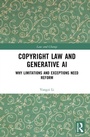
The book begins by explaining the basic principles of copyright law and why they matter for both AI training and AI-generated content. It then surveys the key copyright exceptions and licensing routes currently available, highlighting how legal uncertainty has complicated efforts to regulate the way generative AI systems access and use protected material. To make sense of this uncertainty, the book looks beyond the law and examines the broader forces shaping the debate: emerging norms around AI ethics and copyright, the evolving business models built on generative AI, concerns about the market impact of AI-generated products, and the technical realities of generative models, from the black-box problem to the structure of latent space. These dynamics show why existing copyright exceptions, designed for an earlier technological era, often struggle to keep pace with generative AI. The book concludes with a framework for rethinking copyright exceptions that integrates legal, economic, normative, and technological considerations.
By bringing together insights across jurisdictions and disciplines, this book offers a clear and timely account of how legal systems are trying to adapt copyright rules to the rise of generative AI without stifling innovation. It will appeal to scholars of intellectual property and artificial intelligence, as well as policymakers, regulators, and AI developers navigating this fast-changing landscape.
More details
Other editions
Additional editions
Person
Yangzi Li is a postdoctoral researcher at the Center for Technology, Robotics, Artificial Intelligence and Law, Faculty of Law, National University of Singapore. She received her PhD from The Chinese University of Hong Kong, Faculty of Law.
Content
1. Introduction: Linking Generative AI to Copyright Law
2. Evaluating Present-Day Copyright Limitations and Exceptions
3. Social Norms Governing Generative AI's Access to Protected Works
4. The Emerging Market for Generative AI Works: Consumption, Demand, and Regulatory Challenges
5. Technical Features Impeding Application of Copyright L&Es
6. A Four-Prong Strategy for Reformulating Copyright L&Es
7. Beyond Copyright: Other AI-Related Intellectual Property Issues
8. Conclusion: Key Findings, Recommendations, and Future Research Directions
