

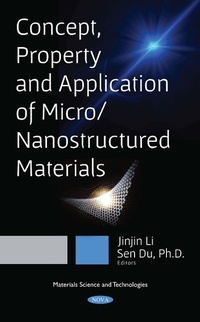
Concept, Property and Application of Micro/Nanostructured Materials
Published on 1. May 2018
249 pages
978-1-5361-3609-8 (ISBN)
Description

From the perspectives of theory and experiment, this book introduces several different micro/nanostructure materials, including the Mg-based alloy materials, carbon nanotubes and graphene-based materials, micro-crystals, nanostructured Al-SiC composites, optomechanical systems, compound containing functional groups, and biologically active diazoles. Using this book, readers will be able to understand, derive, and confidently implement the relevant phenomena in other complex micro/nanostructures that have not been investigated by traditional methods. Dozens of figures and diagrams throughout this book enhance the understandability through visualization of experimental techniques and computational procedures. Meanwhile, the extensive references and detailed index allow for the further exploration of this evolving area. This book provides a comprehensive treatment of the subject for graduates and researchers within material science, quantum chemistry, as well as atomic, molecular and solid-state physics.
More details
Other editions
Additional editions
Jinjin Li | Sen Du
Concept, Property and Application of Micro / Nanostructured Materials
Book
06/2018
Nova Science Publishers Inc
€276.30
Shipment within 15-20 days
Content
- Intro
- Contents
- Preface
- Chapter 1
- Mg-Based Bulk Metallic Glass Composite with High Bio-Corrosion Resistance and Excellent Mechanical Properties
- Abstract
- Introduction
- Methods
- 1. Experimental
- 2. The Corrosion Resistance and Mechanical Properties of Mg75Cu13.33Y6.67Zn5
- 2.1. XRD Diffraction Patterns, Microstructure and Thermal Stability of the Alloys
- 2.2. The Mechanical Properties
- 2.3. Corrosion Behaviour
- 3. The Corrosion Resistance and Mechanical Properties of (Mg65Cu10Ni10Y10Zn5)91Zr9
- 3.1. XRD Diffraction Patterns, Microstructure and Thermal Stability of the Alloys
- 3.2. The Mechanical Properties
- 3.3. Corrosion Behaviour
- References
- Chapter 2
- Some Recent and Remarkable Applications of Carbon Nanotube and Graphene Based Materıals
- Abstract
- Introduction
- 1. Two Allotropes of Carbon: Graphene and Carbon Nanotube
- 1.1. Structure of Graphene and Carbon Nanotube
- 1.2. Electronic Properties
- 1.2.1. Tight Binding Method
- 1.2.2. Energy Dispersion Relations of Graphene
- 1.2.3. Energy Dispersion Relations of Carbon Nanotube
- 1.3. Mechanical Properties of Graphene
- 1.4. Synthesis Methods of CNTs and Graphene
- 2. Some Recent And Remarkable Applications
- 2.1. CNT and Graphene Based Sensor Applications
- 2.1.1. Bio-Sensor Applications for Medicine
- 2.1.2. Industrial Sensor Applications
- 2.1.3. Gas Sensing Applications for Environmental Monitoring
- 2.2. Energy Related Applications
- 2.2.1. CNT and Graphene Based Supercapacitor Applications
- 2.2.2. CNT and Graphene Based Solar Cell Applications
- Conclusıon
- References
- Chapter 3
- Multiferroic Single Crystals with Layered Structure in Pb-Mn-Ni-Ti-O System - Growth and Investigation of Their Properties
- Abstract
- 1. Introduction
- 2. Why Single Crystals
- 3. The System Pb3Mn7-x-y(Nix,Tiy)O15?
- 4. The Growth Method
- 5. Materials Preparation and Growth
- 6. Dielectric Measurements
- 7. Magnetic Measurements
- 7.1. Magnetic Nature of Pb3Mn7-x-y(Nix, Tiy)O15
- Conclusion
- Acknowledgments
- References
- Chapter 4
- Growth of Sapphire Shaped Crystals by the Noncapillary Shaping (NCS) Technique
- Abstract
- Conclusion
- Acknowledgments
- References
- Chapter 5
- Investigation on Wear and Corrosion Resistance of Nanostructured Al1050-SiC Composite Produced by the Accumulative Roll Bonding Process
- Abstract
- 1. Introduction
- 2. Experimental Procedure
- 2.1. Samples Preparation
- 2.2. Corrosion Tests
- 2.3. Micro-Hardness and Wear Tests
- 3. Results and Discussion
- 3.1. Microstructure Evaluation
- 3.2. OCP Measurements
- 3.3. Electrochemical Impedance Spectroscopy
- 3.4. Investigating Linear and Cyclic Polarization
- 3.5. Surface Analysis after Corrosion
- 3.6. Micro-Hardness
- 3.7. Friction Coefficient Analysis
- 3.8. Weight Loss
- 3.9. SEM Analysis of Wear Tracks
- Conclusion
- References
- Chapter 6
- Light Manipulation with a Cavity Optomechanical System
- Abstract
- 1. Introduction
- 2. Theory
- 3. Results and Discussion
- Acknowledgments
- Conclusion
- References
- Chapter 7
- Experimental and Theoretical Studies of Compound Containing Functional Groups Such as Hydrazone and Oxime
- Abstract
- 1. Introduction
- 2. Experimental Section
- 2.1. General
- 2.2. Synthesis of the Title Compound
- 2.3. Single Crystal XRD
- 2.4. Computational Methodology
- 3. Results and Discussion
- 3.1. Description of the Crystal Structure Using XRD
- 3.2. Theoretical Studies Using DFT Method
- 3.2.1. Optimized Structure
- 3.2.2. Vibrational Spectra
- 3.2.3. Fukui Function Analysis
- 3.2.4. Molecular Electrostatic Potential
- 3.2.5. Thermodynamic Properties
- 3.2.6. Potential Energy Surface (PES) Scan
- 3.2.7. Natural Bond Orbital (NBO) Analysis
- 3.2.8. Electronic Absorption Spectra
- 3.2.9. Mulliken Electronegativity and Chemical Activity
- 3.2.10. Nonlinear Optical Effects (NLO)
- Conclusion
- Supplementary Data
- References
- Chapter 8
- Review: An Experimental (Synthesis, NMR and Crystallography) and Theoretical Study of Three Biologically Active Diazoles
- Abstract
- 1. Introduction
- 2. Results and Discussion
- 2.1. Pyrazole
- 2.1.1. Synthesis of N-phenyl pyrazoles
- 2.2. Imidazole
- 2.2.1. Synthesis of 1,2,4,5-Tetrasubstituted imidazoles
- 2.3. Pyrazoline
- 2.3.1. Synthesis of hydroxypyrazoline
- 3. Spectral Analysis
- 3.1. 1H NMR Studies
- 3.2. R Spectral Studies
- 3.3. Single Crystal X-Ray Analysis
- References
- About the Editors
- Index
- Blank Page
