

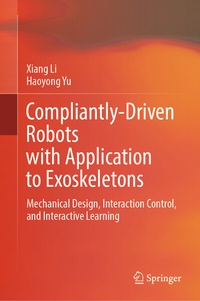
Compliantly-Driven Robots with Application to Exoskeletons
Description

This book adopts a multidisciplinary approach to comprehensively explore the intricacies of compliantly driven robots and their application in exoskeletons. It is structured in three main parts.
1) The first part delves into mechanical design, offering a detailed examination of the underlying principles governing the construction and fabrication of these robots. This section encompasses discussions on actuators, joints, and overall system architecture.
2) The second part focuses on interaction control, delving into algorithms and strategies that govern the dynamic and responsive behavior of these robots when interacting with their environment and human users. Topics such as intention sensing, feedback systems, and adaptive control are addressed.
3) The third part is dedicated to interactive learning, where we explore the evolving field of machine learning algorithms tailored for robots, enabling them to adapt and improve their performance over time. Human demonstration, unsupervised learning, and human-in-the-loop methodologies are central themes.
Throughout the book, we emphasize real-world applications, particularly in the realm of exoskeleton technology, showcasing how these principles manifest in practical contexts such as rehabilitation and assistive devices. By intertwining theory with practical implementation, this book provides a comprehensive guide for researchers, engineers, and enthusiasts in the field of compliantly driven robotics.
More details
Other editions
Additional editions
Persons
Xiang Li is an Associate Professor with the Department of Automation, Tsinghua University. His research interests include robotic dexterous manipulation and human-robot collaboration. He has published a monograph distributed by Springer and authored over 100 papers in the field of robotics, including publications in IJRR, TRO, Automatica, TAC, ICRA, and IROS. He has been the Associate Editor of IJRR since 2024 and the Associate Editor of TRO since 2025. He received the IROS Best Application Paper Finalist in 2017, the ICRA Best Medical Robotics Paper Finalist in 2024, and the RAL Outstanding Associate Editor in 2025. He led the team and won the first place at 2024 ICRA Robotic Grasping and Manipulation Challenge - in-hand track and also the Most Elegant Solution across all the tracks. He was the Program Chair of the 2023 IEEE International Conference on Real-time Computing and Robotics (RCAR).
Dr. Haoyong Yu is an associate professor of the Department of Biomedical Engineering at the National University of Singapore. He received his Bachelor's Degree and Master's Degree from Shanghai Jiao Tong University and his Ph.D. degree from Massachusetts institute of Technology (MIT). He has been the associate editor of IEEE Transactions on Automation Science and Engineering since Jan 2021 and associate editor of IEEE/ASME Transactions on Mechatronics since Jan 2022. His current research interests include biomedical robotics and devices, rehabilitation engineering and assistive technology, service robots, human-robot interaction, intelligent control, and machine learning.
Content
Introduction to Compliant Actuators.- Compliantly-Actuated Robots.- Robotic Exoskeleton.- Interactive Learning.- Rehabilitation Robots.- Future Directions and Research Opportunities.
