

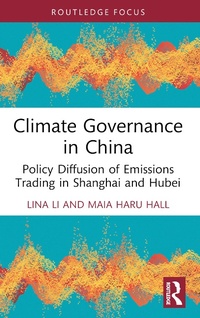
Climate Governance in China
Policy Diffusion of Emissions Trading in Shanghai and Hubei
1st Edition
Published on 3. May 2023
146 pages
978-1-000-91653-9 (ISBN)
Description

This book explores how and why innovative climate policies spread across subnational regions and between governance levels in China.
Despite the significance of emerging economies in a pathway to a zero-carbon future, research to date on China's transformation governance remains limited. Drawing on a theoretical framework for policy diffusion and based on extensive data from expert interviews with Chinese decisionmakers and policy practitioners, Lina Li and Maia Haru Hall focus on the policy of emissions trading systems (ETS) and two key case studies: Shanghai and Hubei. The authors examine the role of the national government and how much freedom the subnational regions have in developing ETS policy, as well as pinpointing key actors and the role of policy and knowledge diffusion mechanisms. Overall, this book sheds light on the competition between China and the West in the transition to climate-friendly societies and economies, highlighting opportunities for cooperation between them.
This book will be of great interest to students and scholars of environmental politics and policy, climate change, urban studies, and Chinese studies more broadly.
Despite the significance of emerging economies in a pathway to a zero-carbon future, research to date on China's transformation governance remains limited. Drawing on a theoretical framework for policy diffusion and based on extensive data from expert interviews with Chinese decisionmakers and policy practitioners, Lina Li and Maia Haru Hall focus on the policy of emissions trading systems (ETS) and two key case studies: Shanghai and Hubei. The authors examine the role of the national government and how much freedom the subnational regions have in developing ETS policy, as well as pinpointing key actors and the role of policy and knowledge diffusion mechanisms. Overall, this book sheds light on the competition between China and the West in the transition to climate-friendly societies and economies, highlighting opportunities for cooperation between them.
This book will be of great interest to students and scholars of environmental politics and policy, climate change, urban studies, and Chinese studies more broadly.
More details
Series
Edition
1. Auflage
Language
English
Place of publication
London
United Kingdom
Publishing group
Taylor & Francis Ltd
Target group
College/higher education
Product notice
Reflowable
Illustrations
14 Tables, black and white; 22 Line drawings, black and white; 22 Illustrations, black and white
ISBN-13
978-1-000-91653-9 (9781000916539)
Copyright in bibliographic data and cover images is held by Nielsen Book Services Limited or by the publishers or by their respective licensors: all rights reserved.
Schweitzer Classification
Other editions
Additional editions
Lina Li | Maia Haru Hall
Climate Governance in China
Policy Diffusion of Emissions Trading in Shanghai and Hubei
Book
10/2024
1st Edition
Routledge
€33.00
Shipment within 10-20 days
Lina Li | Maia Haru Hall
Climate Governance in China
Policy Diffusion of Emissions Trading in Shanghai and Hubei
Book
05/2023
1st Edition
Routledge
€77.90
Shipment within 10-20 days
Persons
Lina Li is the Asia Strategy Director at the International Energy Program (PIE), a platform hosted by the European Climate Foundation dedicated to securing a global clean power sector compatible with 1.5 degreesC. With 15 years of experience in energy and climate policy, Lina has previously worked for various think tanks, consultancies, and NGOs, including Adelphi, Ecofys, and Greenovation Hub.
Maia Haru Hall is a consultant at Adelphi, a leading independent think tank for climate, environment, and development. She is also part of the Secretariat of the International Carbon Action Partnership, specializing in the Asia-Pacific region and working in carbon pricing and broader climate policy.
Maia Haru Hall is a consultant at Adelphi, a leading independent think tank for climate, environment, and development. She is also part of the Secretariat of the International Carbon Action Partnership, specializing in the Asia-Pacific region and working in carbon pricing and broader climate policy.
Content
Acknowledgements
List of acronyms and abbreviations
1 Introduction
China's role in the global transformation
Lack of transformation governance research on China
The fundamentals of policy diffusion
About this book's approach
2 Climate governance and policymaking in China
The Tiao-Kuai system
Climate policy and ETS in China: from piloting to national policy
The ETS pilots
Institutional arrangements for climate policy in China
3 Shanghai's ETS and diffusion experience
ETS policy developments
Shanghai's institutional setup
Policy diffusion mechanisms
Policy entrepreneurs
4 Hubei's ETS and diffusion experience
ETS policy developments
Hubei's institutional setup
Policy diffusion mechanisms
Policy entrepreneurs
5 Conclusion: The role of policy diffusion in China's climate transformation
Shanghai and Hubei: A comparison of diffusion patterns
Diffusion mechanisms
Institutions and actors
Conceptual implications
Practical implications
6 Recent developments and a view ahead
The influence of national policies and politics
Progressive regions continue to expand their carbon markets and interact with others
External influences on new dynamics in China's ETS policy diffusion
The dawn of a new era
Appendix
Index
List of acronyms and abbreviations
1 Introduction
China's role in the global transformation
Lack of transformation governance research on China
The fundamentals of policy diffusion
About this book's approach
2 Climate governance and policymaking in China
The Tiao-Kuai system
Climate policy and ETS in China: from piloting to national policy
The ETS pilots
Institutional arrangements for climate policy in China
3 Shanghai's ETS and diffusion experience
ETS policy developments
Shanghai's institutional setup
Policy diffusion mechanisms
Policy entrepreneurs
4 Hubei's ETS and diffusion experience
ETS policy developments
Hubei's institutional setup
Policy diffusion mechanisms
Policy entrepreneurs
5 Conclusion: The role of policy diffusion in China's climate transformation
Shanghai and Hubei: A comparison of diffusion patterns
Diffusion mechanisms
Institutions and actors
Conceptual implications
Practical implications
6 Recent developments and a view ahead
The influence of national policies and politics
Progressive regions continue to expand their carbon markets and interact with others
External influences on new dynamics in China's ETS policy diffusion
The dawn of a new era
Appendix
Index
