

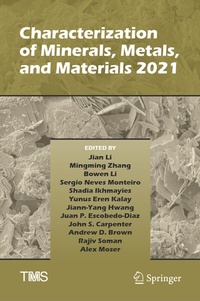
Characterization of Minerals, Metals, and Materials 2021
Description

The collection focuses on the advancements of characterization of minerals, metals, and materials and the applications of characterization results on the processing of these materials. Advanced characterization methods, techniques, and new instruments are emphasized. Areas of interest include, but are not limited to:
· Novel methods and techniques for characterizing materials across a spectrum of systems and processes.
· Characterization of mechanical, thermal, electrical, optical, dielectric, magnetic, physical, and other properties of materials.
· Characterization of structural, morphological, and topographical natures of materials at micro- and nano- scales.
· Characterization of extraction and processing including process development and analysis.
· Advances in instrument developments for microstructure analysis and performance evaluation of materials, such as computer tomography (CT), X-ray and neutron diffraction, electron microscopy (SEM, FIB, TEM), and spectroscopy (EDS, WDS, EBSD) techniques.
· 2D and 3D modelling for materials characterization.
The book explores scientific processes to characterize materials using modern technologies, and focuses on the interrelationships and interdependence among processing, structure, properties, and performance of materials.
More details
Other editions
Additional editions
Persons
Content
- Intro
- Preface
- Contents
- About the Editors
- Part I Advanced Microstructure Characterization
- 1 Insights into the Formation of Al-Cu Intermetallic Compounds During the Solid-Liquid Reaction by High-Resolution Transmission Electron Microscopy
- Part II Advanced Characterization Methods II
- 2 Applying Stereological Characterisation to the Solidification Structure of Single Crystal Alloys to Deduce the 3D Macroscopic Solid/Liquid Interface Shape
- Part III Characterization of Composite Materials
- 3 Influence of Graphene Oxide Functionalization Strategy on the Dynamic Mechanical Response of Natural Fiber Reinforced Polymer Matrix Composites
- 4 Characterization of Ultra-Hard Ceramic AlMgB14-based Materials Obtained by Self-propagating High-Temperature Synthesis and Spark Plasma Sintering
- 5 Preparation of Ceramic Coating on Copper Substrate with Transitional Layer by Low-Temperature Slurry Method
- Part IV Characterization of Mechanical Properties
- 6 Analysis of the Elasto-Plastic Behavior of SAE 1045 Steel Submitted to Cyclic Loads
- 7 Characterization of Solidification Structure Morphology in High-Carbon Steel Billet by Fractal Dimension
- Part V Advanced Characterization Methods III
- 8 A Study of the Absorption Edge of ZnO Thin Films Prepared by the Spray Pyrolysis Method
- Part VI Minerals Processing and Analyses
- 9 Petrographic and SEM-EDS Analysis of Riruwai Cassiterite Ore in North Western Nigeria
- 10 Characterization on Behavior of Al During the Oxidization Roasting Process of Polymetallic Ferruginous Manganese Ores
- 11 Preparation of Multifunctional Fused Magnesium Phosphate Fertilizer from Low-Grade Phosphate Ores
- 12 Zinc Extraction from Industrial Waste Residue by Conventional Acid Leaching
- 13 Extraction of Zinc from Metallurgical Residue with a NH³-(NH4)²SO4-H²O System
- Part VII Metallurgical Process Optimization
- 14 Characterization of Brazilian Linz-Donawitz-LD Steel Sludges
- 15 Study on Sinter Iron Ores and Titanium Ores Used in Pelletizing
- 16 Research Progress on Application of Steel Slag in Agriculture
- 17 Effect of MgO on Oxidation of Vanadium Slag at High Temperature
- 18 Effects of Basicity, FeO, and TiO2 on Phase Transformation and Viscosity of TiO2-Bearing Primary Slag in Blast Furnace
- 19 Manufacture of Porous Frit Vents Using Space Holder Methodology for Radioisotopic Space Power Systems
- 20 Utilization of Ferronickel Slag for Producing Concrete
- 21 Adsorption of Methylene Blue by CuFe²O4 Prepared from Precipitation Flotation Sludge
- Part VIII Poster Session
- 22 Analysis of Potential Applications of Kamafugite Rocks in Fertilizer
- 23 Application of Desulphurization Residue in Cementitious Mortars
- 24 Cause Analysis on Buildup Formation of Carbon Sleeve in Continuous Annealing Furnace for Low-Temperature Grain-Oriented Silicon Steel Production
- 25 Characterization of Arsenopyrite Depression During Collectorless Flotation
- 26 Chemical, Physical, and Morphological Characterization of Eco-Clinker Produced from Industrial Wastes
- 27 Life Cycle Assessment Applied to Red Ceramic Bricks Production Versus Red Ceramic Bricks Incorporated with Stone Wastes: A Comparative Study
- 28 Comparison Between Red Ceramic Parts With and Without Ornamental Stone Waste Under Wetting and Drying Cycles
- 29 Compressive Properties of Additively Manufactured Titanium-Carbide
- 30 Density Weibull Analysis of Tucum Fiber with Different Diameters
- 31 Ecological Mortars with Blast Slag Waste Application
- 32 Effect of Flying Ash as an Additive or Substitute for Portland Cement on Compression Strength in Concrete Blocks (Vibro-Compacted)
- 33 Effect of Mg with Different Combination Form of Mg-Ca in MgO-Bearing Fluxes on Fluidity of Liquid Phase in Sintering Process
- 34 Effect of SiO² Sources Addition on the Microstructure and Thermal Shock Performance of Alumina-Spinel Castables
- 35 Effect of the Incorporation of Bauxite and Iron Ore Tailings on the Properties of Clay Bricks
- 36 Effects of K²O Addition on the Reduction Smelting of Phosphorite for the Yellow Phosphorus Production
- 37 Evaluation of Different Methods of Surface Treatment of Natural Açai Fiber Added in Cementitious Composites
- 38 Evaluation of Full Bedding Concrete Blocks Prisms with Different Laying Mortar Strength
- 39 Evaluation of Thermal Healing in Pervious Concrete Pavers Produced with Reactive Powders Concrete
- 40 Evaluation of the Mechanical Behavior of Epoxy Matrix-Hybrid Natural Fabric Composite: Accelerated Aging by UV Radiation
- 41 Failure Analysis of the Bellows After Service in Hot Blast Stove System by Dissection
- 42 Flotation Behaviors of Magnesite and Dolomite Using a Mixed Collector
- 43 Incorporation of Porcelain Powder and Mineral Wastes in Epoxy Matrix for Artificial Stone Purchase
- 44 Influence of Modifier Admixture Based on LAS in Cement Pastes
- 45 Influence of the Ceramic Block Sorptivity on the Adherence of Rendering Mortars
- 46 Influence of the Granulometry of the Granite Residue on the Sorptivity of Ceramic Blocks
- 47 Influence of the Incorporation of Granite Waste on the Weathering Resistance of Soil Pigment-Based Paints
- 48 Influence of the Mixing Processes of the Constituents of Incorporated Geopolymer Materials with Glass Waste
- 49 In Situ Investigation of Iron Ore Stock Pile During Its Stacking and Reclaiming Process
- 50 Particle Size Matching Mechanism of Blending Ore and Solid Fuel in Sintering Process
- 51 Research Progress of Aging Effects on Fiber-Reinforced Polymer Composites: A Brief Review
- 52 Study of Face Shell Bedding Concrete Blocks Prisms with Different Laying Mortar Strength
- 53 Study of Pathologies in Alkali-Activated Materials Based on Slag
- 54 Study of the Feasibility of Incorporation Clay from Campos Dos Goytacazes-RJ, in Mortar Applied on Walls and Ceilings
- 55 Surface Characterization of Concentrated Jamesonite, in the Collectorless Flotation, in Acid, Neutral, and Alkaline Medium
- 56 Superficial Speciation by FTIR Spectroscopy of Floated PbS (Galena) in the Presence of Copper Aqueous (+2)
- 57 Synchronous Extraction of Valuable Metals from Low-Nickel Matte Using Ammonium Sulfate Roasting-Water Leaching Process
- 58 Synthesis and Characterization of ZnO Nanoparticles Obtained from the Extract of Schinus Molle
- 59 Technical, Environmental, and Economic Advantages in the Use of Asphalt Rubber
- 60 The Incorporation of the Light Green Clay in the Textile Polyamide Residues
- 61 The Simpex-Lattice Method Application to Optimize the Design of Soil-Slag-Fly Ash Mixtures
- 62 Variation of the Silica Module for Dosing Activated Alkali Mortars
- Author Index
- Subject Index
